


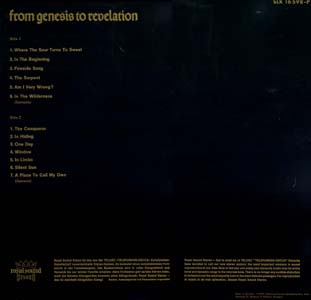
 It shows no or at best only the most minuscule traces of the style that would make them well-known later, and therefore frequently meets with a refusal and lack of affection. Justly so?







 March 16th, 2015 By Jim Laugelli
I could have very easily chosen a number of other Genesis albums but I decided on this one simply because it features what is perhaps the most significant song in all of progressive rock: “Supper’s Ready.” My introduction to Genesis occurred 41 years ago and had one of the most profound impacts on my personal musical journey. On that night, in May of 1974, a friend asked if I wanted to see a concert. He had a few extra tickets for a Genesis show and no one to join him. I never heard of the band and for some reason thought they were probably some sort of acoustic act. As far as I recall, my friend knew little about the band as well. I believe someone just gave him the tickets. With nothing better to do I decided to check it out. When we arrived at the venue and had taken our seats I remember my curiosity ratcheting up when the pre-concert music over the P.A. was Mike Oldfield’s Tubular Bells. This signaled to me that I was probably going to hear something unexpected. Sure enough, when the lights went down and the crowd quieted, the opening chords to “Watcher Of The Skies” begins. I immediately leaned forward in my seat totally consumed by the sound of the mellotron.
As that instrument eases, the staccato rhythm of the bass begins and in the darkness a pair eyes appear, they seem to be searching, radiating, only to reveal a figure in a cape with bat wings wrapped around his head. The vocals then begin and until the end of the show I remain completely and utterly captivated. My mind was officially blown. It was a revelation. I left that show a changed person. This was music that went beyond my imagination. It was presented like theater, it told stories. In fact, before many songs, Gabriel told surreal little tales as a way of introducing the tunes. The next day I bought Foxtrot, and then Selling England By The Pound, Nursery Cryme and Trespass all in short order. I immersed myself in their music.
Foxtrot begins the band’s high point of three consecutive outstanding albums. It was released in 1972, a banner year for progressive rock that also saw the release of Close To The Edge by Yes, Thick As A Brick from Jethro Tull, Trilogy by ELP, Three Friends from Gentle Giant and a slew of other incredible records. For Genesis, Foxtrot saw them tackle ideas they started with their two previous releases, Trespass and Nursery Cryme. The level of complexity in song structure, the emphasis on theatricality and drama, storytelling and extended song form all reached a new level of sophistication on Foxtrot.
The album opens with a track that would serve as the opener for many of their concerts and its easy to see why. “Watcher Of The Skies” begins with that powerful mellotron that rises and falls and keeps you on edge. The pulsating rhythm drives it, and Gabriel’s vocals serve as a dramatic warning to mankind. Lost romanticism provides the theme for “Time Table,” the following track. Here Tony Banks’ piano provides the gorgeous melody that dominates the song evoking lovely pastoral sentiment. On “Get’m Out By Friday,” Genesis take on greed by telling a futuristic tale where people are evicted and forced to live in ever-decreasing space. Here Gabriel’s vocals are highlighted as he uses his voice to act out different characters in the song. Even without the visuals of a live performance, his vocals effectively demonstrate the theatricality in the song. The mythologically themed “Can-Utility And The Coastliners” closes out side 1. It opens with a wonderful 12-string acoustic guitar that sets the tone of the song. As the tale unfolds, keyboards begin to dominate. A rich midsection of mellotron and the deep tones of bass pedals while the 12-string strums steadily beside it with the drums punching out a nice rhythm showcases the bands many attributes.
“Horizons” starts side 2. A lovely, albeit very brief (less than 2 minutes), acoustic guitar number showcasing Steve Hackett’s beautifully tasteful and melodic touch before giving way to what many fans of progressive rock consider the greatest song of the genre, “Supper’s Ready.” Clocking in at over 22 minutes this epic number is divided into seven sections utilizing multiple time signatures, variations on themes, and shifts in tempo and mood. These attributes are the reason why some refer to this music as symphonic rock. This is also where the band’s ambitions began to show a level of sophistication merely hinted at before. The interlocking pieces work so well together while often being musically miles apart. The strength of their ideas and musical prowess imbue the composition with tremendous power. Lyrically it is a surreal tale of good and evil, of love and loss, of war and and its consequences, and of hope and redemption. It is filled with biblical allusions as well as references to mythological, ancient and contemporary characters.
Genesis would continue to create many more fantastic albums, most especially the next two, Selling England By The Pound and The Lamb Lies Down On Broadway, but Foxtrot seems to me to be not just a defining album for the band, but for progressive rock as a genre as well. The days following that stunning concert where I first heard them was spent listening to Foxtrot over and over again. When I acquired their other albums I spent many months listening to those as well. Then, just six months after first hearing them, my Genesis immersion reached an additional highpoint as I got to see them once more on their The Lamb Lies Down On Broadway tour.
 When I was 12 years old, I discovered progressive rock. I had been a musician, and an all-around music geek all my life — I come from a long family tradition of salsa and cumbia musicians from my mother’s side. After becoming a punk fan at 10 and a metalhead at 11, to find a style of rock in which compositional complexity and musicianship are at the front was an intense, identity-building experience. It was Tool’s Lateralus which got me into prog-metal, which later (through Opeth) gave me Porcupine Tree, which then sent me on a trip through Rush, Pink Floyd, Yes, ELP, Eloy, the Krautrock scene, the Italian bands and of course, King Crimson and Genesis.
Those two bands, each from its specific trench, set the elements that constitute the sonic idiosyncrasies of golden-era prog, and remain the best examples of what Prog should sound like. While Robert Fripp’s group was dark and brooding, solemn and architectural, Genesis aimed for the epic, the theatrical, and most of all, the unmistakably British. The former was a vehicle for the vision of its generation’s most impressive creator; the latter was a perfect collaborative project. A full-on band in every sense of the word.
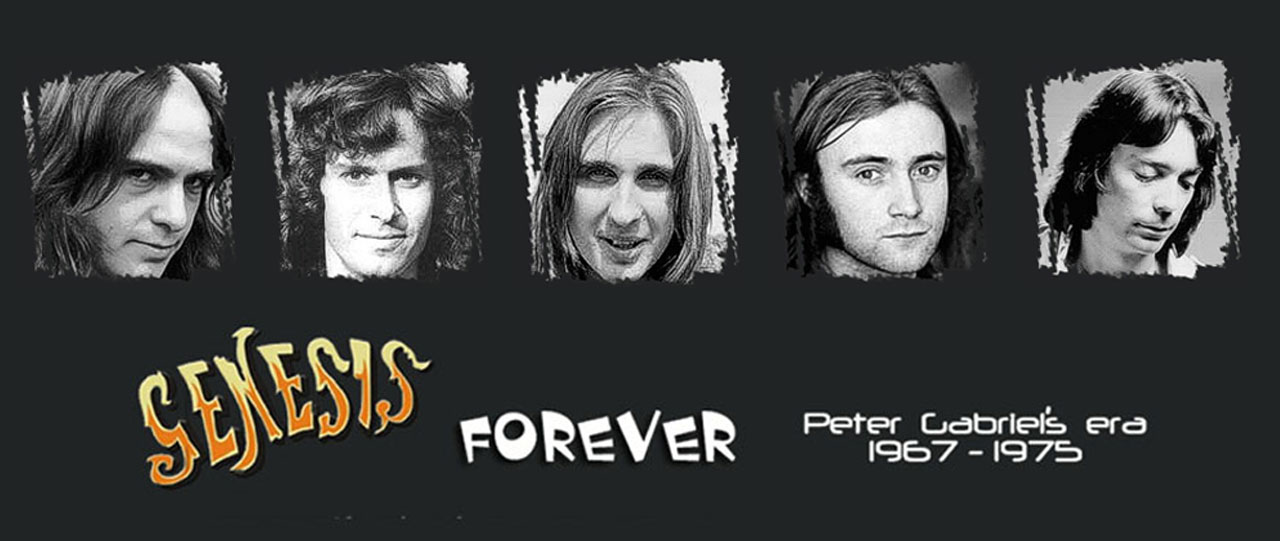
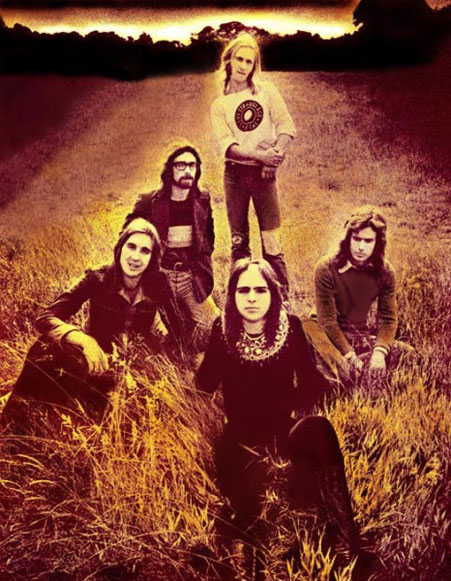
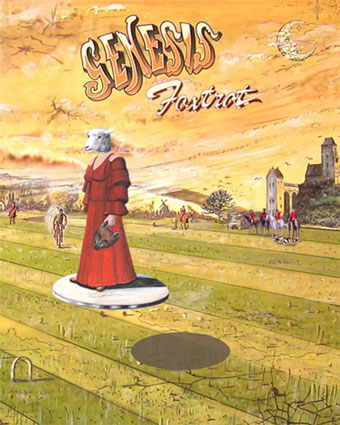
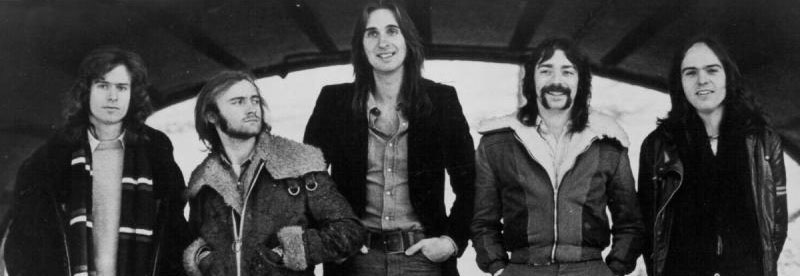
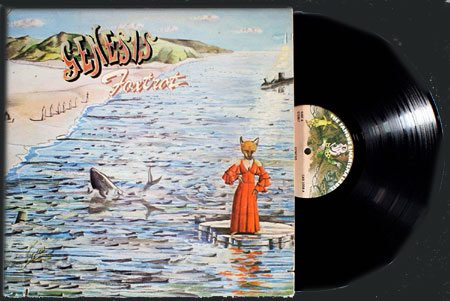
Genesis’ classic line-up is still considered one of the greatest Rock groups ever assembled. Fronting the band was Peter Gabriel, a theater freak from Surrey, who would later go on to revolutionize art-pop. Inspired by Arthur Brown, he developed a striking visual aspect for their live performances — which includes the fox in a red dress costume that graces this album’s cover — and a lyrical style that both honors and satirizes British culture and daily life. On guitar, Steve Hackett’s tender, elegant tone, and intricate techniques provided a different imagination of the instrument in the Rock context. Tony Banks contributes the grandiose compositional scope to the group, with a strong emphasis on dense keyboard sounds and broad arrangements. The rhythm section, though, is the most vital part of the Genesis sound, as bassist Mike Rutherford and drummer (later leader, later lamest rock star on Earth) Phil Collins operate on a level of chemistry and dynamism unparalleled at the time. Squire/Bruford were multifaceted jazz-influenced virtuosi. Ayers/Wyatt were composer-minded explorers. But Rutherford/Collins were anchors, playing only the appropriate amount, tightly solidifying the sonic ground, doing the very thing a rhythm section is for and keeping it exciting.
Foxtrot feels like a masterpiece from the start. “Watcher of the Skies” opens with an affirmation of greatness via its iconic Mellotron and church organ lines. Yet the most memorable component of this piece is Gabriel’s musical theater approach, moving in and out of characters with ease and lyrical conviction. The record follows with the nostalgic, piano-led “Time Table”, and then with “Get’em Out by Friday”, one of the most gripping examples of the band’s dynamics — Peter’s characters illustrating the social commentary of the lyrics, Hackett’s subtle-but-superb leads, and the Rutherford/Collins intelligent interplay. Side A ends with “Can-Utility and the Coastliners”, an effective condensation of the band’s compositional efforts, in which a quiet acoustic guitar intro gives way to a heavier, dramatic track with several shifts in time and melody, led by Rutherford’s thundering basslines. It is a 15-minute suite done in only five.
Steve Hackett has always been my favorite member of the band; he’s one of those guitarists whose brain equals his heart. On “Horizons” he makes a creative use of harmonics while constructing a web of beautiful, heartfelt acoustic melodies. This piece serves as an introduction to the true Epic of this album, the elephant in the room: “Supper’s Ready”. Lyrically based on the book of Revelations, the record’s main event (and possibly the band’s magnum opus) begins with “Lover’s Leap”, an ethereal, multi-layered section once again led by Hackett’s smart overdubbed guitars. Then the band builds into a full song for “The Guaranteed Eternal Sanctuary Man”, a section that introduces the story of a farmer and a con-man, echoing Jesus and the Antichrist. This Good/Evil confrontation becomes a battle, represented in the harder-edged arrangements of “Ikhnaton And Itsacon and their Band Of Merry Men” and in Hackett’s amazing solo — Yes, we’re finally talking about finger-tapping. This conflagration turns into calm in “How Dare I Be So Beautiful?”, a slow, synth-driven reflection on the inevitability of death. “Willow’s Farm”, the following movement, takes you into a bizarre, funny world, in part reminiscent of the Beatles’ weirdest, most-playful moments, but definitely much more deliberately confusing. Genesis are in on the joke, with Gabriel saying “ “we’ll end with a whistle and end with a bang, and all of us fit in our places.” And then comes “Apocalypse in 9/8”, the final battle raging on, St. John’s Armageddon, musicalized. This is perhaps one of the most exciting moments in Prog history, as the full band takes on the titular time signature with singular passion and razor-sharp focus. Then we hear a reprise of “Lover’s Leap”, announcing the battle is over and Good has won. “As Sure as Eggs is Eggs”, a reprise of “The Guaranteed Eternal Sanctuary Man” but bigger in scope, closes the suite, symbolizing the hope of mankind and the possibility of Heaven.
There is a pretty strong consensus that this is Genesis’ peak period, but the debate as for which is their best record is still on. If Foxtrot is not the most solid (that may be Selling England by the Pound) or the most ambitious (The Lamb Lies Down on Broadway), it sure is the most progressive, the one that encapsulates the nerdy spirit of the genre that I love so much. And it’s an awesome introduction to Prog; I still remember going through Live365 Radio that evening in 2002 and getting my mind blown.
"This is where we started to become significant"
By Chris Roberts ( Prog )
published March 22, 2017
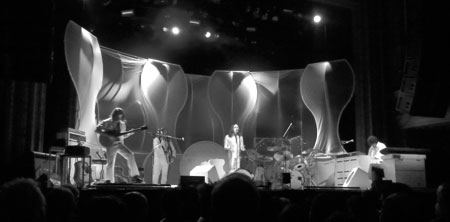 Genesis' Supper's Ready has been voted your number one prog anthem of all time. Here, the band look back on the track
Supper’s Ready has been voted your favourite prog anthem of all time. To see the rest of the list, click here.
‘The frog was a prince, the prince was a brick, the brick was an egg – and the egg was a bird. Hadn’t you heard?
Well, 45 years on from the creation of Supper’s Ready, you probably have heard this invaluable information. You’ve heard the 23 minutes and seven sections of the definitive Genesis track – indeed the definitive prog track, as voted for by you, our readers – and been transported by its breathtaking ambition. Its carefully cohesive meanderings lash together symphonic rock, heartbreaking melodies, surrealist lyrics and sky-high drama to build ‘new Jerusalem’.
Those involved were trying to conjure up previously-unheard music, while taking detours to rifle through the book of Revelation and pay visits to Lover’s Leap and Willow Farm. Oh, and to soundtrack an apocalypse…in 9⁄8 time.
“We wanted to go further,” says Tony Banks. “We’d all been wanting to push away from the regular structures.” With a very English, very Genesis reserve, he adds, “It turned out better than we’d thought.”
Foxtrot, the fourth Genesis studio album and the second with the classic line-up of Peter Gabriel, Mike Rutherford, Phil Collins, Steve Hackett and Tony Banks, was where that ensemble fully coalesced and realised how far they could go.
“It was about creating a film for the ear rather than the eye,” says Hackett. “We felt that we were underway,” says Banks, “that we were heading somewhere different. Foxtrot was where we started, in my opinion, to become significant.” As the song goes: ‘We’ve got everything; we’re growing everything.’
While the album sounds like a meticulously confident execution of a master plan, it actually came to be in a loose, relatively rushed manner. The band’s touring schedule was exhausting, and Hackett recalls that whereas with the band’s previous record, Nursery Cryme, they’d taken the summer to bond as a group, writing and recording together, for this one they were darting in and out of the studio.
“I remember flying back from Italy to be there a day or two ahead of the others, who were travelling by road, just to finish off my guitar parts over the end of Supper’s Ready,” he says.
Various locations were used for rehearsals but the bulk of Supper’s Ready was crafted – prior to the absent Gabriel adding the words later – in, of all places, the Una Billings School Of Dance in Shepherds Bush.
“We were below this dance studio, in a former refectory, with a counter and a gobstopper machine. There were girls upstairs learning their tap dance and what have you. The sound of those rhythms would come down through the ceiling,” Hackett says. “It was all a bit strange, and the atmosphere influenced our subsequent efforts. You couldn’t be too serious for long, because you’d hear them with this: clumpety clump clump. We’d break into smiles.”
While Foxtrot is more than just a series of apperitifs leading up to the main course – there’s social comment and sci-fi along the way – it’s indisputably the old Side Two which steals the show. Hackett’s instrumental Horizons is, in his words, “an hors d’oeuvre, an introduction”, and then it begins. The ascent of Everest. Even the sometimes lukewarm Gabriel remains a loyal fan of the work.
“It does feel like we captured some emotion there, particularly at the climax,” he says. “For my part, it was influenced by John Bunyan’s The Pilgrim’s Progress, as, later, was The Lamb Lies Down On Broadway. It was that idea of a journey. Also we were then trying, consciously, to break out of tradition. We were tossing together different ideas and influences to see if there was a fresh way of putting them all together. I still enjoy it now; I’m still attracted to it.”
Indeed he counter-intuitively considered performing it live a few years ago, but admits, laughing, that it proved incredibly tough for his band to learn. “We didn’t get far. There was some resistance – it’s not easy!”
This uneasy listening embraces, within its scale and scope, short sweet pastoral songs, longer more savage cuts, trembling dreamscapes and jolting blasts of reality. Gabriel sings – though it’s more than singing, it’s also a delivery, an acting performance – of good versus evil, love, religion, Winston Churchill dressed in drag, firemen, farmers and – somehow – the link between walking across the room to turn the television off and the Antichrist. And then of course there’s a flower. (A flower?)
Genesis’ only side-long song cycle isn’t afraid to lull you into a cosy sense of security then jump out from behind the curtain. “Supper’s Ready,” Mike Rutherford has mused, “was a great moment… of luck. Because, sometimes, you don’t quite know what you are doing.”
So what were they doing? “We were not one of those boring bands that went diddly-diddly-diddly on the guitar,” Phil Collins says, suggesting – as the members of Genesis often do – that if they were prog they were not at the noodling, indulgent end of the spectrum.
“We did not do that!” Rutherford says similarly. “Some of the progressive bands were more about musicianship, but even though we did long numbers, they were very much song-driven. That’s the key to longevity.”
Banks also “never liked being lumped in with anybody. We felt a slightly different ethos. King Crimson, Yes and ELP were selling technical proficiency a little more than us. Technique got displayed in the early 70s, but it was never our motivation.”
Hackett suggests astutely that one of their USPs was what he calls “lead chords”. “Genesis constructed melodies from chords. We’d have that “swirly-cloudy” feel. That impressionistic feel characterises much of Foxtrot, where you’re not entirely certain what you’re listening to.”
Banks recalls that they’d debate the very “rules” of music. “We’d say: why have you got to go verse-chorus-verse-chorus, etc?” They decided that was “fine for some, but it’s nice if you can go somewhere else. And you can tell more of a story that way, without the repetition”.
The band initially thought they were writing “a kind of follow-up to The Musical Box, from Nursery Cryme”. That was coming along well but, according to Banks, there was also “this ‘pretty-pretty’ song called Willow Farm, all on its own, and we thought: what if we suddenly went from there into this ‘ugly’, descending-chords sequence? Nobody would be expecting that. That then brought in all the louder, electric instruments, and once we got into that… well, we were there now, so let’s carry on! With freedom. See where that leads us. When we put the whole thing together and heard it back for the first time, we went: ‘Oh, this is actually pretty good.’”
If there’s one man more prone to English restraint than Banks, it’s Rutherford. “That end section happened effortlessly, as good music often does. The act of doing Supper’s Ready seemed quite easy. If things take too long, it’s a bad sign. When Pete put that ‘666’ vocal over that passage, that felt a bit special. The voice going over that strong instrumental wasn’t how you’d imagined it at all. The game got raised.”
Needless to say, quietly competitive school friends Gabriel and Banks took time to accept that they were on the same page in this brewing book of revelations. Banks had most of the Apocalypse In 9⁄8 section down as keyboard solos.
“But then Peter started singing over them, because his lyrics required more information to get out. Initially, I have to say, I was pissed off,” he says with a laugh. “‘You’re singing on my bit!’ Then I realised it now had all the excitement we’d been hoping to create. Especially the ‘666’ bit. There’s a lot of drama in the chords themselves, but then what he did on top just took it to another level.”
And then he makes a very specific call, with which many long-term Genesis fans would agree: “That half-minute or so is probably our peak.”
Gabriel’s lyrics are a splendour of the fantastical and the intimate. He’s described them as being both a “personal journey walking through scenes in the book of Revelation” and inspired by nightmares his wife had. (A line in the Bible reference mentions “the supper of the mighty one”.) Gabriel was a fan of King Crimson lyricist Peter Sinfield, and perceived in his work an intriguing blend of British eccentricity and raging psychedelic visions. At the time of Foxtrot’s release, the singer agreed that there was an element of escapism, but denied it was anything to do with drug culture.
“I don’t think drug-induced states are valuable,” he said, while allowing that he was no stranger to mental anguish. “One of the great troubles with the mind is that it’s always lost between two extremes,” he said back then. “That’s partly what Willow Farm is about. Wherever you are and whatever you do, there’s always a left and right, an up and down, a good and bad.”
Sombre as that sounds, and as gloriously melodramatic and occasionally macabre as much of Supper’s Ready is, there is lots of leavening humour to keep the journey both palatable and unpredictable. The scene where Narcissus is turned into a flower (OK, you can do the response here if you like) takes its title How Dare I Be So Beautiful? from a catchphrase of the band’s erstwhile, not then yet discredited mentor, Jonathan King. In Willow Farm, there are flavours of Monty Python and The Flowerpot Men, and Gabriel’s onstage, in-character storytelling tendencies run riot throughout. You can of course take the young man’s purple verbiage as seriously or as lightly as you wish, but as effective as those “lead chords” are, his vocals are our indispensable guide, our narrator, our beacon to the far shore. ‘We will rock you, rock you, little snake/ We will keep you snug and warm.’
All these years on, Supper’s Ready has survived the slings and arrows of fashion and stands as the matchless, majestic monolith of prog. Every progressive band worth their salt since, from Marillion to Big Big Train and many more inbetween, have used it as a touchstone. Hackett recalls that Genesis did in fact think of it as “futuristic” in ’72.
“I can’t remember whose idea it was, but we came to the conclusion that you could join any two bits of music together, no matter how disparate the styles, provided the bridge or atmospheric link was strong enough,” he says, laying out one of the definitions of prog. “It creates for the listener an adventure, an odyssey. You’ve got the stuff of concertos and symphonies, which nod to the past, but it was also futuristic at that point. Bands just weren’t creating pieces of music like that. I think it was then the longest piece that any rock band had ever played live.”
Phil Collins retains his enthusiasm for the song. “Supper’s Ready was great!” he says. “The music and imagery worked so strongly together. And then on stage the visuals boosted it too.” (So fond of it was Collins that you can hear him subtly quote the lyrics – ‘There’s an angel standing in the sun’ – on the fade-out of Los Endos, the closing track on A Trick Of The Tail, his debut album as the band’s vocalist after Gabriel’s departure. He also sang Supper’s Ready beautifully on live album Seconds Out.)
Audiences at first were equal parts bewildered and exhilarated by Supper’s Ready. “We’d gone out on a limb,” remembers Hackett. “It was labyrinthine. It was like when The Beatles released Sgt. Pepper’s Lonely Hearts Club Band and then they worried whether they’d gone too far and might get the thumbs-down. Except we didn’t have their number of fans!”
“In the early 1970s we were lucky. The Beatles had started to go a bit further, then pulled themselves back. But they’d opened a door,” says Banks. “We – and Pink Floyd, King Crimson, and others – all thought: ‘We can do what we like now!’”
They knew what they liked. Evidently you do too, voting Supper’s Ready as the consummate, nonpareil banquet of prog.
“Sometimes,” ponders Steve Hackett, “you get a great crystallisation. You may not fully recognise it at the time – as musicians you may still be searching. But the audience, the true owners, will see it as a Mona Lisa. They’ll say: ‘Look no further, we’ve found it.’”
Ben Greenstein
 Not their best, but I really like a lot of the tunes. Especially "Can-Utility and the Coastliners," which you obviously don't care for. And I agree about "Supper's Ready" being too long - I'm working on making an edited version as we speak (er, type), and, coincidentally, I would omit all of the parts that you don't care for. And, one last note - "Watcher of the Skies" is a TERRIBLE song.
The worst they've ever done, and that's including the last couple of Phil Collins-era albums. Am I the only one who realizes how ugly the chorus is? Awful, awful, awful. One of those songs which I just don't understand. I'm not familiar with your rating scale, but on my own reveiws of it, I gave it an 8/10.
Mike DeFabio
You people will think I'm really dumb but this is my favorite album ever. Better songs have been written, sure, but on this album everything comes together and clicks and makes something absolutely wonderful. Run down to the record store and get it now! And if you can't afford it, steal somebody's wallet!
John McFerrin
A really, really good album. Now, at first, it was the side-A tracks that sucked me in, just like with you (although, like you, 'Can-Utility' doesn't do jack for me). But at the time I would've only given it an 8, mainly because I just couldn't 'get' 'Supper's Ready'.
After five or six listens, however, that changed drastically. There are certainly chunks where it meanders a bit too much (ie 'How Dare I be so Beautiful'), but on the other hand, I can somewhat forgive that. See, the supper referred to is the "Marriage Supper of the Lamb," which is discussed a bit in Revelations.
Now, since the track is ultimately about the apocalypse and events before and after, it almost seems to work better that the song is somewhat unconnected before Apocalypse in 9/8 (which I just LOVE, btw), since it is stated that no man knows when the Apocalypse is going to happen, so life would be relatively normal right up to the time when it happens (ie it would be more or less haphazard). And in that way, the track works perfectly. A solid, solid 9, and the band's second best effort after England.
Bob Josef
Big disagreement here! Genesis comes up with its best epic piece with "Supper's Ready" -- the lyrics are bizarre but still intriguing and the music is captivating. "Watcher" perfectly catches a sci-fi/outer space mood with its use of the mellotron.
The other tunes suffer from Pete getting a bit too eccentric in an old British man sort of way, which is weird for someone who was only 21 at the time.
By the way, you complain a lot about Tony's "synths", but at this point he was still sticking to organ and mellotron.
Rich Bunnell
I have to agree with Mike's perfect score, even though it isn't my favorite album ever. This is the kind of stuff I -like- in my Genesis-- it's not too bombastic, it's prog without the big, ominous overbearing dynamics which mar some other great Genesis material. "Supper's Ready" is a masterpiece, one better viewed as a lot of different songs mashed into one rather than one big, long 23-minute song. If the CD divided the sections of it into separate tracks, no one would complain. I'll stop here. I love this album. It's the perfect Genesis experience for me.
Also, the thing that's confused me the most throughout my review-page-browsing is Ben's utter contempt for "Watcher Of The Skies." I just can't help wondering what's in the song that makes it horrible at all...it's amazing!
Jeff Blehar
I'm going to have to side with most of people here in disagreeing with you, George. I think that Foxtrot is an absolute peak performance for the early Genesis, which is easily the equal if not the better of Selling England By The Pound (it's close, but I'd ultimately favor Foxtrot because "The Battle Of Epping Forest" is just lamentably bad). Almost everything is top-notch here; "Watcher Of The Skies" is a great opening shot, with those portentous organ chords and that bizarrely clipped 7/4 meter.
I like the "short" songs like "Time Table" and "Can-Utility" quite a lot as well, especially the melody line of the latter. The only song on here I actively dislike is "Get 'Em Out By Friday," which is just a bit TOO British for my tastes...I think the opening is also really ungainly and ugly, too. "Horizons" is a beautiful acoustic showcase, but really now, the reason why we all love this album is that thing on Side 2: "Supper's Ready." I can't think of very many songs that I'm happy to sit and listen to for 24 minutes, but this is one of them.
There are just SO many intriguing things going on in here, brilliant little bits that you just sit up and smile for: that mystical and momentous opening passage (goosebumps for me always), the loping melody of "Guaranteed Eternal Sanctuary Man," the orgasmic release of the guitar soloing on "Ihknaton & Itsacon," the inspired goofiness of "Willow Farm," and then of course the apocalypse, capped by the brilliant recapitulation complete with church bells and a truly thunderous fade out where the whole band sounds like it's waving goodbye.
Sure, there are some slow moments like "How Dare I Be So Beautiful?," and I could have done without a couple of minutes of the 9/8 playing easily, but taken all in all, the final effect floors me. Now I quite like Thick As A Brick, but I think "Supper's Ready" compares favorably to it. Perhaps Genesis couldn't play as well as Tull, but each composition is going for different moods, and Genesis does a better job with theirs.
Gabriel's lyrics (for all of their cheerful insanity) certainly hold together far better than Ian Anderson's burblings about modern culture; I defy you to point out any moment in Thick As A Brick that rivals "Lover's Leap" or the finale for sheer ability to transport you some mystical, visceral place (sure: 'Do You Believe In The Day' is just as, if not more, mystically poignant; but ultimately you're right, Thick As A Brick is about quite different things; still, it has far less boring moments during its 45 minutes - G. S.). Those references to strange transfigurations, "guardian eyes of blue," and souls igniting really take me somewhere. This deserves no less than a 9. Not a 10 because of "Friday," but a strong 9 nonetheless.
Philip Maddox
This was my second Genesis album, and though I originally liked it more than Selling England, that one grew on me immeasurably and this one never did. It still rules, of course. It takes most people a long time to get into 'Supper's Ready', but for some reason, it clicked with me immediately. I must have listened to that song 5 times in a row. I don't think any of it's weak - I wouldn't change a second of it.
Highlights are the 'Ikhnaton' part, the conclusion, and my favorite, 'Willow Farm'. Ooh, now that's a groovy song. The hook in the verses reeled me in instantly. Plus, it's fun! It segues right into that beautiful acoustic guitar and flute bit, too. I love that! 'Supper's Ready' is, without doubt, my favorite song on here. The rest isn't bad at all, though. 'Watcher Of The Skies' is very majestic, as is 'Time Table'. Both of 'em are great.
I even love 'Can-Utility And The Coastliners', especially that vocal section near the end. Or maybe the part when Peter sings "All who love... OUR
MAJESTY!". It doesn't strike me as filler at all - actually, it may be my favorite side A track. By a strange coincidence, 'Get 'Em Out' is probably my least favorite track here - it's good, but not quite great. It's probably just because it doesn't strike me as very pretty, while everything else is extremely pretty. I can't decide if I'd give this a really high 9 or a 10. I'll have to wait until I get more Genesis albums.
Nick Karn
Yeah, this is indeed an awesome album, and probably one of their absolute best. I have to confess, though, that my listening experiences for this album revolve around the countdown until "Supper's Ready" and its' preceding acoustic instrumental "Horizons" (it might as well be an intro to the song as far as I'm concerned), which is one of the candidates in my mind for prog rock's finest ever creation.
The last half of it is simply some of the most absolutely breathtaking music I've ever heard, with Gabriel's spectacular theatrical display in "Willow Farm", the threatening 9/8 jam (really setting a spectacular mood), and the shatteringly majestic final section reprising the "Guaranteed Eternal Sanctuary Man" bit (I LOVE that main melody in both forms!!). Simply blows me away.
But since that song is less than half of this 51 minute album, the rest of the album would have to be fairly excellent for it to earn an overall high rating, and it is for the most part. "Watcher Of The Skies" has a good dramatic intro and mood, though it doesn't REALLY thrill me - just a very well played 7 minute epic. "Get Em Out By Friday", though, really is a great sequel to "Return Of The Giant Hogweed", with an even more curious, truly original, and downright twisted plot and all those different character sketches.
Great overlooked drumming in that piece too. And I think "Can Utility And The Coastliners" is actually quite beautiful near the beginning of it - it's just the middle acoustic meandering part that's not too exciting, but the end of the song is rather good. "Time Table" to me is the least thrilling full length song on here, though it is a rather pretty ballad piece, and a step up from the unassuming filler on Nursery Cryme. I agree with the 12 rating overall - a normal nine.
Brian Sittinger
Very solid album. I do not find any weak spots in this album. It just took a bit of adjusting to appreciate this great work. Except for a small portion of "Supper's Ready", this album does not have the extreme contrasts of mood that Nursery Cryme (in particular, "The Musical Box" possesses.
As such, I don't have many comments for this record. The often neglected "Horizons" is a pretty, and unfortunately short classical guitar song by Steve Hackett. Check out the harmonics at the beginning! Finally, "Supper's Ready" moves very smoothly through its 20+ minutes playing time. Right hen it seems that the song will get dull, it changes direction. This song gets especially going once you're at "Willow Farm".
"Apocalypse in 9/8" features a unique, catchy rhythm (err, something like 9/8 perhaps!) building up to "As Sure As Eggs Are Eggs" (what wacky subtitles!) with a cathartic final section courtesy of especially Gabriel and Hackett (more heavenly/emotional notes from him, accompanying Gabriel's vocals). It will blow you away. 10 out of 10 (on a very bad day,
Billy Williams
Foxtrot is a great album, and, in my humble opinion, is the greatest prog album I've ever heard. "Watcher of the Skies" (I like the creepy organ intro) is quite good, as is "Time Table." Both have solid melodies. "Get 'Em Out By Friday" is tremendous. I love this song.
It's humorous and it rocks, and, in many ways is a precursor to songs like "The Battle of Epping Forest." I think you've underrated "Can Utility and the Coastliners" just a bit, George. It ain't that bad! The major highlight is, obviously, "Supper's Ready." What more could be said about it? All in all, this is Genesis' finest effort, just slightly ahead of Selling England.
Ben Kramer
When I got this a few weeks ago and listened to it, I knew that Genesis would be my favorite prog band and one of my favorite bands of rock. This album is just about as amazing as its follower, the epic Selling England By The Pound.
'Watcher of the Skies' is the perfect song to open it and it is also my favorite song on the album. The opening 2 minutes is amazing, and it sets more atmosphere than Yes ever did. The instrumental is great too, almost as great as the one found in 'Dancing With The Moonllit Knight'. 'Time Table' is a nice little pop song, maybe not as good as 'I Know What I Like', but it is still memorable. 'Get 'Em Out By Friday' is just phenomenal, being one of the best songs of the Gabriel era (Which is by far their best era, I don't have any albums after he left with the exception of A Trick Of The Trail (excellent!), but the napster files don't prove to make the later Genesis era promising.).
The little opening riff is simple, yet intriguing. The only problem I have with it is that it seems to drag on at the end a little too long, not in a bad way, but it just seems like it would have been better if they shaved 30 seconds off of it. I don't see what you have against 'Can-Utility And The Coastliners' because I love it. They could have built a 7 minute prog song around it and it would be as amazing as 'Watcher Of The Skies'. 'Horizons' is totally pointless and I don't see the need to make side one 27 minutes from 25. However, that is my only problem with side one. Side two is as good as side one.
The 23 minute 'Supper's Ready' (I don't know how famous it is, but I can't imagine it ever becoming a common radio hit, so I wouldn't call it famous) is built on the best melody Genesis ever did (except the piano/synth part on 'Firth of Fifth', but I don't know if that actually counts). Also, Pete's lyrics are his best ever and he wouldn't top them until, maybe 'Biko', maybe 'Intruder', but not until his solo career. The problem with it is, like all sidelongs (not 'Thick As A Brick'), contains many themes along with the main theme.
So, while the main theme may be awesome and Genesis' peak, within the song, there are a couple of small sections that I would have cut. I can't really say which ones, because they change from listen to listen, but about 10 minutes in is what I'd consider the only true boring part in the whole song. Other than that, this is prime Genesis, and excellent prog. Overall, this album is worth a 9(14) on the McFerrin scale and a 10(14) on your scale. Why does this get a slightly weaker score than Selling England By The Pound?
Well, Selling England By The Pound is one of the most emotional albums I have ever heard (along with Abbey Road and Quadrophenia, as well as a couple Dylan albums, but that's a given). It isn't something that you could listen to 5 times in a row. Foxtrot isn't as emotional and while a superb album, it isn't quite up to Selling England By The Pound which I would give a 15, though I still see Genesis as a 4 star band, at least the Gabriel era.
The rest is probably a 2, maybe a three because A Trick Of The Trail is so great. Good Job Guys, you managed to outdo yourselves on this one, and even followed it with more excellence. In case you were wondering, this is my second favorite progressive album ever, only behind Selling England By The Pound.
Glenn Wiener
If I were to sum up Foxtrot, I would say that it is loaded with creative instrumental passages. However, melody wise its a hit and miss affair. 'Watcher Of The Skies' has the most memorable melody. 'Time Table' is fairly memorable as well but its the keyboard touches and the vocals that make it special.
'Get 'Em Out By Friday' is way too all over the place. An occasional interesting passage but just not too captivating for an 8 1/2 minute tune. 'The Coastliners' tune is pretty good for the most part but there are some so so spots. 'Horizons' is good background music. And 'Supper's Ready' has both good and trying moments. 10 out of 15 sounds right.
Fernando H. Canto
Wow, did Genesis learn to like to do long albums. They must have looked at the huge lead-out groove on Nursery Cryme, and Tony said: "How much music can we fit in there?" "Three," Steve said, coldly. "I think we can fit in *five*, if we squeeze the rest of the record a bit more", Peter challenged. "But we'll be reducing the sound quality!," Mike replied, reluctantly. "Who cares about sound quality, if we can compensate it with *musical" quality, eh?," Peter said, even more challenging. Silence fell for a few seconds, until it was broken by Phil's shy voice: "Can we?"
I think they could! They spent less time going on stuff like 'Seven Stones', and went on to the real meat: My only gripe against the album is that Tony is *too* heavy on the vibrato-less organ, and that monotonous hum can be a bit grating sometimes. Also, there's less Steve Hackett. But, the good songs are just as good as on Nursery Cryme, and the bad songs...
Heck, there are no bad songs! Shut up, you whiny 'Can-Utility And The Coastliners' hater. I mean... Seriously, if this compares to 'Harlequin', then 'Time Table' certainly compares to 'Firth Of Fifth'. I like the way the mood of the song flows from soft and gentle to tense and nervous and finally to screaming and ascending into the finale. That's a cool song. Oh, well... I guess my main disagreement is that Genesis' strength is not the "power".
I don't really care whether they're being powerful or soft - if they have got a good melody, they can make anything work. Then again, I like 'For Absent Friends', so I can see where our tastes differ. Other than that, you're pretty right on 'Time Table' being beautiful. I've seen some people comment on the "hideous" lyrics to that song.
Sheesh, if 'Time Table' has hideous lyrics, what does 'Watcher Of The Skies' have? Man, people are crazy! These must be the same folks who love Graeme Edge's poetry on Days Of Future Passed! Okay, okay, on topic, on topic. I *love* 'Watcher Of The Skies'. Corny Mellotrons? You're crazy, man!
Those Mellotrons give me chills! And 'Get 'em Out By Friday' is pretty much perfect, too. I like all the transitions of mood and instrumentation and vocal intonations. I'm not one of those who go totally ape over 'Supper's Ready', just because it isn't as mindblowingly fantastic as other sidelongs I know, but it is a great composition, anyways.
Whether all those different things fit well together, I don't care. Those are very good musical ideas, and it sure has a grandiose finale. And 'Horizons' rules! I wish I could play harmonics like that!
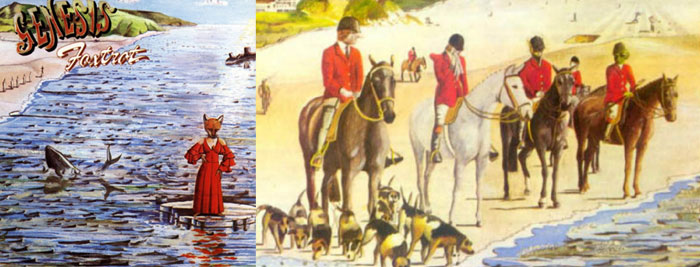
“Every time I play Foxtrot in my car I spend the full 23 minutes of Supper’s Ready singing along and having a shitload of fun. The best of the best.”
Pablo Alvarez
“The humour, drama, action, horror and adventure. It has everything!”
Alexi Keltto
“I remember listening to this with my earphones on in the family room when my mom and sister were watching TV. I threw down my earphones and said to them, ‘You have got to hear this!’ I played the section over for them but they never got it. Some people just never get to be part of the magic.”
Paul Bilyea
“The bizarre images from the book of Revelation fit perfectly into an epic prog song, putting a cap on the psychedelic lyrics that thread their way through the entire piece.”
Chris Files
“The classic prog epic – the structure of this has been copied by many others over the last 40-plus years, but few have done it as well.”
Ken Lansdowne
“Genesis never forgot how to weave an emotional web around their listener, and the song will have you laughing one minute while crying from its sheer beauty the next.”
Dean Barrett
“Mad then, mad now and still a work of utter genius, showcasing the talents of the whole band like they were going on a bear hunt (but weren’t scared)!”
Sam Spencer
“Genre defining, the template for so many bands that followed.”
Tim D
“This is the best of the best of the side-long epics. It just astounds me how a band could come up with everything that’s packed into this track.”
Jonathan ‘JS’
“Long and flowing, tells an interesting story with many Biblical allusions, classically inspired and includes some Orwellian imagery and social commentary.”
Jeff Haas
“This is the ultimate prog rock song as it has everything… Complexity, dynamic, intensity, whimsy, melody, atmosphere…”
Bill Pompilli
“It isn’t so much the individual sections that make it so great; it’s the way its themes and mood build and build upon each other, a mounting surreal darkness that culminates in the jaw-dropping Apocalypse section, and the denouement at the end. It’s so much more than the sum of its parts. Plus, it’s completely bonkers.”
Niels Hazeborg