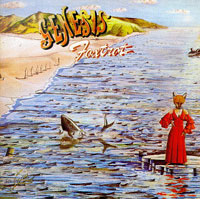
 More of the same formula: lengthy marathons with boring instrumental passages, increasingly complicated prog lyrics and Gabriel’s fantastic singing skills. But even better this time around; the instrumental passages are generally less boring because they tend to be shorter and more multi-part, the lyrics are getting interestinger and interestinger, and Gabriel’s singing skills are on the rise again, as he goes deeper and deeper into his amazing brand of “rock theater”.
Just like in Cryme, there are three lengthy marathons, but one of them is really long. You know, of course, what I’m talking about: the famous side-long ‘Supper’s Ready’. While you’ll see quite a few reader comments condemning me for my initial rejection of the most part of the suite below, time has certainly improved my feelings towards it. Obviously, the suite was written mostly with the aim of “not falling behind” the other prog bands like ELP, Van Der Graaf Generator, King Crimson and particularly Jethro Tull, all of which had already released side-long pieces by the time – and some of them had done pretty well on the charts. But fortunately for us, Peter Gabriel was such a talented fella that the effort eventually turned out to be much more than an obligatory tribute to his predecessors.
‘Supper’s Ready’ is basically Gabriel’s take on the Apocalypse (actually, one of the parts is subtitled ‘Apocalypse In 9/8’) – I will not go into details on the song’s ‘spiritual essence’ and the meaning of all of its individual sections, because all such things are rather debatable. There are lengthy resources for the explanation of ‘Supper’ on the Net, together with resources annotating The Lamb; check ’em out for yourselves. Here, it must be noted that most of the parts are supposed to have actual meaning, and the suite flows quite well. Kudos to the band, in particular, for actually providing us with quite a few melodies: the twenty-plus minute length is fully compensated by the multiple themes, ranging from soft and subtly ominous to gritty and openly aggressive. With all their pretentions and ambitions, they could have easily pumped out the Close To The Edge formula (a few good melodies diluted by tons of acquired-taste atmosphere), but instead they’re in for some real musical meat.
And thus, after a few listens that are needed to get used to the tune in general, it only sags in a couple of places: some instrumental breaks are, as usual, lengthier than they should be, and a couple sections like ‘How Dare I Be So Beautiful’ and the already mentioned ‘Apocalypse In 9/8’ are, well, overshadowed by the better moments. But when said moment is better, it’s usually topnotch. ‘Lover’s Leap’, with its tale of two lovers merging as one, is sad and romantic, driven forth by a gorgeous medieval guitar line; ‘The Guaranteed Eternal Sanctuary Man’ is climactic, with loads of wonderful atmosphere; and ‘Ikhnaton And Itsacon And Their Band Of Merry Men’ is a stomping piece of battle fury with Hackett at his very very best. The fun comes on ‘Willow Farm’, where Gabriel is the main and only star: it’s one of his most impressive theatrical British deliveries ever. And ‘As Sure As Eggs Are Eggs’ brings us back to the climactic moments of the second part, culminating in the triumphant coming of the Lord ‘to lead his children home, to take them to the new Jerusalem’.
Throughout, the band pulls out nearly everything out of their sleeves: Tony’s playing is moderate and restrained, resulting in quite a few blistering organ and Mellotron passages, Rutherford is supplying pretty acoustic guitar, Hackett stays in the shadows but the presence of his guitar in the background is always noticeable, Phil is Phil, and Gabriel… no, his starry hour had yet to come with the next record, but his singing on ‘Willow Farm’ definitely puts him in the league of Supermen. If you haven’t yet seen that video of the Genesis History, rent it if only with the aim of witnessing Mr Gabriel hop around the stage in his flower outfit while doing the ‘Willow Farm’ bit. An unforgettable experience. So screw the meaning – Apocalypse or not, this is simply a hodge-podge of enthralling musical ideas and inspired vocal and instrumental performances.
For me, however, side A hardly refuses to match Gabriel’s interpretation of the Apocalypse on side B. Not all, of course: ‘Can-Utility And The Coasters’ is classic Genesis filler, it doesn’t do a single thing for me. Some people seem to like it, but I don’t see how it is better than, say, ‘Harlequin’ on the previous record. Genesis are essentially a power band: they very rarely get on by soft melodies alone, it’s the contrast between soft and hard (I mean, upbeat and majestic) that makes their songs work. There is hardly any power in ‘Can-Utility’, just a lot of atmospheric acoustic guitar and a few more Mellotron notes that don’t seem to achieve any positive effect.
But the fan favourite ‘Watcher Of The Skies’ is certainly a great song, even with all those corny Mellotrons that predict the much later murky Wind And Wuthering synth stylizations: the melody manages to be memorable while not being very simple (as usual), and the lyrics, pretentious as they might be, are at least funny (I don’t know, I for one find a lot of fun in the lines ‘maybe the lizard shedded it’s tail/This is the end of man’s long union with Earth’). It also manages to go from stately and calm to raging and rocking with the transition effectuated smoother than most prog rock bands could ever manage such subtle changes – courtesy of Mr Hackett, whose guitar technique is even more impressive than before.
Same goes for the more obscure ‘Time Table’, with Gabriel at his most ‘universally-important’ tone – the gorgeous chorus of the song is, well, gorgeous, and Tony’s tinkling electric piano solo is utterly cute; why didn’t the man stick to non-electronic devices more often in his life is way beyond me. But my absolute favourite on the album is the sadly ignored ingenious sci-fi tale of ‘Get ‘Em Out By Friday’ in which the corporation of Genetic Control buys up all the housing on the planet and then reduces humanity to half its size so that they could make more money by putting twice as many inhabitants in each house. What a bummer, eh? Why hasn’t Ray Davies come up with a rock opera like this? (Which, by the way, is no idle question: there’s much more in common between Ray Davies and Peter Gabriel than you might imagine).
‘Get ‘Em Out By Friday’ is a worthy inheritor to ‘Hogweed’, with an even more complicated, but an even more funny and entertaining structure and Gabriel taking pure delight in impersonating both the ‘innocent lambs’ and the ‘big bad wolves’ of the story. While the song is nowhere near as ‘all-encompassing’ as ‘Supper’s Ready’, it manages to enthral me even more successfully: after all, it’s like an entire play stuffed in eight and a half minutes, not to mention the tons of cool melodies the band throws on here without any serious effort. Finally, Rutherford’s two-minute classic guitar showcase on ‘Horizons’ is at least a brief relief after all those nauseating Banksynths. So you see, there’s enough to make this record stand out even without the silly supper that’s finally ready.
Whatever I might say, though, there may be no doubt that this is Peter Gabriel’s peak as a lyricist. His exaggerated ‘Britishness’ shines through on all the corners, but it seems to be not the kind of ‘conservative Britishness’ that characterizes the Kinks, or the kind of ‘medieval-minstrelian Britishness’ that characterizes Jethro Tull. I’d call it ‘fairy tale Britishness’: in his imagery Gabriel relies on Germanic and Celtic mythology and old folk tales and pagan practices rather than on ‘social Britain’. So, at least in this respect, we might say that Genesis certainly delved itself a unique niche in British prog rock. Let it stay there for all its worth. And move on to their glorious culmination!



Written by Thomas Schrage
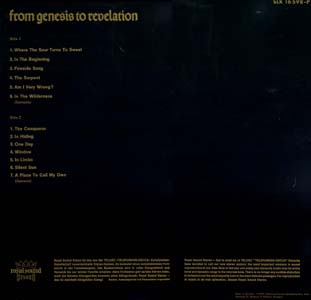 Genesis‘ first album was not called Trespass but From Genesis To Revelation. Many fans tend to count it as their zeroeth album.
 It shows no or at best only the most minuscule traces of the style that would make them well-known later, and therefore frequently meets with a refusal and lack of affection. Justly so?
The band did not have the line-up they got known with yet. One could say they did not even exist. They came together to record demo-tapes in the first place. All of them knew each other from Charterhouse public school. The songwriter team Rutherford and Anthony Phillips asked Tony Banks to play the piano for them; Banks only agreed if he could bring his songwriting partner Peter Gabriel to record a song. Soon they were convinced that Gabriel’s voice sounded better than Phillips’ so he ended up singing on all the songs.
When he did not sing, Phillips played the guitar, a position he would retain up to Trespass. Initially, the drums were played by one Chris Stewart, though the drumming on the album would be done by John Silver. The drummer’s stool would not be filled permanently until Phil Collins joined Genesis. Only with him did the band find someone who was accepted as a full member and could incorporate himself.
These boys (most of them were around 17 at the time) managed to land a record contract with Jonjo Music in August 1967. That only meant that a single would be released. King was an alumnus of Charterhouse and had had quite a successful hit with Everyone’s Gone To The Moon. A shallow pop song though that may have been, he nevertheless seemed to be a person of success and influence, and they found it very promising that they could have him produce them.
Read More
 The year was 1969. Among the many discoveries made that year was something called "the import record" - albums from England that were either different from those released here, or just plain never released in Athens.
I remember pulling together a stack of domestic promotional albums and heading to a downtown rendezvous, near Acropolis to a place called Plaka, where in a small records shop they were traded for a decidedly smaller stack of imports. One of them was a little item that had a black cover with gold lettering proclaiming FROM GENESIS TO REVELATION. It was the first effort of a British group that couldn't decide on their name, although the music was much more decisive - I immediately vowed to become a fan once they figured out what to call themselves....


Genesis Group Members
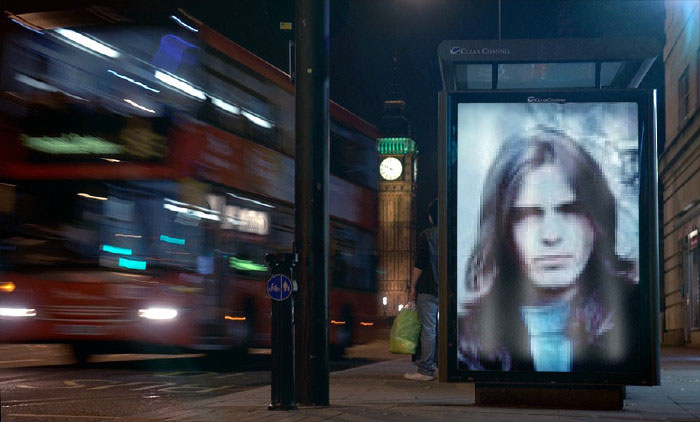 Gemesis 1970 - 1975
BORN: February 13, 1950, London, England
As the leader of Genesis in the early '70s, Peter Gabriel helped move progressive rock to new levels of theatricality. In his solo career, Gabriel was no less ambitious, but he was more subtle in his methods.
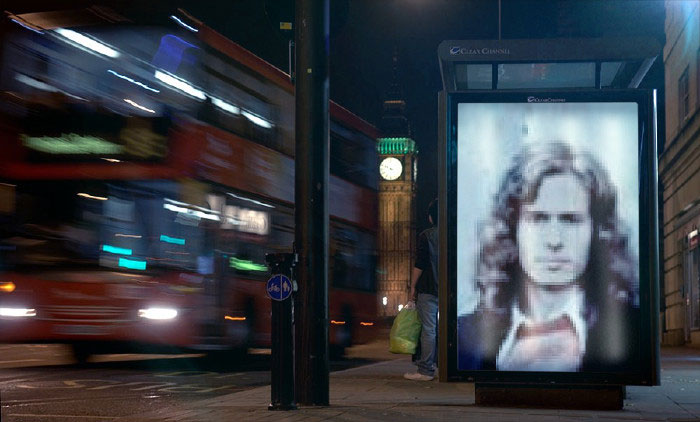 Gemesis 1970 - 1975
BORN: March 27th, 1950, East Sussex, England
Tony Banks started his career with Genesis in 1967 as the pianist/keyboardist, after the emergence of the Charterhouse School Bands The Garden Wall, which Tony was a member,..
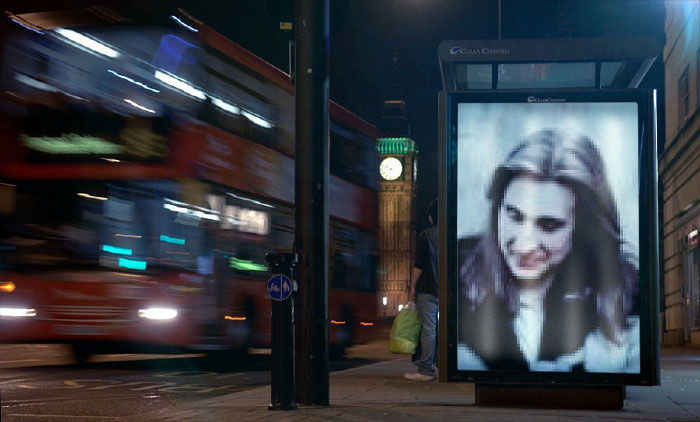 Gemesis 1970 - 1975
BORN: October 2nd, 1950, Guildford, Surrey, England
A founding member of the long-running art-rock band Genesis, Mike Rutherford also made the occasional excursion into solo projects, most notably the pop combo Mike + the Mechanics.
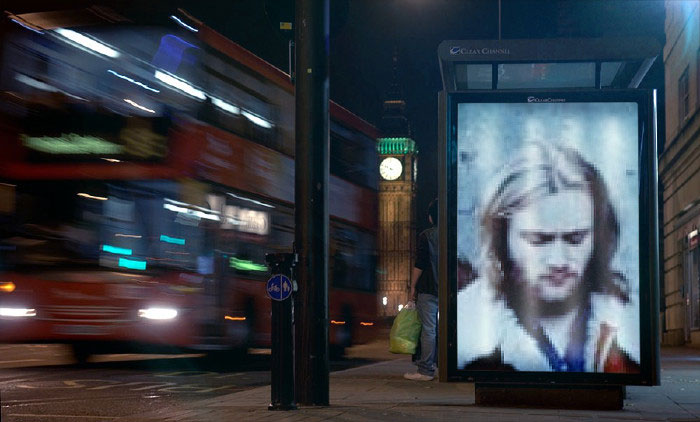 Gemesis 1970 - 1975
BORN: January 31, 1951, Chiswick, London, England
Phil Collins' ascent to the status of one of the most successful pop and adult-contemporary singers of the '80s and beyond was probably as much of a surprise to him as it was to many others.
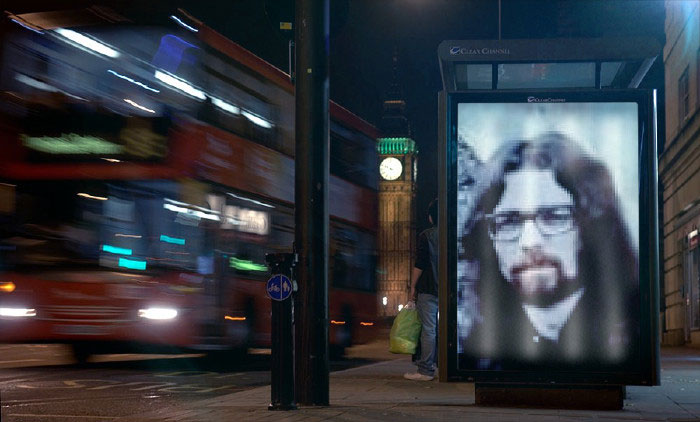 Gemesis 1970 - 1975
BORN: February 12th, 1951, England
Formerly a member of various minor bands, including Canterbury Glass, Heel Pier, Sarabande and Quiet World, the latter releasing a solitary album on Dawn Records in 1970, Hackett joined Genesis as guitarist in early 1971.

March 16th, 2015 By Jim Laugelli
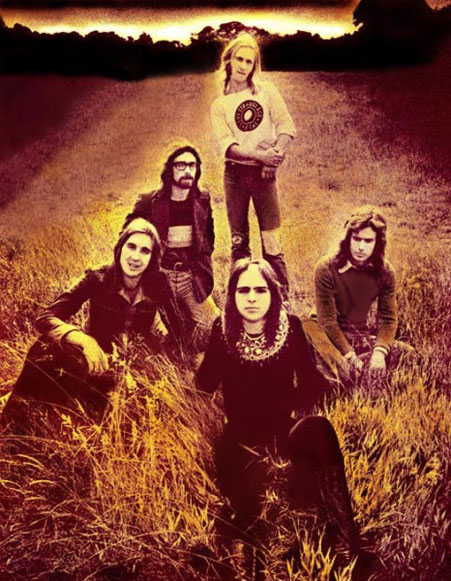 I could have very easily chosen a number of other Genesis albums but I decided on this one simply because it features what is perhaps the most significant song in all of progressive rock: “Supper’s Ready.” My introduction to Genesis occurred 41 years ago and had one of the most profound impacts on my personal musical journey. On that night, in May of 1974, a friend asked if I wanted to see a concert. He had a few extra tickets for a Genesis show and no one to join him. I never heard of the band and for some reason thought they were probably some sort of acoustic act. As far as I recall, my friend knew little about the band as well. I believe someone just gave him the tickets. With nothing better to do I decided to check it out. When we arrived at the venue and had taken our seats I remember my curiosity ratcheting up when the pre-concert music over the P.A. was Mike Oldfield’s Tubular Bells. This signaled to me that I was probably going to hear something unexpected. Sure enough, when the lights went down and the crowd quieted, the opening chords to “Watcher Of The Skies” begins. I immediately leaned forward in my seat totally consumed by the sound of the mellotron.
As that instrument eases, the staccato rhythm of the bass begins and in the darkness a pair eyes appear, they seem to be searching, radiating, only to reveal a figure in a cape with bat wings wrapped around his head. The vocals then begin and until the end of the show I remain completely and utterly captivated. My mind was officially blown. It was a revelation. I left that show a changed person. This was music that went beyond my imagination. It was presented like theater, it told stories. In fact, before many songs, Gabriel told surreal little tales as a way of introducing the tunes. The next day I bought Foxtrot, and then Selling England By The Pound, Nursery Cryme and Trespass all in short order. I immersed myself in their music.
Foxtrot begins the band’s high point of three consecutive outstanding albums. It was released in 1972, a banner year for progressive rock that also saw the release of Close To The Edge by Yes, Thick As A Brick from Jethro Tull, Trilogy by ELP, Three Friends from Gentle Giant and a slew of other incredible records. For Genesis, Foxtrot saw them tackle ideas they started with their two previous releases, Trespass and Nursery Cryme. The level of complexity in song structure, the emphasis on theatricality and drama, storytelling and extended song form all reached a new level of sophistication on Foxtrot.


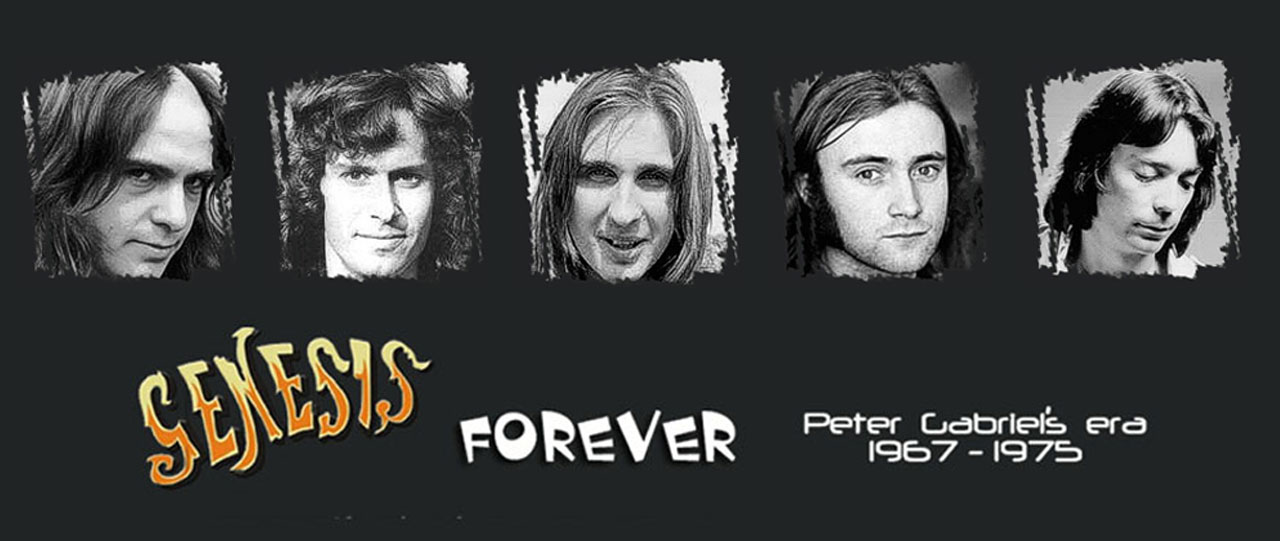
1967 - 1975
 Compiled by Ikon Designing
Aside from a portion of the box set, this is the only commercially available live document of vintage Gabriel-era Genesis.
 Compiled by Ikon Designing
That's it. Genesis' most ambitious work to date that ultimately led to the shock departure of their much loved singer Peter Gabriel.
 Compiled by Ikon Designing
The painterly texture of the album art is a very nuanced addition to the artwork., but with a plain light yellow-tan border, the artwork itself can feel a bit drab.
 Compiled by Ikon Designing
In 1963 Peter Gabriel and Tony Banks met at Charterhouse, a boarding-school, that layed in the English county Surrey in the middle 1960s.
 Compiled by Ikon Designing
Once upon a time, in a land far, far away. . . England, I think it was called. . . There lived four young men. . Their names were Ant Phillips, Michael Rutherford, Tony Banks and Peter Gabriel.
 Compiled by Ikon Designing
While recovering from this, he began writing Genesis' most ambitious project to date, "Supper's Ready," a 23-minute masterpiece
 Compiled by Ikon Designing
On every level the band transcend any kind of expected performance standard. Musically they are so proficient they make that part of the job look like a secondary exercise.
 Compiled by Ikon Designing
Genesis obviously differ from the dressed-up 12-bar that most bands unravel. And because of these very differences, the band have been slated over over their motives.
 Compiled by Ikon Designing
Lifeless was the performance of leader Peter Gabriel; the protagonist's name is Rael so it's surely no accident that Gabriel is a Roger Daltry sound alike.

This Website is for non-commercial use
It is an online digital library
© Genesis Forever 2000 - 2025 All rights reserved. - Version 18.1a - Designed & Developed by Ikon Designing - Powered by ENARTIA - Crete, Greece