

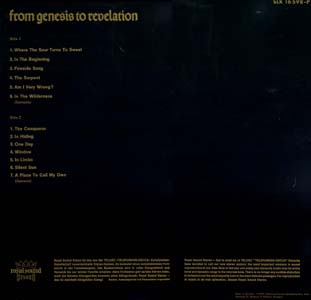
 It shows no or at best only the most minuscule traces of the style that would make them well-known later, and therefore frequently meets with a refusal and lack of affection. Justly so?



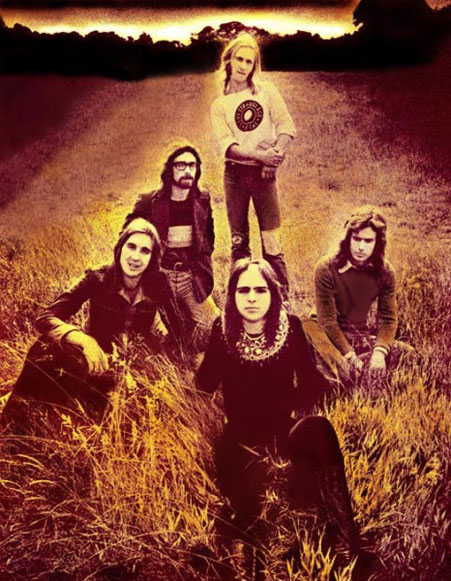




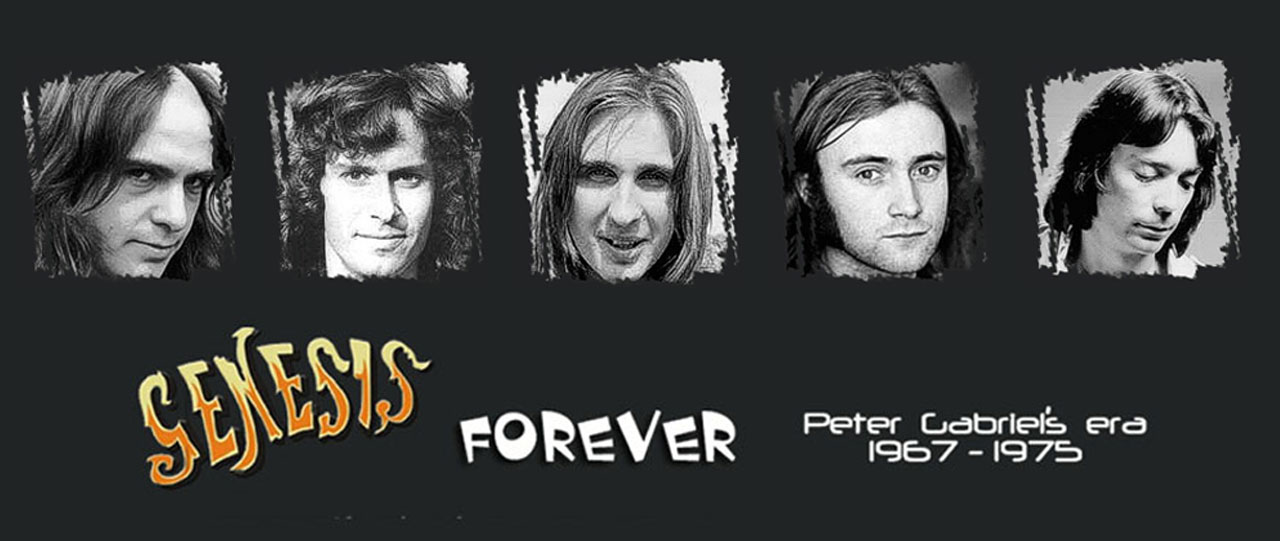
 For this first classic Genesis line-up, the years 1974-5 were the years of both their greatest triumph and their most dramatic loss.
Gabriel's pre-eminence in the press - not something he himself had wanted, but an inevitable consequence of his outlandish performances - was beginning to be too much for a group which had always considered itself a democracy.
Two further things happened which widened the gap between him and the rest of the group: he was offered an opportunity to work with "Exorcist" director William Friedkin as scriptwriter, and needed to spend time with his wife Jill following the problematic birth of their first child. However, in November he re-joined the group in the studio where they'd been writing the music for what was to become the line-up's masterpiece and Gabriel's swansong: "The Lamb Lies down On Broadway".
It was the ultimate concept album: a double LP-long surrealist tale of a Puerto Rican youth - Rael - dragged into a netherworld beneath Manhattan to experience a series of bizarre adventures and some kind of inscrutable mystical epiphany. The group went on to perform the entire album to over 100 audiences worldwide (including the LA Shrine gig preserved on the Archive), many of whom, thanks to record company release cycles, had never even heard the album, and were perhaps expecting to hear their favourites. Despite this, it is a tour which has legitimately gone down in rock music history.
Batwings Over Watford
"Peter looked beyond Genesis for future projects. He'd been asked to write a script by film director William Friedkin. As Peter seemed more excited by the film project than Genesis, the 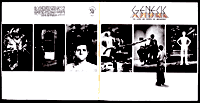 band went into the studios to start work without him."
"While Gabriel was waiting for Friedkin to confirm whether his film would go ahead... he took some time to be with his wife and baby, further aggravating the relationship with the band, who started to prepare some instrumental work for the next album, 'The Lamb Lies Down On Broadway.'"
"Peter then returned to the studios, when the film project was abandoned. 'The Lamb' was released in November 1974, as a double album, and was performed 'live' at over a hundred shows world-wide. Gabriel played the lead role of Rael, a New York Puerto Rican punk who undergoes a kind of transcendental experience. The 'Lamb' involves lots of bizarre characters, strange lyrics and an impenetrable story line. The show's special effects included three projection screens and the use of two Peter Gabriels - a dummy and the real one - which were impossible to tell apart!"
Chris Welch

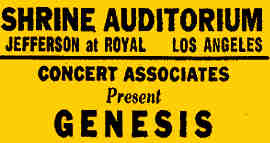 The core of "The Genesis Archive" is its first two CDs, a complete performance of "The Lamb Lies Down On Broadway" recorded at The Shrine Auditorium in Los Angeles on January 24th, 1975. The "Lamb" show was a visual extravaganza, almost presented as a rock opera. Gabriel himself performed the role of Rael, adorned in face make-up and leather bomber jacket, racing around the stage during the album's long, complex instrumental passages, and transforming himself into many of the album's wierder characters, perhaps most notably the elephantiasis-suffering Slipperman. Around the stage three large screens showed psychedelic slides which at once illustrated the story - as far as anything could illustrate the story - and added another layer of strangeness, and giant props - huge plastic cones, a man-sized womb and so on - adorned the stage.
It was the most visually baroque the group's performances ever got (Collins was insistant that they scale things down when he took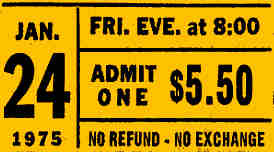 over the lead singer's role) and put them alongside two groups often quoted in the same breath as Genesis: Pink Floyd and Yes. And yet, as these two CDs illustrate, at the heart of "The Lamb" was a bravura piece of music, music which twisted and turned from hair-raising anthems to weird experimentation, haunting balladry to virtuosic instumental grandstanding. That they could perform it so effortlessly live was a tribute to their individual musicianship and their collective, almost telepathic understanding: a tribute to the five years they'd spent together developing this extraordinary music.
 Rather reserved in person, from the earliest days Peter Gabriel always transformed into a fearless performer in front of an audience, a performer who once famously broke his ankle leaping into an audience! During these years, however, Gabriel began to push his showmanship to its limits, deploying a now-notorious variety of masks and costumes: the red dress and fox's head featured on the cover of "Foxtrot"; the flower headdress and unplaceable red triangular mask worn during "Supper's Ready"; the blue batwings of "The
Watcher of The Skies".
Perhaps these ploys were born of necessity: Genesis songs featured increasingly long instrumental passages, during which Gabriel had to do something! Whatever, his performance became the focal point of the band's shows. And his costumes were only part of an ever-more elaborately created live set which featured gauze screens, spectacular lighting and explosions. It was also a show which reputedly put them and Charisma in the hole for upwards of £60,000 by 1973! Still, it paid off.
"Before the band returned to America, they played a stunning concert at London's Rainbow Theatre, on February 9, 1973. A new stage set utilised white gauze draped over the speakers and amplifiers. Gabriel wore a whole range of extraordinary costumes, including the flower mask for 'Supper's Ready,' a curious red box strapped on his head, as well as the famed batwings and capes. The band was given a standing ovation as a mystical atmosphere permeated the theatre that communicated to the band and its audience."
Chris Welch
a fearless performer in front of an audience
"By now their stage act had developed into the realms of theatrical rock, as Peter made extensive use of costumes, masks and make-up. With clever use of lighting, explosions and effects their show became one of the most exciting on the road. As Peter became a star, widely pictured wearing batwings and a fox's head, many began to assume that he WAS Genesis, and perhaps even the sole creator of its ideas and music. But it was obviously a team effort. Despite smouldering frustrations, the band had come a long way since the days of sending a demo to Jonathan King..."

 Peter Gabriel's Press Statement
"The vehicle we had built as a co-op, to serve our song writing, became our master and had cooped us up inside the success we had wanted. It affected the attitudes and the spirit of the whole band. The music had not dried up and I still respect the other musicians, but our roles had set in hard. To get an idea through, meant shifting a lot more concrete than before. For any band, tranferring the heart from idealistic enthusiasm to professionalism is a difficult operation. I believe the use of sound and visual images can be developed to do
much more than we had done, but on a large scale it needs one clear and coherent direction.
Although I have seen and learnt a great deal in the last seven years, I found I began looking through 'rock star' eyes. I had begun to think in business terms -very useful for an often bitten, once shy musician, but treating records and audiences as money was taking me away from them. When performing, there were less shivers up and down the spine."
"I believe the world has soon to go through a difficult period of changes. I'm excited by some of the areas coming through to the surface which seem to have been hidden away in people's minds. I want to explore and be prepared, to be open and flexible enough to respond, not tied in to the old hierarchy.
My future within music, if it exists, will be in as many situations as possible. It's good to see a growing number of artists breaking down the pigeon holes. This is the difference between the profitable, compartmentalised battery chickens and the free-range.
There is no animosity between myself and the band or management. The decision had been made some time ago and we have talked about our new direction. The reason why my leaving was not announced earlier was because I had been asked to delay until they had
found a replacement to plug up the hole. It is not out of the question that we might collaborate in the future."
Peter Gabriel
 Despite the artistic and commercial succes of "The Lamb", it was just a few weeks into the tour when Gabriel confided in their manager Tony Smith that he was going to leave. The reasons were many, but chief among them were the widening gap between him and the rest of the group, and his own restless desire to do his own solo work. He stayed with the group until their last performance at Besançon in France, in the May of 1975 (the last date was actually meant to be in Toulouse, but it was cancelled - a sign that for all this tour's "classic" status, not all audiences at the time necessarily got it). At the time he left, Gabriel didn't even know whether he wanted to continue making music. He did of course, and his solo career since has been one of the most celebrated in pop. Meanwhile, the music press and - more importantly - the group's fans, turned their eyes towards the group: what on Earth would they do without their unique frontman, their voice. They had a lot to prove. And prove it they did, but for now, that's another story...
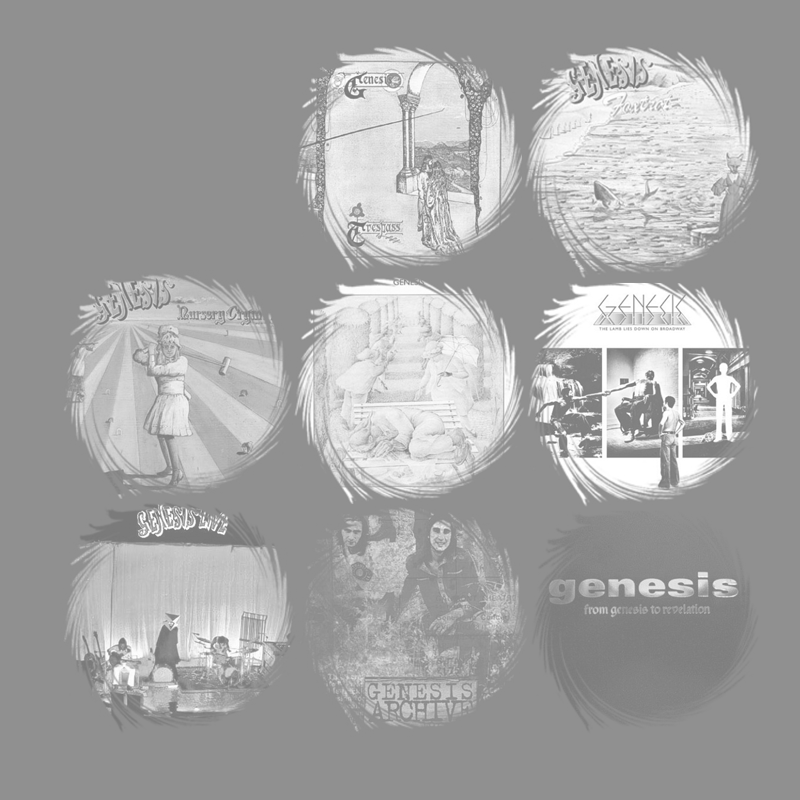
 The albums gave birth to songs which would remain in the band's repertoire for years, indeed, in some cases, until this day: their early anthem "The Knife", the haunting "Fountain of Salmacis" and "Watcher of the Skies" and "I Know What I Like" (a number 17 single in the UK - a huge breakthrough). Above all, it was these albums which saw them develop their taste for huge epics - epics huge in length, scope and ambition, chief among them "Foxtrot's" "Supper's Ready" and "Selling's" "Firth of Fifth". These songs, as much as any by their contemporaries, defined "progressive rock".
The years 1970-1973 are known for the settling-down of the band's line-up, for endless touring and for the development of an extraordinary stage show. But ultuimately, their legacy is a series of albums of gradually increasing self-confidence, extravagance and experimentation. That Tony Stratton-Smith stood by them through these years is a testament to his belief in a developing body of work heard in the albums "Trespass" (1970), "Nursery Cryme" (1971 - Collins' and Hackett's recording debut with the group), "Foxtrot" (1972), "Genesis Live" (1973) and "Selling England By The Pound" (1973).