

 It shows no or at best only the most minuscule traces of the style that would make them well-known later, and therefore frequently meets with a refusal and lack of affection. Justly so?




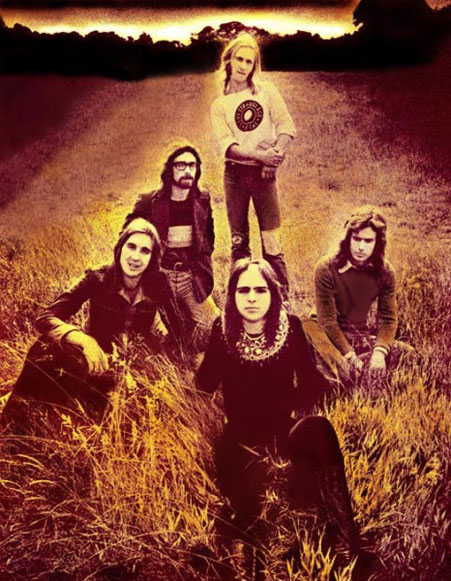





 The classic lineup of Genesis was at their absolute peak musically and melodically on the 1973 album Selling England by the Pound. The band had a steady progression in the early 1970s albums, leading to this climax which fused their heavy prog-rock and overtly theatrical background with an English folk theme topped by incredible rock virtuosity. The album has a storybook quality and is nearly drifts into “concept album” territory. Instead it is more a collection of short stories, fables, and fairy tales that don’t really have much in common save the English themes. And, of course, the fantastic musicianship that made this album one of the greatest albums of the progressive rock genre.
While all members of the quintet are at their absolute peak on this album, no one shines brighter than guitarist Steve Hackett. This is his absolute moment in the sun and makes one wonder why there was relatively so little from him in subsequent years (even though he stayed with Genesis through three more albums). On this album Hackett perfected the use of the tapping technique and sweep picking, techniques which would not become widely popular until a decade later. This is also the album were drummer Phil Collins (who would later be more associated as the band’s front man) best displays his drumming skills. Even lead singer Peter Gabriel gets into the musical act, providing flute on several tracks to add to the overall English folk vibe.
A nice balance is struck throughout the album and on a matrix of levels. The four epic pieces alternate with the four lighter pieces throughout the album and with these an alternation between deeper and heavier eccentricity with contemporary pop and fragile love song themes. There is also a nice consolidation between the rock and folk sections, the overt literary allusions and hook-driven themes often all within the same track. This combination makes this album infinitely listenable and not the least bit dated four decades after its release.
Selling England By the Pound by Genesis
Released: October 12, 1973 (Atlantic)
Produced by: John Burns and Genesis
Recorded: Island Studios, London, August 1973
A long intro with only guitar textures and vocal melody mask the ultimate dynamics of “Dancing with the Moonlit Knight”, the de facto title song of Selling England by the Pound. This eight minute album opening song blends lyricism and acoustic texture during the opening verses with the exquisite musicianship during this middle jam. During this section each musician’s skills are showcased nicely before the song fades into an add yet intriguing mellow outro which eats up nearly two minutes with psychedelic rudiments. “I Know What I Like (In Your Wardrobe)” was the band’s first charting single through five LPs, climbing all the way to #21 on the UK charts. It has a mechanical sound-effect during the intro with spoken word intro before it breaks into a pleasant pop (almost “glam”) song with the chorus melody being mirrored by a heavy synth riff and a very active bass line by Mike Rutherford. The lyrics were derived from the painting by Betty Swanwick called The Dream, which originally did not include the lawn mower which the band asked Swanwick to add to the painting to match the song’s protagonist. A simple, “lawnmower man” who is constantly getting advice from people concerned with his future, but is content with what he is (“I know what I like and I like what I know”). Although the song was the most accessible in their collection to date, it still contains some Genesis edge including a return to the mechanical effect during the coda beneath a flute lead to end the song.
I don’t make such assertions lightly, but “Firth of Fifth” is one of the greatest rock masterpieces ever, despite its relative mainstream and radio obscurity. This song has everything great about a progressive rock song, starting with an unbelievable classical piano intro by Tony Banks which lasts over a minute alternating between among time signatures before giving way to a pure rock verse and chorus performed by the entire ensemble. The song then travels through a sonic journey of several sections, some with vocals, some instrumental, but all purely excellent. There is a part with a light flute solo by Gabriel over Banks’ methodical piano riffs, which leads to part where the piano builds and builds until breaking into a frantic synth led over the full band rendition of the opening piano piece, where Collins especially shines on drum. Then comes perhaps the greatest guitar lead ever by Hackett, who sustains notes into the stratosphere above a basic driving, bluesy backing rhythm. But this guitar is anything but basic, striking notes in the most methodical and melodic way where each one counts. Even the sparse lyrics are superior, especially during the final verse;
Now that the river dissolves in sea, so death too has claimed another soul / and so with Gods and Men the sheep remain inside their pen until the shepherd leads his flock away / the sands of time were eroded by the river of constant change…”
The title of “Firth of Fifth” is a pun on the estuary of the River Forth in Scotland, commonly known as the Firth of Forth. Although, like all tracks on the album, “Firth of Fifth” is credited to all five band members, Banks was actually the author of most of this song with Rutherford helping out with some of the lyrics.
Genesis in 1973
Selling England by the Pound is also notable for a milestone in the band’s career, containing the first song with lead vocals by Phil Collins, who would take over those duties permanently following Gabriel’s departure in 1975. “More Fool Me” is a bit melodramatic yet pleasant love song and pretty much only involves Hackett and Rutherford on acoustic guitars and Collins on lead vocal. Collins sings soprano most of the way, which really stands out due to the song’s sparse arrangement.
Side two is a much more theatrical side, especially with the side’s opener “The Battle of Epping Forest”. This begins with colonial-type battle march, led by flute and a marching drum rhythm. It then bursts into a full prog-rock arrangement through the first verse before morphing its way through many multi-character, story-telling sections in a manner similar to “Get Em Out by Friday” from their previous album Foxtrot. A wild, choppy guitar provides rhythm for the second verse leading to a complete break in the middle “Reverend” section, with a waltz-like tempo and more deliberate melody. The song was inspired by territorial gang battles in East London but uses heavy allegory of middle age clashes in the forest while subtly eschewing an anti-war message;
There’s no one left alive, it must be a draw…”
“After the Ordeal” is presented as an instrumental epilogue to “The Battle of Epping Forest” but acts more like an intermission bridge between two epic songs. Written mainly by Hackett, the piece has two distinct parts with the first half an up-tempo classical guitar piece with a piano backing and the second half a slower rock piece beneath Hackett’s electric lead. This lead is again masterful and the only real problem is that it is edited way too short.
The eleven-plus minute epic “The Cinema Show” sustained as the fan favorite from this album. It begins as a purely romantic, modern day “Romeo and Juliet” tale, led by dual acoustic folk guitars and melodic lead vocals by Gabriel. The lyrics from Banks and Rutherford were inspired from a T.S. Eliot poem along with Greek mythology and have highly sexualized overtones. Like the other epics on this album, the song builds into many sections once the entire band gets involved, including a complex vocal motif and yet another lead to great lead guitar by Hackett which segues into a five minute long jam with various synth leads by Banks, some backing operatic vocal choirs, and incredible drumming by Collins, playing a shuffle in 7/8 time. The synth sounds act as a sneak preview of the band’s next album, the double LP The Lamb Lies Down on Broadway. The song dissolves back to 4/4 time and segues into the closing song “Aisle of Plenty”, a reprise of “Dancing with the Moonlit Knight”, giving the album a bookend effect.
Selling England by the Pound was classic Genesis hitting on all cylinders, and the band put together a completely original and musically superior album like no other. Although it would pale in comparison to the commercial success of the band’s pop-oriented 1980s album, it nearly topped the charts in the UK, which was a big deal at the time. But where there album shines is artistically, and on this front it belongs on the list of best ever.
JON BRYAN
 Genesis may have not been the first, best or even the most original, but to many fans they are the archetypal progressive rock act. From distinctly unpromising beginnings, they had nevertheless evolved from cult favourites in Europe, to the point where in late 1973, they were on the cusp of sizeable commercial success. Much of the press coverage was no doubt down to the fact that frontman Peter Gabriel wore ridiculous stage costumes and entertained the audience with fantastical monologues between songs, but with the success of previous album, Foxtrot, they had found a larger audience, and people had started to talk of Genesis as a band, rather than a backing group for a bizarre frontman. Bankes, Rutherford, Hackett and Collins weren’t just supporting players damn it.
Hearing it now, it’s easy to mark Selling England By The Pound as one of the best of the Gabriel-led Genesis albums. The five piece were playing much tighter than they had previously, Gabriel was exploring his vocal range, as well as providing the band with some ridiculously obscure lyrics, and each band member was allowed to play to his strengths. It even boasted the band’s first hit single in the gloriously mad “I Know What I Like (In Your Wardrobe)”.
As pastoral prog goes, Selling England By The Pound isn’t bad at all, being one of the finest examples of the sub-genre. The downside is that as an album, it suffers from many of the failures that blight much of the prog-rock genre. Despite its sometimes (perhaps international?) laugh-out-loud lyrics, on the whole Selling England By The Pound seems to take itself far too seriously. It’s somewhat bloated in places in that some perfectly good tracks can be stretched to ridiculous extremes, and sometimes the pace of a song is changed just for the sake of changing pace, without it furthering the musical journey one iota. There’s also little warmth here, as Gabriel’s lyrics are often so ambiguous that it’s difficult to relate to many of them. The one exception is the Phil Collins’ fronted number “More Fool Me”, which is strangely unpopular among many fans of early Genesis. I for one think it’s one of the highlights of the album, showing what Genesis could do with a basic love song lyric, and comparatively little in the way of musical frills. It also gave us a sneak-peak of post-Gabriel Genesis.
As far as the actual music goes, there is some fine playing on Selling England By The Pound, particularly on “Dancing With The Moonlit Knight”, where the band go against their usual instincts and actually rock out, and the keyboard intro to “Firth of Fifth”. Sometimes the usual Genesis creative excesses do take over, but it wouldn’t be progressive rock without the excess would it?
by Jan Hecker-Stampehl
 Steady work, frequent album releases and almost permanent live performances paved Genesis’ way into the hearts of European and British fans. The band were slowly making the step from an insider band to a cult band with growing numbers of fans. This also meant that expectations grew as well as the pressure the band was under. The next album had to be nothing less than another masterpiece like Foxtrot. It became Selling England By The Pound, a records fans rank among the big classics to this day. During this period tensions in the band began to grow…
Relentless touring to make the band better-known brought them new fans but also had its disadvantages. When the band started writing the successor for Foxtrot they did not have many song ideas. Tony Stratton-Smith decided to close the gap between studio albums with the Live album – a solution the band felt was less than ideal. Between October 1972 and September 1973 Genesis released three albums: Foxtrot, Genesis Live (their first foray into the UK Top Ten) and Selling England By The Pound. Creatively they seemed to have backed into a corner, though. Steve Hackett tried to work his way out of there by disregarding full song structures and experimenting with riffs. One of those riffs he would play endlessly on soundchecks became the basis of I Know What I Like. Steve Hackett was very involved in the writing process, in part also because it allowed him to flee from his marriage problems. Steve’s input for Selling England became larger than for any album before or after, and he often called it his favourite Genesis album.
Phil Collins, on the other hand, found the band’s situation and the hard-going work on the new album frustrating. Mike Rutherford and Tony Stratton-Smith would later admit that they rather feared Phil would leave the band. Instead he found a musical outlet in the short-lived band Zox And The Radar Boys which involved, amongst others, former Yes guitarist Peter Banks. Genesis seemed to lose their spontaneity, their ability to achieve those magic moments when they jammed together. As tensions within the band grew two factions developed, and Steve and Phil frequently found themselves backed into a corner by the other three band members.
The album was finally written in a mere six weeks, with several roads leading to Rome: They had songs that were finished when introduced (e.g. Firth Of Fifth by Tony Banks), they put together songs that were brought by several band members (Dancing With The Moonlit Knight was based on piano pieces by Peter Gabriel and a guitar melody by Steve Hackett). Some songs also developed in jam sessions (Mike, Tony and Phil wrote the instrumental section of The Cinema Show that way). Genesis tried hard not to repeat themselves too much. The plan of merging Dancing With The Moonlit Knight and The Cinema Show into one long song was soon scrapped because the band wanted to avoid comparisons with Supper’s Ready.
coverThe band’s continued cooperation with producer John Burns paid off and resulted in the Genesis record with their best sound so far. The formation had not changed for two years, and these two years of stage experience had finely attuned each musician to the other. It certainly showed on the record. Some even thought it sounded too polished, and the studio sessions for Selling England By The Pound were deemed a little sterile compared to its successors and predecessors; that, of course, would be different in the live performances. The record plays an important role in the history of Genesis. They borrowed the title from the Labour Party’s programme of the time, which pointed at the main theme of the album, i.e. the decline of traditional British culture and the crisis of the British middle class. I Know What I Like became their first pop single and chart success (#21 in the UK charts). The band declined a possible live performance in the British chart show Top Of The Pops. Charisma were shocked, and today the members of the band smilingly remember the youthful arrogance with which they made that decision. Genesis remained an album band, and Selling… is a collection of songs that either became huge classics or are almost forgotten today.
Dancing With The Moonlit Knight
Folky a-capella vocals by Peter Gabriel and soft, broken chords played on 12-string guitar, organ and piano form the remarkable beginning of the album. What begins as a tender acoustic song in the pastoral vein rapidly turns into a dramatic tour de force. This song is like a complete Genesis concert condensed – full of changes in dynamics, speed, rhythm, varied keyboard textures, driving drums and lyrics that are not always easy to understand. It mixes a number of different styles – near the end Genesis even venture into the jazz rock area. The end picks up the markedly pastoral lines from Trespass, but the tender ethereal outro seems like an afterthought tacked on to the rest of the song.
I Know What I Like
Swirling sounds introduce the most unlikely follow-up to these pastoral sounds. Phil Collins’ drumming oscillates between catchy rhythms and fill that could be in jazz rock or even world music pieces. The lyrics satirize the bourgeois British middle class life that comes to life in the narrator’s character of the “lawn mower”. Britishness is celebrated and ironized in a bizarre way. The chorus has sing-along quality but never descends into shallow pop. I Know What I Like impresses by its simplicity – and the chorus offers one of the best Rutherford bass lines ever.
Firth Of Fifth
Tony Banks never sound so classical before. His piano intro brings a new element into Genesis’ music and makes good use of his training on classical piano. The band comes in rather abruptly, but that makes it just all the more impressive. The big guitar and organ sounds and the powerful drumming make the verses sound massive – cinemascope gone music… The flute takes the lead in an instrumental part in Genesis’ pastoral vein which segues into a very prog synth reprise of the piano intro. Phil brings his predilection for jazz rock to bear in his drumming in this part. The drums turn into a marvellous percussive extension or support of the synthesizer melody that moves into Steve Hackett’s most memorable moment in Genesis: The legendary, unending guitar solo that picks up the flute melody and brings it to a whole new level. The music calms down before the melody returns to the verse so that we can listen to Peter’s aphorism, “The sands of time were eroded by the river of constant change”. A song with a perfect structure, the most symphonic piece in the Genesis catalogue, it remained in the live set until 2007, albeit in increasingly mutilated versions. Hackett himself would play it many times in its entirety.
More Fool Me
Another transition full of contrast. From the bombast of Fifth Of Fifth to Phil Collins’ second lead vocal performance in Genesis. More Fool Me is not quite as intimate as For Absent Friends on Nursery Cryme. The subject matter is quite unusual for a Genesis song from that period, because it is a lovesong. Not an infectious piece, but a celebrated solo spot on the tour – and a glimpse at the things Phil and Mike, the writers of this piece, would write later.
The Battle Of Epping Forest
This is probably one of the weakest Genesis songs from the era. The Battle Of Epping Forest attempts to have a go at a more realistic and modern topic, namely gang wars. Tony Banks remembers that they would keep tacking on new parts every day, and it sure sounds like that. Peter Gabriel admits that he lost himself in the story when he wrote the lyrics. In fact, it took Peter so long to write the lyrics that the others completed the backing tracks without melody and lyrics. This would, of course, happen again during the recordings of their next album. There are a number of fine moments such as the brief synthesizer solo or the honky-tonk piano, but the song as a whole is simply stuffed with too many ideas. The music and the lyrics do not really connect. Many passages are pleasant, but they do not leave an overall impression of a complete song.
After The Ordeal
Whether this piece should be included or not was one of the most controversial decisions the band had to make. Neither Tony nor Peter wanted this instrumental of Steve’s on the record. It still made the cut after a bizarre search for a compromise: Peter wanted to cut away the instrumental part of The Cinema Show, too, and to save that Tony voted for Steve’s composition. A wrong decision, it has to be said. The first half of this piece remains pale and pseudo-classic, and it does not become any more relevant when the band comes in for the second half. Not a special highlight of the Genesis discography.
The Cinema Show
A longer song follows those three weaker numbers. The Cinema Show begins in a familiar pastoral acoustic mood. Mike and Steve bring the wonderful pickings on the twelve-string guitar back again just like the early days of Genesis. The vocal melody is catchy without being shallow. A love story, classical epics and mythology meet in the lyrics. The piece moves away from the song and into an instrumental that moves from one glorious climax to another. Tony Banks plays a full-fledged synthesizer solo for the first time, but it is so well woven into Mike and Phil’s rhythm part that it does not become Emersonian bragging but remains an instrumental performed by the whole band (three of them, anyway).
Aisle Of Plenty
The end of The Cinema Show segues smoothly into Aisle Of Plenty, which is not really a song but a collage that reprises melodies from Dancing With The Moonlit Knight. One pun follows the other, but this bit is more of an appendage than a song in its own right.
Selling… was a moderate success for Genesis, but it is less balanced than, for example, Foxtrot. The songs one remembers best from this album are those that became medium classics (Dancing With The Moonlit Knight) or huge classics (I Know What I Like, Firth Of Fifth, The Cinema Show) in the band’s history. As an album, it was not a perfect selection: All longtracks have approximately the same length, while the other songs, with the exception of I Know What I Like, are fillers. Unlike Steve Phil and Tony do not consider the album particularly memorable – they like individual songs, but Tony in particular called the album “ridiculously long”. A playtime of 53:42 minutes is not impressive anymore in the CD age, but at the time it was very long. It became clear in the end that Selling England marked the end of a development that began with Nursery Cryme and Foxtrot. It was thererefore no surprise that Genesis wanted to go into a different direction after this record and the promotion tour. But before that happened Genesis reached #3 in the UK album charts. Genesis had reached a new degree of fame and popularity.
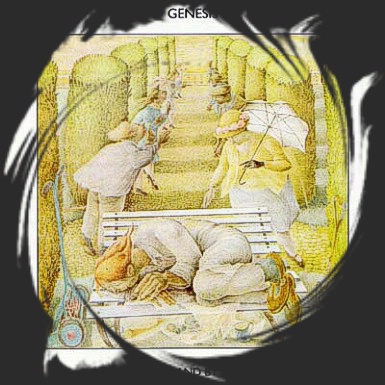 Selling England by the Pound, released on October 12, 1973, represented a culmination of sorts for Genesis — deftly combining the flights of fancy that lifted 1971’s Nursery Cryme with the more determined edge of 1972’s Foxtrot.
Though quickly overshadowed by the follow up Lamb Lies Down on Broadway, an epic tale which marked Peter Gabriel’s farewell, Selling England has enjoyed a critical reevaluation over the years — and remains Genesis’ first-ever album to achieve gold status in the U.S., sparking a unbroken run of chart success that continued until the band’s studio days were over some 25 years later.
Unlike its more narrative successor, Selling England by the Pound was free to roam creatively, even as it found Genesis’ five-man lineup — also featuring Tony Banks, Phil Collins, Steve Hackett and Mike Rutherford — at the peak of their collaborative powers.
There’s nothing with the crunchy immediacy of “Watcher of the Skies” to be found here, but hook-filled fare like “I Know What I Like” certainly echo the immediacy that made Foxtrot such a visceral experience. The difference is in what surrounds those moments. Genesis moves with lithe grace between folk and jazz rock, offering four epic journeys to go with a quartet of shorter pieces — a symmetry perhaps best displayed via “Dancing with the Moonlit Knight,” this crescendoing, Mellotron-driven short story that moved from accapella reverie to brawny rock bravura.
“That tune started off with the influence of a Scottish song,” Hackett tells us in an exclusive Something Else! Sitdown, “then it moved into something that I think of in a more elegiac way — something nostalgic and wistful, and common to a lot of Genesis tunes. Then it bursts forth, it fights off its shackles, really takes off like a rocket, into another section, which seems to borrow from something that sounds more Russian in a way. It’s European, but then at times, it turns into the jazz that I liked originally — but big band, with the accents.”
In this way, even as Selling moved into bold new complexities, it retained everything that had made Genesis so intriguing once Hackett arrived — including the violent strangeness that marked Gabriel’s best work in this era, as on “The Battle of Epping Forest.” The album included some of Banks’ most involving contributions, in particular on “Firth,” even as Rutherford and Gabriel added exotic flourishes from the electric sitar and oboe, respectively.
Selling, in fact, is a feast of musical invention. Hackett, for instance, employed the dramatic use of both an early sweep-picking sound and the tapping technique would would later have such a huge influence on Eddie Van Halen’s playing — notably on “Dancing with the Moonlit Knight.” Just as interestingly, Collins begins to come into his own, both as an instrumentalist (with complex and engaging performances like the one from “Cinema Show”) and also as a singer of striking emotional power on “More Fool Me.”
The album’s highpoint remains Banks’ rhythmically complex ‘Firth of Fifth,” which found Hackett echoing Gabriel’s flute melody and then building upon it — creating a stirring, violin-esque narrative.
“I was playing it on electric guitar,” Hackett says of those initial sessions, “then it struck me that it had certain similarities with other melodies that I had been playing that I liked. It ended up with aspects of Eric Satie, and aspects of King Crimson. The song had an aspect of blues, an aspect of gospel about it. It had something of English church music — but it also had an aspect of something Oriental or Indian, almost. So, it was a fusion of influences. But at the time, we weren’t using the word fusion — and we weren’t using the word progressive. It would eventually be described as progressive, which was a catch-all phase covering an awful lot of bases.”
For Hackett, who likes to craft brief bursts of imagination within a larger song structure, “Firth” remains one of his longest-ever recorded solos: “I think it can support that, though, because it’s thematic,” he tells us. “Basically, it’s the same melody played three times with minimal variation. It’s done like jazz, with the statement of the theme then you go off and improvise, and then return to the theme. On ‘Firth of Fifth,’ when it comes back, it’s a larger arrangement. It’s the tune as written, then ‘let’s take this to the mountains,’ to a certain extent.”
In a larger sense, that journey is what gives Selling England by the Pound its lasting gravitas. In creating a delicate balance between genres both known and as yet unnamed, between light and dark, between every element of their own burgeoning personas, this soon-to-vanish quintet created the most complete album ever issued by Genesis.
Bill Golembeski
 Sadly, this album is yet another example of some ex-girlfriend asking, “Exactly how many copies of that record do you really need?”
That said, well, as everyone knows, it was Helen of Troy, whose face launched a thousand ships. And it was this album that launched a thousand (and perhaps many more) nerdy guys toward the nearest dictionary in our own noble quest to find the meaning of the word, undinal.
You know, I loved other less proggy bands in the 70’s like Mott the Hoople, Big Star, Free, Stray, and (my beloved) Budgie, but not once did those bands ever use the word undinal, or any other adjective that referenced (according to Mr. Webster) “a female water spirit who could earn a soul by marrying a mortal and bearing his child.” Even Peter Sinfield, Crimson’s word guy, never ventured so deeply into mythology.
Not only that, but the song “Cinema Show” has a wonderfully catchy chorus that name-checks none other than Tiresias, that blind Greek soothsayer who hung outside of Thebes, and had the dubious distinction of being transformed into a woman for seven years, only to be asked the equally dubious question as to which gender enjoyed life, and all of its many bounties, more? Well, he didn’t exactly ingratiate himself to the big guy Zeus. And, trust me, that’s not a smart thing to do.
Not only that (again), but that Father Tiresias reference caught my ear when some literature professor mentioned that he was the very same Greek geezer who does something or other in T.S. Eliot’s The Wasteland.
And that’s why I became a big reader. Of course, there were other bands, but that word, undinal, a Tony Banks and Mike Rutherford casual mention of Tiresias in the chorus of a progged up pop song, and, of course, the rest of this glorious fifty-two or so minutes of music, certainly opened a few doors of perception.
By the way, this was the very first Genesis record I bought. And as I waited for the city bus, I examined the record and was really amazed by its length of playing time, especially with the number of really long songs.
Many records of this era ended with a coup de grace of, say, Heep’s “July Morning,” Savoy Brown’s “Hellbound Train,” or the double-barrel shot gun blast of Wishbone Ash’s “Warrior/Throw Down the Sword.”
But this one had epics all over the place.
And that’s the way of the Genesis world before Phil, Mike, and even Tony, decided to become “Illegal Aliens” and not have any “Fun” (Oh my goodness!). But way back then, as a five-piece, they had epics all over the place.
So, epic number one, “Dancing Out with the Moonlit Knight”: This is a very arranged song that harkens back to the previous album Foxtrot (which included the greatest prog song ever, “Supper’s Ready”). Steve Hackett’s guitar figure is lovely, and it will resurface in the final moments of the record. (But that’s something only Tiresias could predict). And, Peter Gabriel’s lyrics are clever and ironic beyond anyone’s belief in cleverness and irony. Sure, we all chew through our Wimpy dreams. And the song has a twelve-stringed coda that is a Time Table back to the innocent Charterhouse School Anthony Phillips days. And, oh, Gabriel’s voice is a gift from the gods.
Epic number two is the monumental “Firth of Fifth,” with its generous proportions of all things prog. There’s the (almost classical) piano intro, the song proper, which is filled with self-importance and drama (Yes! This is mainly a Tony Banks composition!), lyrical images of “gods and men,” “Neptune,” “The Shepard,” and well, the whole shebang of progressive rock. But all of this is simply a prelude to the lengthy instrumental section that fuses Gabriel’s haunting flute, Tony Banks’s big orchestrated keyboard canvas of color; and, most importantly, Steve Hackett’s signature guitar solo that, quite simply, bleeds with sonic passion. This is the music of benevolent Sirens.
I think this is the most beautiful moment in the progressive rock movement. And that’s saying quite a bit.
Now, tucked betwixt these two songs is the quirky almost hit single, “I Know What I Like (In Your Wardrobe"). And this sort of tune is the necessary relief, the jester’s joke, the weird melodic sideshow, and, ultimately, Genesis the band being surreal, hopelessly silly, and, at the same time, impossibly creative.
It’s all like a bit from (the already mentioned) T.S. Eliot’s The Wasteland, whose title speaks of the severe pathos in our modern world; yet amid the bleak topographical lines of the poem, suddenly, some guy thinks about a popular song and we read (and sing) the lines: “O O O O that Shakespearian Rag/It’s so elegant/It’s so intelligent.”
Yeah, the almost-hit single was a wonderful paradigm shift, that follows in the footsteps of “Willow Farm.”
And that’s the absolute salvation of the song. Amid the dense structured drama of deep prog rock, there lies the silent sun of a pop tune, a timely music hall rag, albeit with a guy on stage trying to be a lawnmower or a flower, but that’s beside the point.
For Phil Collins fans, I suppose, it’s important to note that he sings the acoustic side-ending “More Fool Me.” But it’s also important to note, as stated in Robin Platts’s book Genesis Behind the Lines, that Daryl Stuermer (Steve Hackett’s replacement) said, “I find it hard to believe they (Gabriel and Genesis) were ever in the same band.”
So, for all Phil fans, as Joseph Conrad said, “Approach with caution.”
For all others, simply enjoy the complex “Battle of Epping Forest.” This is a multi-voiced character drama, an early Genesis trademark that started with “Harold the Barrel” and then morphed into the concert favorite “Get’em Out by Friday.” It’s an absolutely wonderful thirty-minute song that is urgently compressed into the confines of eleven minutes.
But, in all critical fairness, Tony Banks may be right when he said (again in Robin Platt’s book), “Everyone had a part and everyone’s part on its own was good enough to be the top line of the song and none of us would give an inch.”
Ah, but I love the acoustic break recounting the sad saga of “Louise and her Beautiful Chest.”
To avoid the song’s compression of an auditory case of the bends, what follows is neither “you” or “me,” but rather the very necessary sort of classical guitar bit (with Tony Banks’ keyboard help) by Steve Hackett called “After the Ordeal.” But this simply bridged the necessary breath of oxygen into “The Cinema Show,” which is perhaps the show stopper, and perhaps the acoustic-based keyboard enhanced tapestry that Genesis had always promised to produce.
It’s great because it is an extremely satisfying piece of intelligent rock music in a time when intelligent rock music, for some odd reason, seemed to matter.
Yes, this tune quotes that soothsayer Father Tiresias, but with this mainly Banks/Rutherford/Collins tour-de-force, when viewed through the shared eyeball of The Fates (yet another famous trio), the musical future of Genesis, even after the future loss of both Peter Gabriel and Steve Hackett, will echo the words to the before-mentioned Phil sung “More Fool Me,” that says, “I’m sure that it will work out alright.”
It all dissolves into Steve Hackett’s lovely opening guitar melody and a litany of grocery prices sung by the “Don’t Give Up” world-weary voice of Peter Gabriel, he of future international anthem “Biko” fame.
Selling England by the Pound, indeed.
It pleased the crowds for years to come, even with Phil singing the song.
Back in the not-so-old days, when I still bought hard copy glossy magazines, one progressive rock special edition rated Selling England as the #1 greatest prog album of all time. And then a different mag, not to be out done by the cash register’s claim on those of us who still bought actual printed musical news, announced Yes’s Close to the Edge to be the topper most of the prog popper most.
But my vote will always be cast for this Genesis record. I mean, imagine my shock and horror, when, thinking my vocabulary had grown a notch with the really cool word khatru, found, sadly that there was no such entry in my well-worn Webster, well, because there was no such word, Siberian or otherwise.
And, that said, I’ll just agree with Lewis Carroll who once wrote, “’Twas brillig, … And the mome raths were (certainly) outgrabe.”
And I somehow managed to use the word khatru once or twice while attempting to sound intelligent. (Can I say it? More Fool Me!)
So, after all these years, after all the purchased copies, after countless spins while reading equally countless books, and after, quite frankly, never once being able to successfully use the word undinul in useful conversation, let’s just say (again!) this is an album of British wit, sublime melodies, and, etched into all these grooves, a great dose of progressive rock oddball everything.