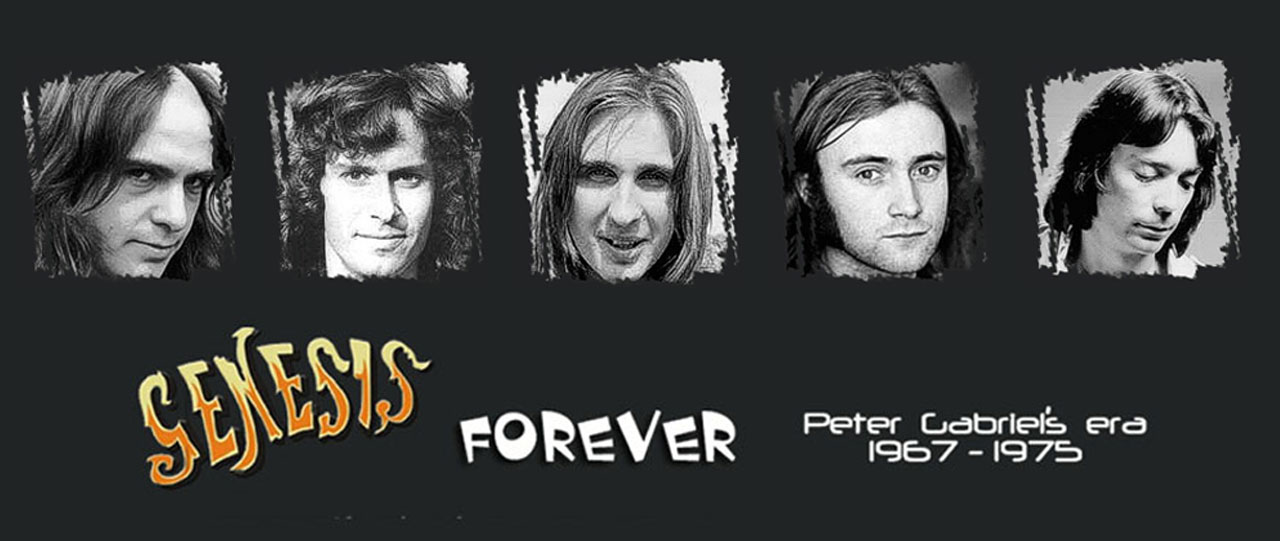


 It shows no or at best only the most minuscule traces of the style that would make them well-known later, and therefore frequently meets with a refusal and lack of affection. Justly so?







Some New York Times Reviews '72 -'74 New York Times, April 7, 1973
A black-clad singer has large batwings on his shoulders; the organ player rumbles along, a mixture of Notre Dame de Paris and Fillmore East; black lighting makes everything luminous violet; flash and flare come from the sides of the stage -- theater rock is alive again in New York, delivered by the British group Genesis at Philharmonic Hall on Monday.
Theater rock groups often pay too much attention to externals and not enough to the music. Happily, this is not so with the members of Genesis who are held together firmly by the lead singer Peter Gabriel -- articulate, precise, given to mime and accents, show -- bizarre and one of the most original artists to come along. The material, such as the tale of the little boy who had his head removed or Old Michael, who uses his bare feet tapping to get earthworms to the surface, is offbeat, to say the least.
Sandy Denny, who is also British and has the classic clarity associated with that country's best folk artists, opened the concert as a solo. Her closing number, "At the End of the Day" (by which time she had overcome some audience restlessness), was a thing of beauty and a joy that deserved an encore.
by Ian Dove
Concert Reviews in 'The New York Times', Dec. 15, 1972:
A Nursery Cryme review - from Rolling Stone, 26.10.1971.
From Rolling Stone, October 26, 1971. by Richard Cromelin. 'NURSERY CRYME' CHARISMA CAS 1052
The countryside cottage in which (it says here) Genesis regrouped their creative energies must have had a lot of strange stuff coming out of the walls to have been worthy of hosting this new contender for the coveted British weirdo-rock championship.
The cover of 'Nursery Cryme' is a De Chirico-like painting of a croquet field littered with Surrealist paraphernalia. At stage center stands a large-eyed Alice sort, her mallet raised to poke through the wicked one of the disembodied heads that lie scattered about. Paul Whitehead's painting was "inspired by 'The Musical Box,'" the album's opener: playing croquet, Cynthia gracefully lops off Henry's head; two weeks later a tiny Henry makes an appearance in his music box, and his body begins aging rapidly; "a lifetime of desires" surges through him, desires that Cynthia will be no party to; the nurse enters and hurls the music box at the bearded child, "destroying both."
OK? Well, with the exception of 'The Return of the Giant Hogweed', the rest of it isn't quite that bizarro. 'Harold the Barrel' and 'For Absent Friends' are observations of British life and characters that remind (in theme if not quality) of the Kinks; 'Seven Stones' and 'Harlequin' are vaguely poetic and impressionistic, and 'The Fountain of Salmacis' relates the myth of Hermaphroditus and Salmacis in a straightforward manner.
'Nursery Cryme's main problem lies not in Genesis' concepts, which are, if nothing else, outrageously imaginative and lovably eccentric, nor with their musical structures - long, involved, multi-movemented frameworks on which they hang their narratives - nor even with their playing, which does get pretty lethargic at points. It's the godawful production, a murky, distant stew that at best bubbles quietly when what is desperately needed are the explosions of drums and guitars, the screaming of the organ, the abrasive rasp of vocal chords.
It might really be there, and at times you can actually detect a genuine electricity in their music (which lies roughly within the territory staked out by Yes, Strawbs and Family, with a touch of Procol Harum). It could be simply a matter of taking off the lid.
Some numbers, including 'The Musical Box', survives even under this handicap. 'Harold the Barrel' moves well and features lots of enjoyable musical ideas and some fine lines. 'Salmacis' swims about in a nicely drawn atmosphere and is a good example of Genesis' refusal to indulge in gratuitous eclecticism at the expense of rock & roll. And 'Hogweed', while perhaps a bit stilted, is admirably ambitious and uses its excessive wordiness to humorous advantage.
It's definitely a type of music that skulks down back alleys far from the beaten path, but if Genesis (which consists of Tony Banks, Michael Rutherford, Peter Gabriel, Steve Hackett and Phil Collins) learn how to gear things up to explosion level and manage to develop their ideas a bit more thoroughly, they could be the ones to successfully repopulate those forgotten passageways.
From The Times, January 15, 1974. by Michael Wale.
A segment of rock music history is created this evening by the appearance of Genesis at the Theatre Royal, Drury Lane, for five nights. There have been a few Sunday night concerts at Drury Lane in the past, but never before has a rock group taken over the house for a week. It is fitting that Genesis should be the group to do so, because they are one of the most theatrical bands around.
Three of them, including their lead singer Peter Gabriel, were educated at Charterhouse. It was this background that made them first approach another old Carthusian linked with pop, Jonathan King, who some years ago had such a success with his own song 'Everyone's Gone to the Moon'.
The idea was that the emergent members of Genesis should write, and perhaps perform, hit singles. However, it soon became apparent to all concerned that this was not their line. Peter Gabriel recalls: "I think we did actually once have a song recorded in Italy by Rita Pavone's brother".
Gradually, and thankfully, they began to develop their own identity which no longer involved Mr King, nor a wish to make the Top Twenty. What happened was that they developed along highly individual [word not readable, what about 'style'?] not far away from the style of Pink Floyd. But although the Floyd have always used stage lightning and effects to great benefit, Peter Gabriel began to explore the use of mime and costume.
Recently Keith Reid, Procol Harums's thoughtful and seriousminded lyricist, told me that rock was embracing theatrical effects in a desparate attempt to take the minds of their audiences off the poverty of the music. I [told] this point of view to Gabriel when we met, to which he replied: "It may be true in some cases, but I don't think it applies to us, otherwise I wouldn't stick around. The theatrical aspect is something I've enjoyed from the start. It's a way of getting over to the audience what we're trying to write about." Genesis basically deal in fantasy, the reflection of a world where nothing is quite what it would seem.
This week's performance will be based largely upon their latest album, released towards the end of last year, 'Selling England by the Pound', which calls upon Gabriel to appear at one moment as Britannia and later as a gangster. This last charade, 'The Battle of Epping Forest', was actually based on a news clipping from this newspaper about a gang fighting it out some years ago amid the leafiness of a forest glade.
Events like this appeal to Gabriel's sense of humour. He grinned at a recollection of the group's first big American tour: "We've got a big underground mystique on this West Coast. There was this guy from Rolling Stone magazine presenting a theory that we were the last British underground band. We got a great welcome when we played, and what's more they liked us at the end."
In fact Genesis are the latest product of British provincial audiences who latched on to them in their formative days. They get little airplay on the radio, have never been seen on Top of the Pops and indeed have never appeared on any television show in Britain; nor do they release "singles". Their popularity depends purely on "live" performance and their four albums. But it is essentially their stage presence that is the main ingredient in their gradual success. Gabriel underlines this view when he says: "I think there will be quite a few groups demanding a more theatrical presentation, and that will go on until it reaches the point where skilled actors, mime artists, and film-makers will become on an almost equal level with the musicians, and do the thing professionally."
Genesis already use back projection, stage lightning, and Gabriel's disguises, but this does not detract from their music, written by all the members of the group, which often leans heavily on, for want of a better description, public school sefulchral. Anyone who thinks rock music is only reflected by the Top Twenty would do well recall in at Drury Lane this week.
'Genesis - Sit, Look and Listen.' by Richard Green from Music Scene.
Note - I think this is from a publication called "MUSIC SCENE" and will date from 1973 sometime between Foxtrot and Selling England By The Pound.
In these days, when so-called weanyboppers are gradually becoming more and more vociferous and bands are striving to create uproar among their audiences, it comes as something of a restful and pleasing change to find that Genesis require, demand even, concentration from the masses.
A mark of the audiences' willingness to conform to the band's wish may be found in the best-selling 'Foxtrot' album which was given a healthy shot in the arm by the recently-completed tour with Lindisfarne and Rab Noakes. Such is Genesis' current popularity that a headlining British tour is being set up for February, by which time it is hoped to have another album ready. That tour will follow visits to America and the Continent and preceed a lengthier U.S. trek, plus concerts in Australia and Japan.
Over a 'lunch' of Newcastle Brown Ale in a Soho pub near the offices of Charisma Records (Genesis' label), drummer/vocalist/percussionist Phil Collins talked to me about the band's workings, attitudes and plans. "We are to an extent a bit stylised, as some of the lyrics are pure fantasy," he admitted. "It didn't start off like that, though. Someone comes in with the idea for a song or an arrangement and we work on it. Tony Banks (organ) is very good on chord changes, Pete Gabriel (lead vocals, flute and front man) is on the melody side, and I'm on the rhythm side.
"I change my music at much as possible on stage apart from the breaks I do to bring everyone in. We're not like Humble Pie who will change if the audience are up and bopping, because our audiences don't get up and bop until we've finished, they come to listen to a particular piece of music."
Pete Gabriel has something of a reputation for his energetic stage act and because he partially shaves his head and wears garish make-up. "Pete's act is outrage," Phil agreed. "The make-up is a development. He's been doing it ever since I've been in the band. It's definitely schizophrenic, he's just the opposite off stage."
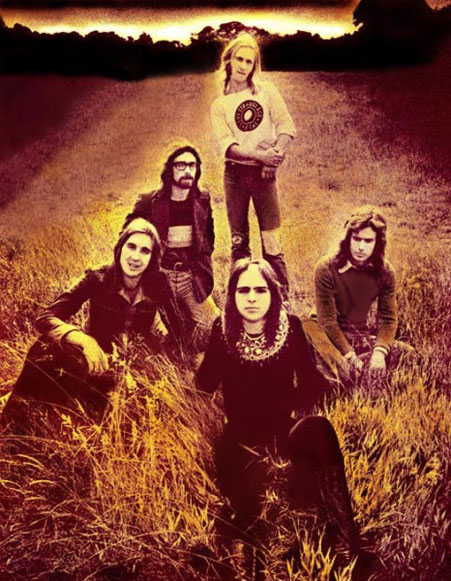
Phil, it should be pointed out, joined Genesis something like two-and-a-half years ago from Flaming Youth when the bassist and drummer left. Genesis had originally been formed at Charterhouse by Tony Banks, Peter Gabriel, Michael Rutherford and Anthony Phillips in 1966.
On the theme of the band's audiences, Phil continued: "We started with audiences of fourteen upwards, now we've got a good college following, but not at universities until recently, which is pretty odd . . . they tend to be very blas.
"On the Charisma tour the advantages outweighed the disadvantages; The advantages were playing to full audiences, and a nice atmosphere among the bands; the disadvantages were going on first with people still coming in, and we demand attention."
To follow 'Foxtrot', Genesis realise they have to do something totally different. "We were hurried on the last one so we want to take as much time as possible with the next," Phil said. "I love playing in front of people on the road, but the band as a whole would prefer to cut down, which is what is happening now."