

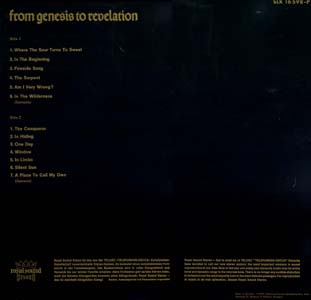
 It shows no or at best only the most minuscule traces of the style that would make them well-known later, and therefore frequently meets with a refusal and lack of affection. Justly so?







from NME, August 25, 1973
Three months is a long time for a band to be out of the limelight: But Genesis feel they can afford it. BARBARA CHARONE talks to three members of Britain's only cosmic flower show - headlining this Sunday's bill at Reading.
"OBVIOUSLY we're out of the public's attention - but we come back that much stronger; some bands seem afraid to take time off; they feel they have to capitalise on their popularity."
Confident words from Tony Banks - the Genesis keyboard wizard - taking time off from a rehearsal session this week to answer questions like just what have the band been up to since ... when was it?
"What we've been doing is running through many different musical ideas. That's what takes up most of our time. The rest of the time is spent putting everything together, making it flow.
"We try to file all these little musical ideas into a giant catalogue in our heads. And quite often we'll find room for old passages - after all, joining on any two sequences is possible.
"Someone might come up with a really beautiful bit," lead guitarist Steve Hackett added, "but the problem is where to put it. Getting an album together is like working on a giant jig-saw puzzle, fitting all the various pieces."
- Mitchell Paul talks to Peter Gabriel about the past, present and future of Genesis.
From Music Scene, October 1973
Take note of this - in the August 4 issue of New Musical Express the album, 'Genesis Live', entered the top 30 chart. The following week they reviewed it. When a group's record makes the chart before the reviewing scribes can get to work you know the group is beginning to move in a big way.
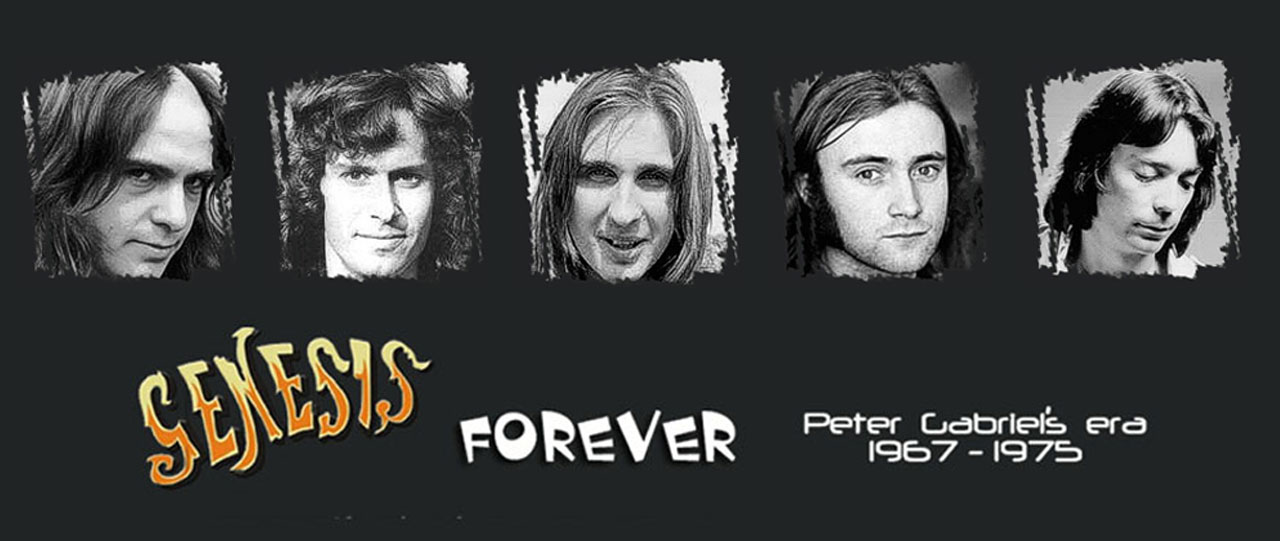
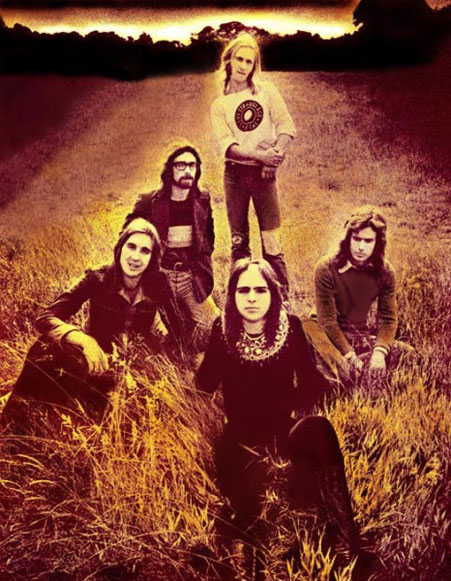
Genesis is Peter Gabriel, lead vocalist flute, oboe; Tony Banks, mellotron, organ, pianette, acoustic guitar; Michael Rutherford, acoustic and bass guitar; Steve Hackett, 12-string guitar and Phil Collins, drums.
They've been together since school. They're unique in the contemporary music scene. Many groups experiment with lights, smoke effects, film thrown on to large backcloths. Genesis do all this and like others use the mellotron, wander into vaguely classical fields, and wear colourful garb.
What sorts them out from others is the basic concept behind their material. Their musical compositions clothe the body which is a story.
These stories set to music may be short or long, they're always introduced by the Dickensian vocal tones of lead singer, Peter Gabriel, Dickensian in narrative, cool and crystal clear the tones, dramatic and slightly tinged with mystery, the kind of feel you would expect someone to give if they were telling a ghost story.
Go to their shows and you find an almost theatrical atmosphere. Buy their album 'Genesis Live', and you'll know what I mean, surprisingly, for many a live album fails, but this record succeeds to a large degree in capturing a Genesis show, from the first musical notes on 'Watcher of The Skies'.
Now this Autumn we have their studio made album. Their music like their theatre is good and in any case the music often comes before the words.
I talked to Peter Gabriel and he talked of their present and, more important, their exciting plans for the future.
"We actually started together as songwriters and then we got this thing about music. We realised the immense possibilities of relating the two, the ideas and images you can get across. "We had these stories set with a particular kind of mood. We try to give them musical atmosphere. "We have not yet made one complete story. We prefer to have a number of stories forming our act so as to get across a number of different feeling situations. "We never decide length but rather let our composing dictate at the time of writing and in consequent mulling over of what we are up to. "We have these times when we look at our recorded stuff and see how we can present such on the road. We try and keep things loose and not lose spontaneity. Actually the live album was something of a surprise to us! "It was originally recorded as an American radio show and since the tapes were there and our Autumn album was only in preparation the company suggested we put them on to the market.
"We realise live albums do present a problem, in that people may come expecting us to do exactly the material they are now so familiar with. The thing is we want to keep enlarging our repertoire and hopefully and to date we've managed it, to keep on creating fresh stuff.
"The future seems to hold some exciting ideas. We would like to be somewhere for two or three nights. We would not do the same show. our fans could then come on the three nights and hear and watch us, but have an entirely different presentation.
"Apart from anything else it would be good from the practical point of view. I mean we wouldn't have the usual road problems of getting stuff around and setting it up! "And then we have ideas of taking a place for say two to four weeks and see how many would come, I suppose! There we could really get lights co-ordinated, stage props and so on. "You know there could be a permanent structure, something to take our projected pictures in all kinds of ways, better quality and visual possibility than the one night stand, hastily erected backcloths.
"There might ... well, I won't go on, for the possibilities are enormous. Live gigs those in the open air are fraught with problems but providing you get something like this year's Reading with two stages then things can be achieved. "Anyway it's good to know we are making headway!"
He can say that again! The group which began playing folk type material on two 12 string guitars and then moving to add electric piano, delving into fantasy stories adding to their equipment, building good sound and developing musical theater have a good winter ahead of them and should hit the top in 1974 if not before.
Why Genesis wouldn't chop up 'The Lamb Lies Down on Broadway''
Article from Circus Magazine No. 106; March 1975; pp 66 - 70
For years Genesis had dreamed of cooking up their most powerful of surreal visuals and mesmerizing music. Yet they feared their ambitious new double album might prove too intense for in-concert consumption.
by Ron Ross
Peter Gabriel stared at himself in his dressing room mirror and methodically began to wipe off the layers of dusky make-up that only a few hours before had transformed him into a young Puerto Rican New Yorker named Rael. In the course of Genesis' startling two hour performance, Peter had further mutated from a leather-jacketed street punk to the hideously deformed Slipperman, finally becoming an eerie silhouette of Death Himself. But now, as he washed the last of the tan paint from his distinctively British features, Gabriel began to look once again very much like the private school student he was when Genesis was first formed - not at all like the all-powerful Watcher of the Skies whose bat-wings seemed smoky gray from hell-fire.
Dressed more like an unstylish fan than a rock star on the ascendant, Peter wrapped a plain wool muffler around his neck and stepped out the stage door into the chilly New Jersey night air. There a strange sight greeted him. Outside a corral of previously prepared police barricades were dozens of believers in the magic that is Genesis. At their first glimpse of Gabriel, the throng began to cry "Peter! Peter!" and strained toward their favorite fantasy-monger. As he hurried into the waiting limousine, the habitually reserved musical sorcerer began to smile broadly; the long black auto-coach pulled away from the crowd, and still the hands beat upon its roof and eager faces peered curiously in the windows for a look at what their hero was really like. Peter settled back, began to peel a refreshing orange, and sighed. Despite his well-hidden anxiety, Genesis' newest and most ambitious stage presentation had worked.
Blue denim deliquent: American rock audiences at first had been inclined to heckle Peter's subtly atmospheric monologues, chattering during the quieter mood-building instrumental passages. After three carefully planned tours, however, even the most skeptical concert-goers were entranced by Genesis' dramatic representation of "The Musical Box" and Peter's breath-taking flight through the air at the climax of "Supper's Ready." Now The Lamb Lies Down On Broadway (on Atco) had replaced those old favorites, and even Peter's image had changed drastically. He had cropped his long locks and combed them over his bald streak. His sleak black jumpsuit had given way to sneakers and blue-jeans. Though the band had given their all to provide a totally entertaining re-enactment of some of their most imaginative songs ever, the insistent question remained. Aside from the success of their first few concerts with The Lamb , could Genesis convince the world's largest rock audience to take an extended trip into an unfamiliar fantasy world?
Back in his Manhattan hotel room, Peter admitted to Circus Magazine that Genesis had had their doubts about presenting the entirety of their recent double album as the basis for the most important tour of their career. "We were quite worried about introducing the whole of The Lamb to audiences all at once. This new show is very experimental for us," Gabriel acknowledged, biting into a banana. "In the past we've tried to introduce new material in twenty-five minute segments, phasing it in with the better known songs gradually. It's also been difficult achieving a balance between the musical performance and the triple-screen slide presentation that helps the listener to visualize Rael's story more easily. The slides are much stronger than ever before, and to a certain extent, they're an additional risk. They shift attention away from my performance somewhat, although now that I've worked with them onstage, I think they do provide an interest-point when the going gets a little heavier lyrically."
Vividly fantastic visuals: The almost eighty-minute long Lamb show with its 3000 slides arranged by artist Geoffrey Shaw is an important step towards one of Gabriel's most cherished goals for Genesis. Last year he told an interviewer, "I like to keep visuals in mind at the same time as lyrics and music. In the near future, I expect to see groups and artists work more closely together. I think the time is nearly ripe for the first visual artist to become a pop star. There will be situations in which the band itself becomes much less of an ego thing. If one can build the visual image stronger, one can make the fantasy situation more real and involve an audience more deeply."
But slide shows and the eventual film Peter hopes to make are expensive for a group not yet financially endowed by superstardom, so for their earlier theatrical offerings, Gabriel was forced to rely on his considerable assets as a story-teller and pantomimist. His now famous humorous monologues, of which the Lamb innersleeve story might be viewed as an extension, developed for purely functional reasons. "I didn't feel very at home on the stage to begin with," the mysterious multi-talent has allowed. "Audiences shocked us by not being very interested in the music at first. I started to wiggle about trying to personify the lyrics, and then we started to use the monolgues when we brought twelve-string guitars into the act. There were long embarrassed silences while the guitars were tuned. The monologues gave me another outlet by which to express the fantasy."
And all of Genesis' succeeding stage shows have been literally fantastic. When Genesis first came to America to perform such bizarre Victorian epics from Nursery Cryme as "The Return of the Giant Hogweed," Peter appeared in pure white satin with the pancake make-up of a mime. Although he looked like a mischevious young 19th century lad, the prominent streak of baldness down the center of his skull suggested he'd found a book of black magic in a dusty attic.
Foxy Head Trip: Then came the Foxtrot spectacle, during which Peter prattled even stranger prefaces dressed in a woman's ball gown topped by a fox's head. When he sang "Get 'Em Out By Friday," he changed personalities as easily as he doffed one hat and put on another. Come their Selling England By The Pound tour, Genesis had firmly established themselves as the most important new self-admittedly theatrical group since the Who. Peter's impersonations of a lawn-mower and the senile degenerate of "The Musical Box" were frightening and unforgettable. It was in this show that Genesis' use of slides, combined with their very sophisticated lighting, began to take them into areas no band had ever really fully explored. The slides, of course, paralleled the concept of Selling England but it was the sense of animation they conveyed that was strikingly unique.
Genesis has never been less than superb musically for all the lack of ostentation the musicians displayed. No one could deny that guitarist Steve Hackett, keyboardist Tony Banks, drummer/vocalist Phil Collins, and multi-instrumentalist Mike Rutherford were superior musical craftsmen. Yet with Selling England and its slide show, Genesis had achieved an aim close to Steve Hackett's heart. "I think eventually there will be more anonymity amongst musicians in a group, without so many people trying so desperately to find star images." Tony Banks set his sights even more specifically: "The most important thing to us is the songs, then the playing, and only then the presentation. We're not as concerned with flaunting musicianship; Yes and ELP are more dependent on solos. I'm not a soloist as such. I think of myself more as an accompanist who colors the sound."
Crutched-up music?: Shortly before launching the challenging Lamb tour, Gabriel was aware that with such an awesome visual exposition as Genesis was now prepared to project, they might have even more trouble being taken seriously as musicians. "There are people who believe that the costumes, props, and slides we use are crutches to hold up crippled music," Peter told an English interviewer objectively. "But if the visual images are conceived at the time of writing, and you don't use those visuals, then you're not allowing the audience to listen to the song in the full strength of which it was created. And that's what we're after, to give the listener as much in a song as we get from it. Visuals are only rubbish unless they are integrated with the continuity of the music," he emphasized without ambiguity.
Never has a rock theatrical presentation hypnotized an audience on so many sensory levels as The Lamb Lies Down On Broadway. Where groups from the Who to ELP impress their fans visually with walls of amplified thunder-machinery, Genesis' set is virtually bare of electric equipment. Steve Hackett and Mike Rutherford's amps are so well hidden that their music often appears to emanate from the air itself. No mountains of synthesizer technology surround Tony Banks. Aside from the panoramic three-part slide screen and an odd little rock formation at the center of the stage, the most striking "prop" is Phil Collins' beautifully complete and well-ordered drum kit. It is almost a sculpture in itself, but, of course, its function is strictly musical.
Into the twilight zone: So there is nothing onstage to get in the way of the songs themselves, which are among the most moving Genesis has yet composed. For the first time, they link the band's phantasmagoric visions to today's urban street scene. While Genesis play through their most extended built-in jam ever on "Fly On A Windshield," Shaw's slides super-realistically smash a greatly magnified and grotesque insect against a stolid fifties Ford. The plot, the music, and the visuals become even more disturbingly surreal once Rael is sucked body and soul into Genesis' harrowing half-world. As the band plays "The Hairless Heart" Shaw's slides show a snowy white feathered heart nestled in crimson satin drapery. A rubber-gloved hand begins to shave the heart with cruel precision; the combined impact of the music and the visuals makes for one of the show's strongest emotional moments.
Peter's innersleeve story reads: "That night Rael pictured the removal of his hairy heart and to the accompaniment of very romantic music he watched it being shaved smooth by an anonymous stainless steel razor. The palpitating cherry-red organ was returned to its rightful place and began to beat faster as it led our hero, counting out time, through his first romantic encounter." That "romantic encounter" is described graphically in the song, "Counting Out Time," which Peter explained to Circus is a "light-hearted look at the insertion of male organs into female organs."
Wild in the streets: Although the slides, the lyrics, or the story would seem bewildering by themselves, together they have great imaginative coherency. "The album seems clearer in my head than a lot of what we've done before," Peter insists. "We look upon it as being comprised of much shorter units than before. I would like best to see The Lamb as a film, because that would clarify the imagery further than a performance or the record. A film is the easiest medium by which to build another reality." Yet Peter hopes audiences will be able to identify with Rael, as portrayed by Gabriel himself, following the story through his eyes, ears, and feelings. "The point of Rael being earthy and aggressive," according to Gabriel, "is that he provides an accessible response to these fantasy situations. Rael seemed a good starting point because he's surrounded by all this speed and aggression which New York has more of than any other city." Belonging to no real community save that of the streets, Rael is more susceptible to the changes Peter's plot puts him through.
Musically, Steve Hackett is pleased with the added room for improvisation that The Lamb has given the instrumentalists. "With this new stage show, we've left a lot of things looser than we ever have before. We're taking a chance that our spontaneous improvisations will create something we haven't had much of as yet. I think we're playing The Lamb even better live now than we did on record." Steve also takes issue with those critics who have felt that The Lamb is beyond the limit of tolerable obscurity. "There are, of course, some quite obscure parts," he concedes, "but I think that especially as regards New York City and America there are more direct statements than we've ever been willing to make before about a subject in the present time. Previously, we'd preferred to work with the past or the future."
"At any rate," as Mike Rutherford is fond of saying, audiences seem far more satisfied with The Lamb than Genesis could have anticipated. "I'm glad we took the risk; I think it's paid off," Peter was able to say after the first performances had garnered nothing but rave reviews. "Audiences have a way of voicing their confusion and complaints crudely during a concert, but I like the feeling of being close to a rowdy audience. I'd rather have an active audience than a stoned and passive one, even if that includes some hostility."
Genesis now seems poised on the brink of financial as well as artistic triumph. The hard core of their loyal fans is growing with each tour and every concert. Peter Gabriel feels fortunate that the band has never had to compromise for success. "Looking at the Who and Yes, it seems they weren't able to play easily entire works like Tommy or Topographic Oceans ," Peter pointed out, relaxing a little now as he gazed out his hotel room window at the twinkling skyline over New York's Central Park. "So far we've been very lucky; our audiences initially tolerated The Lamb and now are actually positive toward it. Tonight was one of the first gigs ever in America when I felt we'd really gotten across."
The Circus Magazine Interview by Scott Cohen, October 1973
Genesis are probably the most British of all English rock bands. Some music writers, in fact, consider that Genesis don't actually play rock music at all, but use the vehicle of today's most popular art form to convey their strikingly individual antique visions. Hard rock is based on the black man's rhythm & blues, and the lily-skinned English lads don't cater to the physically entrancing rhythms and emotional intensity of the blues at all. Clapping at a Genesis concert comes, not in the rhythmic waves of the boogie fans, but in the brief, sharp spatters more often associated with the classical recital hall. This is not to say that Genesis are dry and wearisome, though. The British fable-mongers display a vigorous intellectual soul a Victorian hunger for gothic excitements which seems to cut across the worlds of Edgar Allen Poe and Lewis Carroll.
Genesis don't write hit songs but lengthy compositions, and they are slow writers. Their lyrics are mentally aggressive explorations, Tolkien-like journeys into a twisted consciousness, a nursery of evil threat as bizarre as "Alice In Wonderland." InstrumentalIy Genesis are as remote and unsettling as they are lyrically, creating, evocative, hitting atmospheres and moods in the manner first introduced by Pink Floyd.
Given Genesis' aristocratically eccentric attitude it's no surprise the core of the band sprang from one of the United Kingdom's exclusive "public schools" Charterhouse. Keyboardist Tony Banks, bassist Mike Rutherford and vocalist Peter Gabriel (and a lad named Anthony Phillips) banded together as a songwriting team in the mid-sixties and gradually mastered their instruments as they made demos of their songs to sell. They were given the name "Genesis" by record producer Jonathan King in 1967. He released their debut album, 'From Genesis To Revelation,' in 1961 and made their first public appearance at Brunel University in 1969. Following a number of personnel changes, including the departure of Phillips, drummer Phil Collins joined the band in 1970 and lead guitarist Steve Hackett signed up in 1971. Starting with 'Trespass' in September 1970, Genesis have released an album every fall. 'Nursery Cryme' (1971), 'Foxtrot' (1972), and 'Selling England By The Pound' (1973). Last spring they also released Genesis Live, which actually represents the "Foxtrot" show and was recorded prior to Selling.
Lead singer and spokesman Peter Gabriel is one of the most unique actors on the rock stage today and his costumes are legendary. Whether appearing as an incubus in fluorescent bat-wings, or sporting his flower-petal face or diamond helmet, Gabriel commands the stage completely as the band's focal point. Though it is the musicians of Genesis who do most of the composing, the four instrumentalists generally appear onstage as expressionless technicians, forfeiting any claim to the eager stares of the audience.
Despite his odd enactments onstage Gabriel's off-duty demeanor is that of a rather shy and quite decently normal Englishman. Circus Magazine interviewer Scott Cohen sat at one end of the transatlantic telephone cables, atop offices across a canyon from the Chrysler Building. Genesis' Peter Gabriel sat at the other end of the line on a posh stairway in the home of his relations in London with a view of the kitchen. Nothing was cooking.
---------------------------------------------------------------------------------------------
INTERVIEW
Circus: There is a popular belief that a person with a name consisting it of either two surnames like Scott Cohen, or with two first names like Peter Gabriel, is destined for either wealth or fame. Do you think there's any truth to that?
Gabriel: We have a good representation in high places, the Gabriel part anyway.
Circus: How high?
Gabriel: Heaven. You see, we run the angels. Officially. That's what the textbooks say. My family arrived in this country from Spain at the time of the Armada, and the story goes we were adopted by Cornish peasants.
Circus: And then what happened?
Gabriel: I was born. I was born on a farm about thirty miles from London, in 1950, at a place called Chobham.
Circus: Does the name Genesis come from the Bible?
Gabriel: It came from the mind of the only guy we could find to pay for the production of our album, Jonathan King. He had an idea for what he wanted to call us, and we weren't in a position to jeopardize our future.
Circus: Where did you meet the other members of the Band?
Gabriel: That was private school in your terms, but what we call public school.
Circus: Oh, private school here is public school there? What's public school called in England?
Gabriel: State.
Circus: We call prisons here "state."
Gabriel: Three of the five in the band have middle-class backgrounds, and two have more earthy urban-based origins.
Circus: Were you dressing up in costumes back then?
Gabriel: Besides impersonations of an oak tree, there was very little. I once designed a hat, and Keith Richard and Marianne Faithful bought one and I was very proud of that. I saw Marianne Faithful wearing it once on "Jukebox Jury." which is a record panel show. It was a tallish hat, a rip-off from a medieval design.
Circus: Who did you identify with, the Mods or the Rockers?
Gabriel: With the Mods of the two. They had The Who and The Small Faces, and the Rockers had Jerry Lee Lewis and not much else.
Circus: I notice that there's a lot of white at Genesis' concerts. Is white your favorite color?
Gabriel: No, but it certainly does show up well. I like sort of electric turquoise.
Circus: Then why do you usually have a white stage white background and the band usually dressed in white?
Gabriel: Originally we did it partially for the lighting, but we also use black a lot. Part of the idea was that the white would act the maximum reflection for any other color put out on the stage. It would heighten whatever color we used with it.
Circus: I guess white is an easier color to work with.
Gabriel: Well, now we use black - I guess, because black is more in my head at this time, and black is easier on the eyes. Black is also the color of night.
Circus: How important is the performance to your music?
Gabriel: To us, to the audience or to the critics? To us the primary pleasure is writing and recording. To the audience it's the most important because it's the most direct medium, and it works as the strongest. To the critics it seems to be the catalyst of shifting a review one way or the other. In other words, to the critics, a review will depend upon how we develop the presentation.
Circus: Have you ever seen the film "Children of Paradise?"
Gabriel: No, I didn't actually. It is one of the films I have on my list.
Circus: Which films have you seen that you liked?
Gabriel: Well, I'm quite partial to some of the Pasolini and Fellini types. I enjoyed your "Serpico" very much.
Circus: How about Walt Disney?
Gabriel: Yeah, I like cartoons very much. I feel there is a similarity between us and cartoons, because cartoons represent very much our type of characters, very easy to understand characteristics, you have to look at them once to understand what they are. They're exaggerated and there's a fantasy to them and very little realistic bounce at the boundaries.
Circus: Do you try to create the musical equivalent of a comic book?
Gabriel: Comic book is the wrong word I think. What I'm thinking of is, well, I don't think these films have been made yet, but saying Disney is pretty apt or Fellini or the surrealist inclined filmmakers.
Circus: How much has mime influenced you?
Gabriel: Well, not too much. I try to use it a bit. With the minimum of fuss we try to say the most that is possible. I really don't think I make a good mime artist, I don't think I'd consider myself such, but rather I try to use my hands to express some thought.
Circus: Have you learned from Marceau and Chaplin?
Gabriel: I saw Marceau once in New York and I was very impressed with him and Lindsay Kemp. With them it's really an art form, with me it's something I just dabble in, so as to get something across; but I think, particularly with Marceau, it's something he's worked with for a great length of time.
Circus: Would you say you are a man of a thousand faces?
Gabriel: No, I wouldn't say so. You would. Mostly when I look in the mirror it's the same face I expect, but it isn't always.
Circus: Do you find when you wear a mask the mask takes you over, that you become the mask?
Gabriel: Yeah, I find that quite so. When I wear the mask I find it easier to be the part the mask is. I'm usually very inhibited, but behind the masks I'm not quite so.
Circus: Who makes your masks?
Gabriel: Well, I did have a guy in London named Guy Chapman, but he had a bust-up with his girlfriend and had to leave, so I'm going to need someone else.
Circus: How many masks do you have so far?
Gabriel: I don't know, I think I have six to ten. Some are also hat pieces.
Circus: In Bali, where they are famous for masks, a mask maker will spend two, to three years creating one and in the end, when it's complete, if the maker doesn't see it fire or spirit emanating from the mask, he will destroy it and start again. Do you have a similar feeling about your masks?
Gabriel: Yeah, with the flower mask and the old man.
Circus: Do you think that the clothes make the man?
Gabriel: No, but they can make some of the packaging, and people are susceptible to packaging.
Circus: Are you influenced by Bowie's costumes?
Gabriel: I think we were headed in that direction before he was, though I'm not sure.
Circus: Do you think he was influenced by you?
Gabriel: No, I wouldn't say that either.
Circus: What would you say the basic differences between Bowie's costumes and yours are?
Gabriel: As far as what I understood about his costumes, they were done for a desired effect rather than for a relevance for the material, whereas what we did was we tried to materialize some of the characters in the lyrics.
Circus: Do you remember your last year's Halloween costume?
Gabriel: I wasn't in a costume. It's not celebrated the same way in this country.
Circus: Your physical trademark is the part in your hair which is shaved, like a zipper.
Gabriel: Yeah, I have one or two reasons I give. Usually I say I shave it so I'll become wealthy and famous. I also do it to make my face seem longer, which gives me an oriental look. But I've stopped doing that now.
Circus: Did you use a razor and cream or Nair?
Gabriel: I'll shave it with a razor and cream every day. If I did something like that again, I think l'll do the opposite, and shave it like a Mohawk.
Circus: Would you say the covers illustrate the music on the albums?
Gabriel: Yeah, though in one case I wrote the lyrics of a song after a painting I thought was particularly interesting for a cover.
Circus: Which British bands most resemble Genesis?
Gabriel: Well, usually. it's the other way around. We've been influenced by the Beatles, Procol Harum, King Crimson, bands like that.
(Two other questions were asked of Peter, "Would you like to do a Broadway show" and "Was Peter Pan a childhood hero," but due to earsplitting static caused by more than the usual electrical interferences, parts of Peter's reply were inaudible, but pricking our ears the best we could, his answers seemed to be:
"The Broadway show is not what it is cracked up to in that there was a certain amount of myth involved about them and Genesis would prefer to make a movie instead."
"Peter Pan was not a childhood hero, but he did enjoy the British performance. He was not aware, but found it quite amusing that Mary Martin played the normally male role ot Peter Pan in the American version."
Circus: When you fly around the stage, what is it like?
Gabriel: I could actually fly when I was seven or eight. We had some apple trees, and I used to fly around them, but generally I'm not believed when I tell people that.
Circus: How high off the ground were you able to fly?
Gabriel: Only about three feet.
Circus: An experience not to he equaled onstage?
Gabriel: No, particularly when the gentleman holding the wire is incompetent...
Circus: Are you thinking about him when you're flying?
Gabriel: Well, one of the things I'm thinking about is how not to get the wire caught around my neck. In London there's one guy who's really great, but over here in the States I have to use the eight or so guys they give me and they all think they're chiefs and there's no indians.
Circus: What's your all-time fairytale?
Gabriel: I was going to say David Bowie, but then I thought again. Actually there's one called Lilith that's put out by Ballentine Books that's a very fine one, that's pre-Tolkien, and it's one of my favorite books.
Circus: How do you handle hecklers when you're reciting a story onstage?
Gabriel: I quite enjoy the heckling atmosphere because it keeps you on edge. You can get complacent if the audience gets too soft. It's less interesting.
Circus: Is Burt Bacharach one of your favorite songwriters?
Gabriel: No, but he is someone I respect - people like Bacharach, Joni Mitchell, some of Jim Welch, people who understand their craft, but I also like some things that are very elementary and very rough.
Circus: Yesterday's newspaper headlines concerned Nixon's pardon and Evel Knievel's blunder.
Gabriel: Yes, I'm very interested in that, I was waiting for Nixon's departure. I didn't expect it to take so long. Evel Knievel, I think, is a great folk hero, he's the stuff that myths are made of. I like that. There have been many plays and books theorizing on the possibilities of attracting world wide attention through suicide or possible suicide. And he really realized that, for the first time ever as far as I know. The fact that he got all the media coverage that he did is obviously because of the fact that he might die, so I find it fascinating from that point of view. It seems that it was impossible that he would die now after the event, but before the event there were no skeptics in the media. On the other hand, there seems to be a political interest there on how people can be moved by political events, but it doesn't seem to be a very just action.
Circus: He dresses up just like Captain America, the comic book character?
Gabriel: Oh, we're on Evel Knievel. I was on Nixon's pardon.
Circus: Well, he too dresses up like a comic book character.
Gabriel: The thing about the President of America is that he's also like a myth, and it seems that Nixon enjoyed perpetuating that sort of kissing the flag routine, whereas over here, although I'm not a monarchist. All the paraphernalia, show and glitter is washed away on the Queen, and the Prime Minister is a dull man who bows to the Queen's feet. I think it's interesting that one of the Watergate people was at one time a tour guide at Disneyland.
Circus: Do you think Americans idolize Hollywood stars and rock stars because there is no royalty?
Gabriel: No, because royalty is in no way a replacement for rock stars. I think people need heroes, which I think is a weakness in some ways. In the same way the press or the media blows up the heroes and the authorities, it also makes ordinary citizens into sex crazed criminals - which is equally unrealistic.
Circus: Which cartoon character do you idolize most?
Gabriel: I can't pick one out, but I think being able to change from one thing to another is something I'm envious of. I have an award for pretentions.
Circus: An award for pretentions? What pretentions? What do you mean?
Gabriel: Well, they're things that appear in other people's heads, particularly when our music and words don't feel comfortable to their senses.
Circus: Who do you identify with most in literature?
Gabriel: I don't know, but it would not include Mary Poppins.
Circus: Who would you like most to produce your album?
Gabriel: Paul Samwell-Smith; He used to be the Yardbirds' bass guitarist. He produced Cat Stevens.
Circus: Would you like Burt Bacharach?
Gabriel: No, he would be too sweet.
Circus: How about Evel Knievel?
Gabriel: Yeah. He would be good. I would like him to do publicity.
Circus: What did you think of Disneyland?
Gabriel: I was very disappointed in the fact that it was much smaller than I thought, and it had a hollow ring that I wish wasn't there. I think that the potential for a place such as that is incredible. I have many dreams of getting a place built where the fantasia are more credible and relevant. In other words, one would get a sort of well known artist to actually build the fair grounds and the rides.
Circus: Disneyland would probably he more interesting as a cemetery. There's one in Hollywood almost like that.
Gabriel: Yeah. I think I saw a program on TV on it. It was very interesting, I loved the vulgarity about it.
Circus: Do you know what kind or tombstone you would like to have?
Gabriel: No. I would like to be cremated. Well, if one wanted to get romantic about it, I'd like to be thrown on a patch of land I'm fond of, or be planted under a tree or something. It's a terrible waste of space to be buried.
Circus: I would rather be buried and keep my body intact.
Gabriel: Well, not necessarily with my body, but I always wanted to see a body left out in a garden or on the grass and naturally go back into the earth. The process of decay could he quite beautiful.