

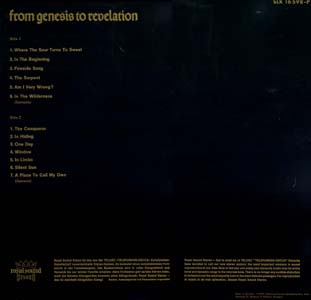
 It shows no or at best only the most minuscule traces of the style that would make them well-known later, and therefore frequently meets with a refusal and lack of affection. Justly so?







The Circus Magazine Interview by Scott Cohen, October 1973
Genesis are probably the most British of all English rock bands. Some music writers, in fact, consider that Genesis don't actually play rock music at all, but use the vehicle of today's most popular art form to convey their strikingly individual antique visions. Hard rock is based on the black man's rhythm & blues, and the lily-skinned English lads don't cater to the physically entrancing rhythms and emotional intensity of the blues at all. Clapping at a Genesis concert comes, not in the rhythmic waves of the boogie fans, but in the brief, sharp spatters more often associated with the classical recital hall. This is not to say that Genesis are dry and wearisome, though. The British fable-mongers display a vigorous intellectual soul a Victorian hunger for gothic excitements which seems to cut across the worlds of Edgar Allen Poe and Lewis Carroll.
Genesis don't write hit songs but lengthy compositions, and they are slow writers. Their lyrics are mentally aggressive explorations, Tolkien-like journeys into a twisted consciousness, a nursery of evil threat as bizarre as "Alice In Wonderland." InstrumentalIy Genesis are as remote and unsettling as they are lyrically, creating, evocative, hitting atmospheres and moods in the manner first introduced by Pink Floyd.
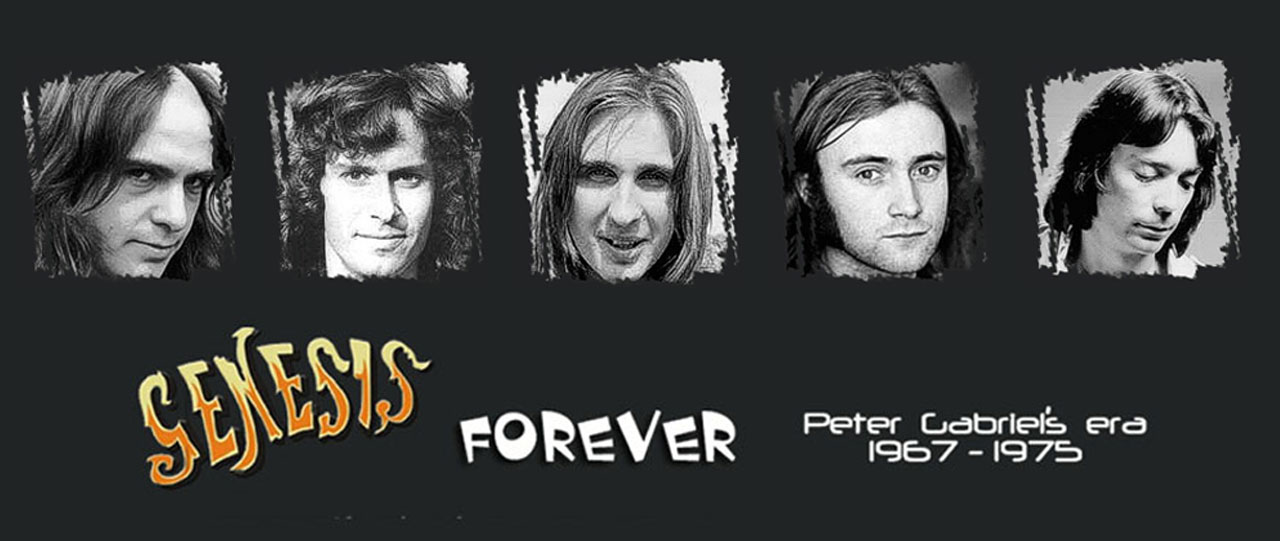
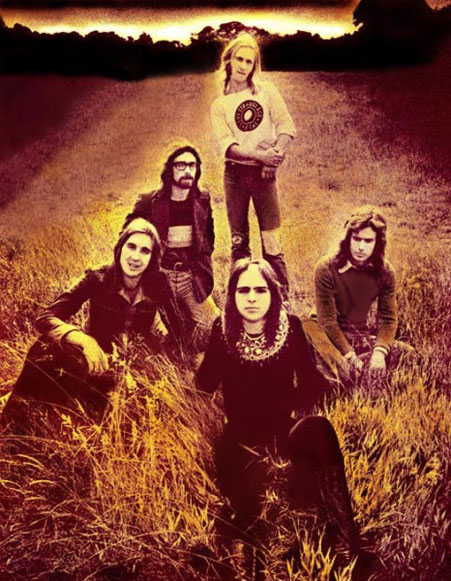
Given Genesis' aristocratically eccentric attitude it's no surprise the core of the band sprang from one of the United Kingdom's exclusive "public schools" Charterhouse. Keyboardist Tony Banks, bassist Mike Rutherford and vocalist Peter Gabriel (and a lad named Anthony Phillips) banded together as a songwriting team in the mid-sixties and gradually mastered their instruments as they made demos of their songs to sell. They were given the name "Genesis" by record producer Jonathan King in 1967. He released their debut album, 'From Genesis To Revelation,' in 1961 and made their first public appearance at Brunel University in 1969. Following a number of personnel changes, including the departure of Phillips, drummer Phil Collins joined the band in 1970 and lead guitarist Steve Hackett signed up in 1971. Starting with 'Trespass' in September 1970, Genesis have released an album every fall. 'Nursery Cryme' (1971), 'Foxtrot' (1972), and 'Selling England By The Pound' (1973). Last spring they also released Genesis Live, which actually represents the "Foxtrot" show and was recorded prior to Selling.
Lead singer and spokesman Peter Gabriel is one of the most unique actors on the rock stage today and his costumes are legendary. Whether appearing as an incubus in fluorescent bat-wings, or sporting his flower-petal face or diamond helmet, Gabriel commands the stage completely as the band's focal point. Though it is the musicians of Genesis who do most of the composing, the four instrumentalists generally appear onstage as expressionless technicians, forfeiting any claim to the eager stares of the audience.
Despite his odd enactments onstage Gabriel's off-duty demeanor is that of a rather shy and quite decently normal Englishman. Circus Magazine interviewer Scott Cohen sat at one end of the transatlantic telephone cables, atop offices across a canyon from the Chrysler Building. Genesis' Peter Gabriel sat at the other end of the line on a posh stairway in the home of his relations in London with a view of the kitchen. Nothing was cooking.
---------------------------------------------------------------------------------------------
INTERVIEW
Circus: There is a popular belief that a person with a name consisting it of either two surnames like Scott Cohen, or with two first names like Peter Gabriel, is destined for either wealth or fame. Do you think there's any truth to that?
Gabriel: We have a good representation in high places, the Gabriel part anyway.
Circus: How high?
Gabriel: Heaven. You see, we run the angels. Officially. That's what the textbooks say. My family arrived in this country from Spain at the time of the Armada, and the story goes we were adopted by Cornish peasants.
Circus: And then what happened?
Gabriel: I was born. I was born on a farm about thirty miles from London, in 1950, at a place called Chobham.
Circus: Does the name Genesis come from the Bible?
Gabriel: It came from the mind of the only guy we could find to pay for the production of our album, Jonathan King. He had an idea for what he wanted to call us, and we weren't in a position to jeopardize our future.
Circus: Where did you meet the other members of the Band?
Gabriel: That was private school in your terms, but what we call public school.
Circus: Oh, private school here is public school there? What's public school called in England?
Gabriel: State.
Circus: We call prisons here "state."
Gabriel: Three of the five in the band have middle-class backgrounds, and two have more earthy urban-based origins.
Circus: Were you dressing up in costumes back then?
Gabriel: Besides impersonations of an oak tree, there was very little. I once designed a hat, and Keith Richard and Marianne Faithful bought one and I was very proud of that. I saw Marianne Faithful wearing it once on "Jukebox Jury." which is a record panel show. It was a tallish hat, a rip-off from a medieval design.
Circus: Who did you identify with, the Mods or the Rockers?
Gabriel: With the Mods of the two. They had The Who and The Small Faces, and the Rockers had Jerry Lee Lewis and not much else.
Circus: I notice that there's a lot of white at Genesis' concerts. Is white your favorite color?
Gabriel: No, but it certainly does show up well. I like sort of electric turquoise.
Circus: Then why do you usually have a white stage white background and the band usually dressed in white?
Gabriel: Originally we did it partially for the lighting, but we also use black a lot. Part of the idea was that the white would act the maximum reflection for any other color put out on the stage. It would heighten whatever color we used with it.
Circus: I guess white is an easier color to work with.
Gabriel: Well, now we use black - I guess, because black is more in my head at this time, and black is easier on the eyes. Black is also the color of night.
Circus: How important is the performance to your music?
Gabriel: To us, to the audience or to the critics? To us the primary pleasure is writing and recording. To the audience it's the most important because it's the most direct medium, and it works as the strongest. To the critics it seems to be the catalyst of shifting a review one way or the other. In other words, to the critics, a review will depend upon how we develop the presentation.
Circus: Have you ever seen the film "Children of Paradise?"
Gabriel: No, I didn't actually. It is one of the films I have on my list.
Circus: Which films have you seen that you liked?
Gabriel: Well, I'm quite partial to some of the Pasolini and Fellini types. I enjoyed your "Serpico" very much.
Circus: How about Walt Disney?
Gabriel: Yeah, I like cartoons very much. I feel there is a similarity between us and cartoons, because cartoons represent very much our type of characters, very easy to understand characteristics, you have to look at them once to understand what they are. They're exaggerated and there's a fantasy to them and very little realistic bounce at the boundaries.
Circus: Do you try to create the musical equivalent of a comic book?
Gabriel: Comic book is the wrong word I think. What I'm thinking of is, well, I don't think these films have been made yet, but saying Disney is pretty apt or Fellini or the surrealist inclined filmmakers.
Circus: How much has mime influenced you?
Gabriel: Well, not too much. I try to use it a bit. With the minimum of fuss we try to say the most that is possible. I really don't think I make a good mime artist, I don't think I'd consider myself such, but rather I try to use my hands to express some thought.
Circus: Have you learned from Marceau and Chaplin?
Gabriel: I saw Marceau once in New York and I was very impressed with him and Lindsay Kemp. With them it's really an art form, with me it's something I just dabble in, so as to get something across; but I think, particularly with Marceau, it's something he's worked with for a great length of time.
Circus: Would you say you are a man of a thousand faces?
Gabriel: No, I wouldn't say so. You would. Mostly when I look in the mirror it's the same face I expect, but it isn't always.
Circus: Do you find when you wear a mask the mask takes you over, that you become the mask?
Gabriel: Yeah, I find that quite so. When I wear the mask I find it easier to be the part the mask is. I'm usually very inhibited, but behind the masks I'm not quite so.
Circus: Who makes your masks?
Gabriel: Well, I did have a guy in London named Guy Chapman, but he had a bust-up with his girlfriend and had to leave, so I'm going to need someone else.
Circus: How many masks do you have so far?
Gabriel: I don't know, I think I have six to ten. Some are also hat pieces.
Circus: In Bali, where they are famous for masks, a mask maker will spend two, to three years creating one and in the end, when it's complete, if the maker doesn't see it fire or spirit emanating from the mask, he will destroy it and start again. Do you have a similar feeling about your masks?
Gabriel: Yeah, with the flower mask and the old man.
Circus: Do you think that the clothes make the man?
Gabriel: No, but they can make some of the packaging, and people are susceptible to packaging.
Circus: Are you influenced by Bowie's costumes?
Gabriel: I think we were headed in that direction before he was, though I'm not sure.
Circus: Do you think he was influenced by you?
Gabriel: No, I wouldn't say that either.
Circus: What would you say the basic differences between Bowie's costumes and yours are?
Gabriel: As far as what I understood about his costumes, they were done for a desired effect rather than for a relevance for the material, whereas what we did was we tried to materialize some of the characters in the lyrics.
Circus: Do you remember your last year's Halloween costume?
Gabriel: I wasn't in a costume. It's not celebrated the same way in this country.
Circus: Your physical trademark is the part in your hair which is shaved, like a zipper.
Gabriel: Yeah, I have one or two reasons I give. Usually I say I shave it so I'll become wealthy and famous. I also do it to make my face seem longer, which gives me an oriental look. But I've stopped doing that now.
Circus: Did you use a razor and cream or Nair?
Gabriel: I'll shave it with a razor and cream every day. If I did something like that again, I think l'll do the opposite, and shave it like a Mohawk.
Circus: Would you say the covers illustrate the music on the albums?
Gabriel: Yeah, though in one case I wrote the lyrics of a song after a painting I thought was particularly interesting for a cover.
Circus: Which British bands most resemble Genesis?
Gabriel: Well, usually. it's the other way around. We've been influenced by the Beatles, Procol Harum, King Crimson, bands like that.
(Two other questions were asked of Peter, "Would you like to do a Broadway show" and "Was Peter Pan a childhood hero," but due to earsplitting static caused by more than the usual electrical interferences, parts of Peter's reply were inaudible, but pricking our ears the best we could, his answers seemed to be:
"The Broadway show is not what it is cracked up to in that there was a certain amount of myth involved about them and Genesis would prefer to make a movie instead."
"Peter Pan was not a childhood hero, but he did enjoy the British performance. He was not aware, but found it quite amusing that Mary Martin played the normally male role ot Peter Pan in the American version."
Circus: When you fly around the stage, what is it like?
Gabriel: I could actually fly when I was seven or eight. We had some apple trees, and I used to fly around them, but generally I'm not believed when I tell people that.
Circus: How high off the ground were you able to fly?
Gabriel: Only about three feet.
Circus: An experience not to he equaled onstage?
Gabriel: No, particularly when the gentleman holding the wire is incompetent...
Circus: Are you thinking about him when you're flying?
Gabriel: Well, one of the things I'm thinking about is how not to get the wire caught around my neck. In London there's one guy who's really great, but over here in the States I have to use the eight or so guys they give me and they all think they're chiefs and there's no indians.
Circus: What's your all-time fairytale?
Gabriel: I was going to say David Bowie, but then I thought again. Actually there's one called Lilith that's put out by Ballentine Books that's a very fine one, that's pre-Tolkien, and it's one of my favorite books.
Circus: How do you handle hecklers when you're reciting a story onstage?
Gabriel: I quite enjoy the heckling atmosphere because it keeps you on edge. You can get complacent if the audience gets too soft. It's less interesting.
Circus: Is Burt Bacharach one of your favorite songwriters?
Gabriel: No, but he is someone I respect - people like Bacharach, Joni Mitchell, some of Jim Welch, people who understand their craft, but I also like some things that are very elementary and very rough.
Circus: Yesterday's newspaper headlines concerned Nixon's pardon and Evel Knievel's blunder.
Gabriel: Yes, I'm very interested in that, I was waiting for Nixon's departure. I didn't expect it to take so long. Evel Knievel, I think, is a great folk hero, he's the stuff that myths are made of. I like that. There have been many plays and books theorizing on the possibilities of attracting world wide attention through suicide or possible suicide. And he really realized that, for the first time ever as far as I know. The fact that he got all the media coverage that he did is obviously because of the fact that he might die, so I find it fascinating from that point of view. It seems that it was impossible that he would die now after the event, but before the event there were no skeptics in the media. On the other hand, there seems to be a political interest there on how people can be moved by political events, but it doesn't seem to be a very just action.
Circus: He dresses up just like Captain America, the comic book character?
Gabriel: Oh, we're on Evel Knievel. I was on Nixon's pardon.
Circus: Well, he too dresses up like a comic book character.
Gabriel: The thing about the President of America is that he's also like a myth, and it seems that Nixon enjoyed perpetuating that sort of kissing the flag routine, whereas over here, although I'm not a monarchist. All the paraphernalia, show and glitter is washed away on the Queen, and the Prime Minister is a dull man who bows to the Queen's feet. I think it's interesting that one of the Watergate people was at one time a tour guide at Disneyland.
Circus: Do you think Americans idolize Hollywood stars and rock stars because there is no royalty?
Gabriel: No, because royalty is in no way a replacement for rock stars. I think people need heroes, which I think is a weakness in some ways. In the same way the press or the media blows up the heroes and the authorities, it also makes ordinary citizens into sex crazed criminals - which is equally unrealistic.
Circus: Which cartoon character do you idolize most?
Gabriel: I can't pick one out, but I think being able to change from one thing to another is something I'm envious of. I have an award for pretentions.
Circus: An award for pretentions? What pretentions? What do you mean?
Gabriel: Well, they're things that appear in other people's heads, particularly when our music and words don't feel comfortable to their senses.
Circus: Who do you identify with most in literature?
Gabriel: I don't know, but it would not include Mary Poppins.
Circus: Who would you like most to produce your album?
Gabriel: Paul Samwell-Smith; He used to be the Yardbirds' bass guitarist. He produced Cat Stevens.
Circus: Would you like Burt Bacharach?
Gabriel: No, he would be too sweet.
Circus: How about Evel Knievel?
Gabriel: Yeah. He would be good. I would like him to do publicity.
Circus: What did you think of Disneyland?
Gabriel: I was very disappointed in the fact that it was much smaller than I thought, and it had a hollow ring that I wish wasn't there. I think that the potential for a place such as that is incredible. I have many dreams of getting a place built where the fantasia are more credible and relevant. In other words, one would get a sort of well known artist to actually build the fair grounds and the rides.
Circus: Disneyland would probably he more interesting as a cemetery. There's one in Hollywood almost like that.
Gabriel: Yeah. I think I saw a program on TV on it. It was very interesting, I loved the vulgarity about it.
Circus: Do you know what kind or tombstone you would like to have?
Gabriel: No. I would like to be cremated. Well, if one wanted to get romantic about it, I'd like to be thrown on a patch of land I'm fond of, or be planted under a tree or something. It's a terrible waste of space to be buried.
Circus: I would rather be buried and keep my body intact.
Gabriel: Well, not necessarily with my body, but I always wanted to see a body left out in a garden or on the grass and naturally go back into the earth. The process of decay could he quite beautiful.