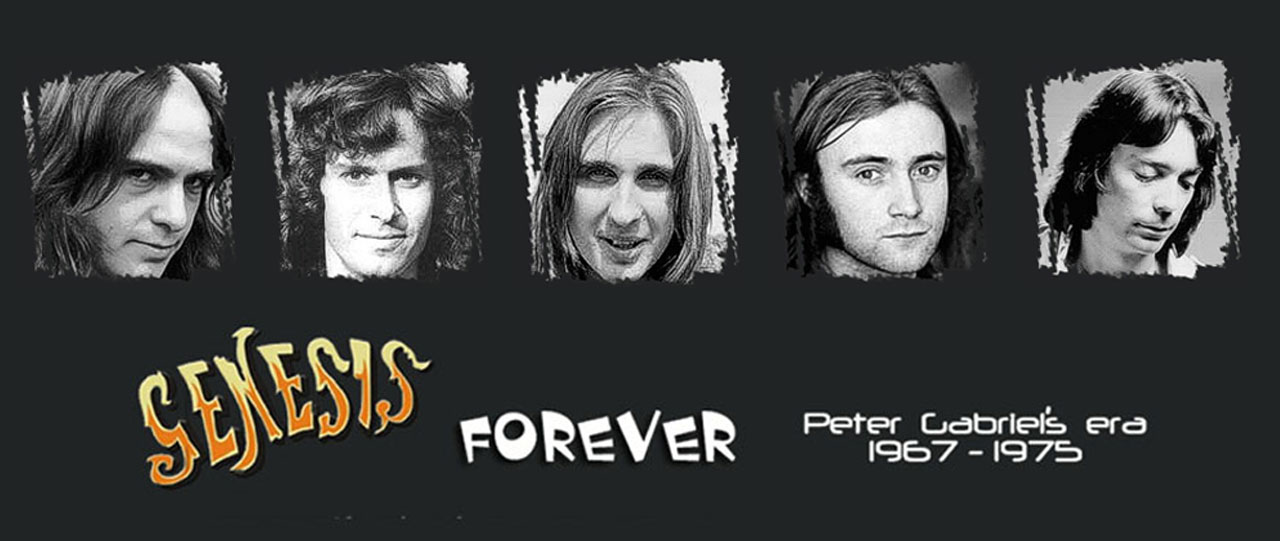



 It shows no or at best only the most minuscule traces of the style that would make them well-known later, and therefore frequently meets with a refusal and lack of affection. Justly so?



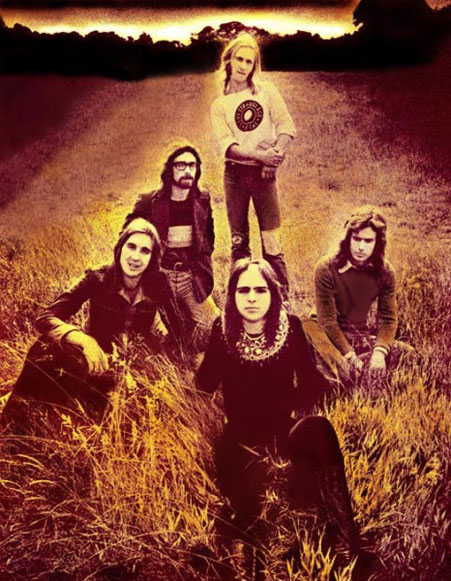




Probably from NME - just after 'I Know What I Like' was released = Do you want to hear some stories? Written by Steve Clarke
Like the one about Rita Pavone's brother recording a Genesis song? And the time old Jonathan "I'm just-making-the-one-record-to-finance-my-studies" King got involved with Genesis and even suggested their name? And Peter Gabriel's fetish for treetrunks and carrots? You do? Now just hold on a minute while I set the scene.
Genesis are writing, rehearsing and recording their next album at Headley Grange in Hampshire, a tumble-down old mansion with a swimming pool that looks as though it hasn't been used since man took to the air.
Led Zep rent out the place from a certain Mrs. Smith, and then sublet it to various rock 'n' roll bands for the purposes set out above. Genesis reckon on being there three months and they're just settling in after returning from an 11-week American tour.
A pretty successful tour, according to Gabriel, we make small-talk before getting down to the more serious and - according to him - boring task of tracing Genesis's career from their days as school-boys at Charterhouse to fame and fortune in the world of showbiz.
GABRIEL'S A MITE eccentric and, I think, a little shy as he makes us comfortable, spreading out on the kitchen table a wedge of Dutch cheese, a loaf of bread, peanut butter and other wholesome goodies. Apparently the last tenants of The Grange, The Pretty Things (whatever happened to), left the old house in a bit of a state and Genesis had to do a lot of sorting out.
Genesis's drummer, who's recently had his barnet cut, wanders in, his wife and daughter making the odd appearance now and again. He sits in on the interview for a while too, until he eventually decides to wander off and fix the television.
According to Gabriel, Genesis see themselves as songwriters-being-musicians being presenters. And it was as songwriters that Michael Rutherford (bass and 12-string) Tony Banks (keyboards), Anthony Phillips (Genesis's guitarist up until and including their first Charisma album 'Trespass'), and Gabriel originally got together at Charterhouse. (Just for the record, Gabriel would like to see public schools wiped off the face of the earth).
Gabriel himself was messing around between song-writing and playing drums, first in a trad jazz group and then in a soul band:
"Blues and soul was the first thing that excited me," he says. He still listens to black music now: "I enjoy a good soul record."
Over the years, he complains, his drum-kit was slowly taken away from him piece by piece, until all he has left now is a bass drum which Phil wants to stuff with concrete - but I don't think he's being too serious.
Gabriel isn't the easiest of fellows to weigh up, wobbling between bouts of intense seriousness and a kind of Pythonesque humour, interspaced with long pauses. He smiles benignly to himself every now and again. And he twitches a lot. But back to the songwriting.
"We got in the situation where the sort of music we were enjoying and writing was getting out of the verse/chorus/verse/chorus/chorus/chorus/end routine - which wasn't suitable for anyone of us, really. If it was going to get recorded we had to do it ourselves."
And so they formed a group and added a drummer. The writing was more or less divided into two partnerships, Gabriel and Banks writing on keyboards, and Rutherford and Phillips writing with guitars.
"Rita Pavone's brother was the only person who'd actually recorded any of the songs apart from us," chuckles Gabriel. "There are still some songs we've written that are unsuitable for the band and which we'd like other people to record."
I think that's something that separates us from the other bands with whom we tend to get lumped. Genesis is more song orientated than musician orientated. There's less desire to show off technique."
The four of them began taking their songs around various publishers, but no-one wanted to know. "It was the same with the band later on when we tried to get a recording contract." Eventually someone did want to know and that was Jonathan King, acting out his role as producer, who coincidentally was also an old Charterhouse boy, although the two factions hadn't made themselves known to each other at school. With a fair amount of sarcasm in his voice, Gabriel says of this period: "It was the opportunity we had all been waiting for." Slipping back into his normal tone, he continues: "We were given a fairly free hand in the studio. At times he (King) was very excited about it and put a lot of energy into it. And sometimes he got bored with it." Was it that far removed from what King himself was doing at the time? "It was a bit," Gabriel replies. "The songs used more than three chords ... whoops!" Whoops, indeed.
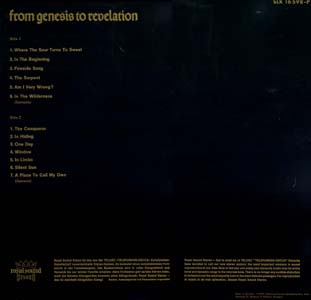
The resulting album was called 'From Genesis To Revelation' and released on Decca. Gabriel now describes it as an amateurish effort. recorded quickly - which means cheaply. None of this lolling around in country mansions for dose months then. Genesis's stay with Decca didn't last more than a year and Gabriel says the company didn't consider Genesis's departure a momentous loss. He also reveals that the group were about to split up around this time but, after temporarily forsaking the music business for other activities, the group resumed once more to the streets of London, searching for a record contract.
"Most The Hoople (They get in everywhere in this paper, don't they?) were good to us then. They were fresh from Hereford and very friendly and got Guy Stevens involved." (Stevens was Hoople's Island producer, you remember.) "Guy Stevens was never the most together of people and his interest took a while to be followed up with a deal. "The Moody Blues showed interest when their record company started up, and we got one of those 'Come back in two years' routines from Warners. Anyway, we went from company to company and, when either Charisma or someone else began to get interested, the rest of the people began to assume there was something worth looking at."
GENESIS, AS YOU KNOW, did join Charisma, who at that time were in a fairly virgin state with only a couple of other acts on them booked after The Nice had split up. Genesis's music, originally acoustically-based, was get ting more electric and their debut Charisma album 'Trespass' set Genesis more or less on the musical path they've been exploring ever since. "The things we were doing at that I time were considered too un-commercial," Gabriel recalls. "Quite a lot of record companies said that you could either do acoustic music or you could do electric music, but you couldn't do both, particularly in the same number. Two musicians, drummer John Mayhew and guitarist Anthony Phillips, left after 'Trespass'. Collins replaced Mayhew, but it took them a while longer to find their current guitarist Steve Hackett. Over to Collins:
"FROM WHAT I CAN GATHER there was a major upheaval in the band at that time. Tony was going to split cos he didn't think we could get it together - this was before I joined. He said he'd only stay with the band if they got a new drummer at the same time as they got a new guitarist. Apparently the drummer was holding the band up because of the speed he worked at."
Gabriel elucidates: The drummer (Maybew) wasn't a good learner. And it was also a major change when Anthony Phillips left - he was an important writer so we weren't sure if we could continue or not."
Continue, they did for a few months as a four-piece minus a guitarist, keyboard man Banks playing the guitar parts on a phased electric piano.
"It was quite interesting. Some gigs made it and some gigs were a bit..."
After six months of searching Hackett was found and Genesis came together in the shape it is now.
The line-up was together a year before recording 'Nursery Cryme', writing and rehearsing the album at Charisma boss Tony Stratton-Smith's house in the country.
Collins again: "The material wasn't that easy to come by. We had 'Musical Box' - which had been written previously - but most of the other stuff came from writing on the spot. Like this one. We haven't got anything written for this one yet."
It's just one of the many unusual faces of Genesis that all their material is band written, the composing credit on their albums being simply "Genesis". Explains Gabriel: "We wanted to avoid bitching and fighting for composer's royalties and glory on albums. A sensible way of doing it is to have mutual credit."
Genesis's lyrics mainly come from Gabriel and the Rutherford-Banks partnership. It's difficult to say precisely who originates the musical ideas since they get moulded in a different direction by each musician in the band.
ALTHOUGH the group's following was mainly restricted to clubs, their signing with Charisma gave them a chance to work in a concert context on the Charisma Sop tour with Van Der Graaf Generator and Lindisfarne on the same bill.
"The emphasis has always been on live gigs," says Gabriel. "If you get to an audience through live gigs, it's a much more direct and honest relationship than records via press hype. It's always been a slow cult thing building, rather than a mass launch.
"People who get into us often use it as escapism. Like they'll go home and listen to a Genesis album on a night when there's nobody else in the house. They'll put on the cans and sink into it, rather than putting it on in a room full of crowded people."
The band don't see any one particular album as being central - although their third album 'Foxtrot' contains two of the group's best known pieces, 'Watcher of The Skies' and the lengthy 'Supper's Ready.'
"We've never recorded albums with a view to live presentation afterwards," says Gabriel. "We do the music that we like best. Some of the last record ('Selling England By The Pound') was probably more suitable to listening to on record than for playing live. 'Watcher of The Skies' and 'Supper's Ready' are more suitable for live performances.
"We see the thing primarily as entertainment, and we write about things that interest us. If a subject which happens to be social comment interests us or seems suitable for a song, then it'll be there - rather than using the whole thing as a political band-wagon."
Gabriel says the idea for 'Get 'Em out By Friday' came from watching a TV documentary on eviction, while 'The Battle of Epping Forest' was inspired by a newspaper story:
"It was a story about a gang battle in Epping Forest. The gang had agreed not to use firearms. It was a very gentlemsaly agreement. It was the only way to decide who would have certain property boundaries without spilling blood."
AS BY WAY of a change, the idea for Genesis's recent hit single 'I Know What I Like (In My Wardrobe)' came from the cover painting of 'Selling England By The Pound' - the album from which the track was lifted. All previous Genesis covers with the exception of the live album and the Decca album, have been inspired by the lyrics of one of the record's songs.
Gabriel sees singles as nothing more than adverts for the album from which they were taken, and it wasn't their's but Charisma's decision to release it.
Which brings us more or less up to the present and, with the Dutch cheese a slightly diminished wedge and the third kettle of water ready to boil for another cup of tea, I ask Gabriel what he thinks the appeal of Genesis is, and this is what he has to say:
"My trousers."
There's a long pause and then he continues:
"Small pieces of rubber hosing borrowed from the Elvis Presley Memorial Society. Perhaps a large part of the British public have certain urges to shave certain areas of their skull, which has a remarkable effect on virility and produces a healthy desire for carrots and tree trunks..."
Now this is getting silly. I think we'll say goodbye and let Genesis continue writing their new album.
'SELLING RECORDS BY THE POUND' - DISC FINDS TOMORROW'S STARS TODAY
From Disc Magazine, November 10th, 1973
He's not the easiest of people to interview," they said, "not that he's unco-operative, you understand, just very shy." Be that as it probably is, when this interview was due to start in Peter Gabriel's flat at the unconductive hour of 10 am. he was in far too much of a flap to bother about his inhibitions.
For a start circumstances demanded that the interview take place in the back of a car instead of in the flat. Then guitarist Mike Rutherford had just run someone over in his car, two cats were going berzerk rushing round the living room after each other in a fit of what could have been either pique or libido and Pete's telephone would connect him only with an engineer marooned at the top of a telegraph pole at the end of the road.
A calming cuppa seemed the only answer, so we consumed a hardy brew of lapsang souchong subtley blended with a couple of Tetley tea bags before piling into the car to set course for Shepperton Studios. [See the boot 'This Planet's Soil'.]
It transpired that Genesis were making an hour-long film of themselves at work for "general purposes" here and abroad. It was all supposed to have been done the previous day, but everything conspired to make sure that it wasn't so a second day's shooting lay ahead.
Before the interview some particularly vicious member of Disc's staff instructed: "Find out if his shaved V-shaped bald patch conceals a receding hairline." It patently (pardon the pun) doesn't since a few millimetres of stubble were much in evidence. Nevertheless, in these days when certain nameless stars are lopping positively decades off their ages it seems strange that a 23-year-old should want to look 30. What was the reason behind this multilation of the Gabriel tresses?
"There isn't one. It's just a cheap gimmick to make me rich and famous." And it works. The band's latest album 'Selling England By The Pound' was way up in the LP chart almost before it was released and their recent British tour was a near sell-out.
Now Genesis are off to crack America. They've only had two visits there in the past - one for a long gig, the other a tour. Almost apologetically Peter says: "If we only worked in this country, we wouldn't be able to afford to put on the show we do." The show, in case you haven't seen it, is a good two hours long, expensive to stage and very theatrical. "Of course, we could make a lot more money by shortening the set and doing two shows in one evening, but it wouldn't seem right."
The theatrics are very much geared to the music as Peter explained. "The difference between us and other bands who are into theatrics is that when we've recorded a song we decide how best to present it onstage rather than just put on costumes which bear no particular relation to the music."
Undoubtedly the visual side of the act has helped to attract a lot of new, younger fans to the band. "And I'm very pleased about it too," says Peter. "Maybe they don't understand some of the more complex elements in the music but I'd much rather have that energy than a bunch of complacent intellectuals."
Visually the show is becoming more sophisticated all the time and great importance is attached to it's development. One member of their crew was out on his ear after a recent Rainbow gig simply because he couldn't cope with the slides that are projected onto the band's impressive new backcloth.
"Actually the backcloth wasn't really what we wanted," he says. "We were going to have an inflatable plastic all round environment which could take much more film on it, but since the Summerland disaster fire regulations have got much tighter and what we had in mind would not have been allowed."
Soon the slides may be on their way out to be replaced with cartoons which Peter thinks are more effective. "We have an Italian firm working on the idea for us at the moment."
We arrive at Shepperton and filming is soon underway. The first song is 'I Know What I Like (In Your Wardrobe)' and watching, one can feel sorry for Peter having to do his mime of a lawnmower watched by just three or four rows of imported audience. Later, over lunch he admits that he's not particularly enjoying the filming.
"There's more atmosphere today than there was yesterday, but I think that when you have to do a song over and over again for the cameras it loses something with each take."
Strangely enough sitting in the studio's works canteen with his face masked with white make up appears to bother him not at all and he seems less shy behind the anonymity than he does bare-faced, but then he's almost as curious as the weird and wonderful fantasies that are his band's musical trademark.
- SOUNDS special on Genesis' extraordinary US debut at the Philharmonic Hall, New York, 12.12.72.
From Sounds, December 23, 1972 Report by Jerry Gilbert.
(There are a couple of "drop outs" in the middle of the article - a few words and sentences were unreadable.)
"OK. Let's see your papers," barked the customs official at Kennedy International Airport. "But we are the papers," someone bounced back in diplomatically dulcet tones; whereupon we became integrated in the largest promotional campaign ever launched by Buddah and Charisma Records.
Genesis were up for sale in the biggest make-or-break attempt since Brinsley Schwarz played the Filmore East three years ago.
Promote
Top New York FM station WNEW had linked up with Buddah to promote a single show at New York's three thousand capacity Philharmonic Hall on 45th and Broadway, and all the leading American writers had homed in the gig - from Philadelphia, Boston, Detroit, and, of course, Los Angeles.
Acquaintances were struck up, reunions brought about and impressions exchanged during the heady atmosphere of anticipation at Buddah before the gig. And all because one New York radio station, in particular DJ Scott Muni - had been flooding the air with the new British wonder product. The seductive voice of Alison Steele had rammed Genesis down the throats of all WNEW listeners, Pete Gabriel tuned in apprehensively and then broke into a grin: "My life has changed since I started using Genesis," he mimicked, and by this time the whole event had become slightly surreal.
A double deck London Transport omnibus drew up outside the Americana Hotel on 7th and 53rd to take us to the gig and America's writers finally extricated themselves from their discourses on the [ars noya? - almost unreadable] of the English rock culture that Genesis represented and awoke to their new unprecedented environment. A double deck bus, wow, man, far out man. "Hey man if they have an accident down there do we have the same accident up here? Wow man far out. Hey man I've never seen Manhattan from this height before."
Try and picture the situation in which Genesis had suddenly become fixed. The politics of experience humming about their ears like a bad dream; no one wanted to be disappointed, no one was there for the slaughter but it was evident that no American critic would shed any tears if the gig went sour.
Shrewd
The interpreters and annalists have been stretched beyond the demarcation lines by English charlatans, it appears, and whatever they were going to make of the Genesis gig views were pretty certain to be dogmatic and polarised. Yet the shrewd mechanics behind the operation require some qualification for the initial maneouvres contributed in no small measure to the ultimate success.
WNEW hold an annual Christmas concert in aid of the Cerebral Palsy Fund. It's a goodwill concert, profits to charity, an exchange of gifts and a general exhibition of charity which, like everything else in New York, is tastelessly ostentatious.
Scott Muni is one of the big shots at MNEW and an Anglofile who picked up on Genesis as soon as Buddah had started the ball rolling. Soon he was playing tracks like 'Watcher Of The Skies', which may be edited down for a single release, and 'Supper's Ready', and as the campaign gained momentum so interest picked up in Philadelphia, Phoenix and, more important, in Cleveland, Ohio, which has suddenly become the place where trends begin.
String Driven Thing, the new Charisma band booked to support Genesis had also been given good air play on album tracks like 'Circus', and 'My Real Hero', and there was every chance that they would create a similar impact. But as the hours of hours approached, the acute sense of anticipation changed to one of mild foreboding.
Proceedings were thirty minutes late kicking off and the capacity audience were subjected to all kinds of platitudinous preamble as deeiavs [?] were introduced and they in turn did their PR thing for the Cerebral Palsy Fund. The slow hand-clapping which prefaced the arrival of String Driven Thing must have put the fear of God up them, but luckily they withstood the pressure, settled quickly and showed remarkable composure and equilibrium for such an inexperienced group.
They opened confidently with 'Let Me Down', and as if already primed to New York audienced they ignored the shit that was hurled sporadically and really got off on the predominant appreciation. By the time they reached 'My Real Hero' and 'Regent Street Incident', they had conveyed sufficient Scottish traits and British enthusiasm tto have convinced those who were willing to be convinced.
Some picked it up from Chris Adams' down to earth, almost self-indulgent rock and roll, others fixed on the petite waif-like figure of his wife Pauline and the freaks found something to associate with in the weird spectral appearance of Graeme Smith, who wove strange wafer thin violn lines over the top of solid rock and roll. String Driven Thing had their hassles - little equipment problems but the time they wrapped up the set with the traditional flavoured 'Jack Diamond' they earned their champagne and had justified a 3.000 mile journey for a mere 45 minutes.
Genesis' preparatory work had been slow and meticulous, allowing no room for last-minute slip ups - or so they thought. Richard McPhail and his road crew had crossed the Atlantic a week in advance to check out the hall, arrange the special effects and figure out an eleventh hour "rehearsal" gig before a handful of kids in Boston the night before. It was then that their worst fears were confirmed. The voltage changes into the American circuit had left problems with Tony Banks' organ and musically the Boston gig just didn't get of the ground. There were all kinds of sound problems although Richard was confident that an early start at the Philharmonic Hall would enable a satisfactory sound check well ahead of schedule. At least that's what would have happened had the Philharmonic Hall been available to the group on the afternoon of the gig.
"But we couldn't take over the hall until 4 o'clock," Peter Gabriel explained afterwards: "We didn't want to do it with only four hours' setting up time. In the end we didn't get the sound check done at all because Philharmonic Orchestra were using the hall, and it was the first time in two years that we haven't done a sound check before the gig. On top of that we were using strange equipment and the whole thing had become quite absurd." And that wasn't all, for Peter had become a victim of the Gorham Hotel's less than adequate ventilation and had woken in a stifled room with signs of catarrh and symptoms of flu.
Watching the group take the stage, Tony Stratton-Smith must have felt like the manager of an injury dogged football team making their first sorti into Europe. The MC gave a nice introduction, reminding the audience of Keith Emerson's recommendations and Genesis stormed straight into one of the best versions of 'Watcher Of The Skies' I have heard.
Problems
From there the impact intensified and when Peter Gabriel appeared through the darkness during the late stages of 'Musical Box' and the lights suddenly greeted the strange apparation of the fox's head and long red dress, the audience reacted volubly.
In retrospect the Gabriel mannerisms which we in England now take for granted, probably won the evening for Genesis in New York; I doubt whether the audience would have tolerated the ensuing hassles but for the shimmering mysticism which Gabriel constantly represented. He handled the situation beautifully, almost punctiliously, whilst being forced to concede that the band were only playing "at around 70 per cent". As one critic pointed out afterwards, the slightest evidence of glitter and razzle dazzle would have blown it completely.
As usual Gabriel prefaced his songs with fantastic stories, but it was after 'Fountain Of Salmacis' that the problems began. Mike Rutherford tried desperately to cure an intermittent buzz from his bass and as the breakdowns at the end of each number grew longer and more embarrassing, [...unreadable, sorry...]
"It demanded a lot of sensitive singing that I wasn't able to provide," Pete reflected, but the combined skills of Steve Hackett, gliding and whining staccato style across his new Les Paul, and Tony Banks strung out, detatched and insignificant on the right flank [ ... ] so the onus lent heavily on Peter Gabriel and drummer Phil Collins. "It was after that third number that I began to lose control of the situation because we were having all the hassles of the equipment," Pete recalled. "If we could have had all the facilities and the time to get things right then this would have been the way I'd like to have tackled America," he decided.
Meanwhile, the concert had continiud to balance on a fine edge as Genesis approached 'Supper's Ready'. Gabriel again came up with the perfect gesture when, during one of the all too frequent interludes, he produced a camera, strode to the front of the stage, focused on the audience and shot, flash gun and all. It evoked the sort of response that must have brought a deep sigh of relief from Tony Stratton Smith. "I've never been so nervous before a gig since I've been in the business," he declared. "The only comparable occasion was the Nice's first gig at the Fillmore East. But what impressed me was that in spite of the technical hang ups they got 100 per cent reaction," he added.
Combined
"I felt that if one was ever to take a gamble - and it was an enormous gamble - then it should be done with a group that (a) had a really fine show and (b) a group that was coming to the top of the curve in terms of confidence, the right point in time to do this sort of thing. It was a tremendous challenge for the band."
In a sense the band were a little too ambitious in tackling the epic composition, 'Supper's Ready', and sure enough just when it mattered most Pete Gabriel's voice failed him, disappearing at worst into a hoarse and inaudible whisper. [ ... ] to keep the number building towards something like its usual climatic ending; audience response, however, was fairly indifferent although the sporadic cry for some rock and roll which had shattered the silence earlier in the evening was repeated.
'Return Of The Giant Hogweed' brought back memories of early Family and it was a good number with which to close the show. Gabriel seemed to find a second wind and the show closed as powerfully as it had started with those that could move surging to the front, those that couldn't moving significantly into the aisles.
Genuine
The final ovation was tremendous by any standards. The reaction was genuine - the crowd wanted more - and that's an extremely rare sight for a little-known British band making their debut in New York. And so Genesis came back to do 'The Knife', after which the house lights were quickly up.
The band retired and the unmitiated might justifiably have thought it would be to celebrate their success. Instead they locked themselves away in the dressing room and would speak to noone. They were mentally exhausted, psychologically brought down because they'd played a million gigs better than that one. It was scant consolation that however well they'd played they could scarcely have created more impact. Mike Rutherford, the man whom the Gods had treated particularly harshly, appeared at the backstage door and was greeted with a bitter sweet mixture of congratulations and condolences.
It is on such occasions that aftermath parties become slightly embarrassing and it was conspicuous that the guests were well into their cocktails before Genesis had regained sufficient equilibrium to make it along to the Tavern On The Green on Central Park's west side. It seemed rather predictable that as the party swung into the morning and Genesis began to straighten out a little, there was still no sign of Peter Gabriel. He showed up eventually, but it was obvious that the gig had taken its toll and, like Richard MacPhail, his voice was suffering.
Next day the Buddah office was buzzing with genuine excitement excitement from the feedback that was starting to filter through and excitement as a result of what they had seen with their own eyes. Executives kept wandering past muttering superlatives at noone particular. Neil Bogart was "overwhelmed" everybody kept saying, and when the man himself fluttered by, sure enough, he was indeed overwhelmed.
Sha Na Na's manager kept appearing from nowhere and accosted all and sundry with a battery of beautiful lines. He eventually caught up with Peter Gabriel in one of the executive rooms where we congregated to hear a WNEW radio playback on the group. A rotound, jocular man, he duly approached Peter: "Y'know, your representative explained the group to me in such a way that I knew our relationship would be one of class warfare..."
The place broke up, the tension eased. Gabriel and Rutherford were in good spirits, Tony Banks and Steve Hackett were typically tacit and Phil Collins continued to grin and jest - just as he had been doing since the band arrived in the States. He was getting off on the entire junket and intermittent punctuations were purely incidental as far as he was concerned.
And so Thursday night the party made its way out to Kennedy Airport for a short stop over at London before flying out to Hamburg for what could only be an anti-climax - "a routine gig".
Memory
Peter Gabriel emerged from the 747 frantically pulling his hair across the shaved area of his head which two nights before had been glistening with white paint. Suddenly he was faced with the reality of customs officials and his one aim was to make himself look presentable and ease his plight. The customs deck - where the story came in, Peter Gabriel turned, proferred a hand, inquired in his humble manner whether there was anything else I wanted to know, and disappeared.
The gathering disseminated and the operation which had cost Buddha and Charisma a total of $16.000 to promote, was now a memory. Sixteen thousand grand for one operation - a small price to pay for an ephemeral onslaught which will be ringing around the United States for a long time yet.