


 It shows no or at best only the most minuscule traces of the style that would make them well-known later, and therefore frequently meets with a refusal and lack of affection. Justly so?



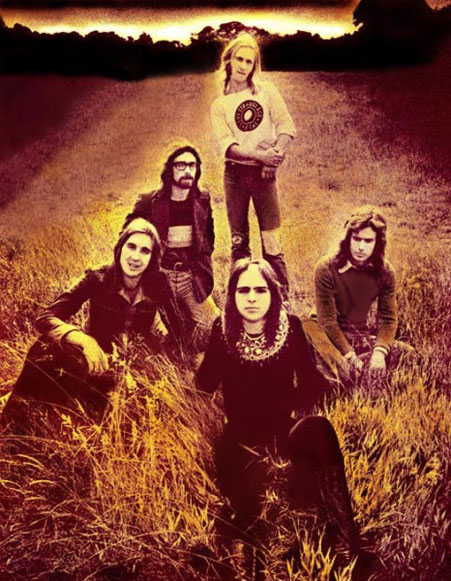




the general "mass" of sound being evocative enough is what counts (it's also their most Banks-driven album, and his keyboards sound good - more of that in a sec). It's flawed in many ways, which
are the result of high stakes being taken and ambitious ideas being attempted, but all of that pays off for its peaks are some of the greatest rock music ever written. I don't know, but there's something about early '70s progressive rock that is... how to put it? Very uplifting? Very faith-in-humanity-restoring? Very 'I'm-trying-this-because-I-want-to-push-the-envelope'? Whatever it is, I love it. It brings tears to my eyes to think about it. Makes me angry to think we could never get music like this today, a product so self-conscious of how ridiculously far it's trying to go. And it takes itself as a big joke while doing so! A fox in a red dress! Standing on a sheet of ice! Unlike the Genesis members themselves, I like Whitehead's cover design a lot. I wonder, what's not to love?
"Watcher of the Skies" is the radiantly triumphant opener (that intro sounds like sunbeams... or like a wizard spewing powerful spells all over the place if you want a more ridiculous comparison) and it's a prime example of Genesis working as a unity
where every single member adds something. Rutherford has his very unique staccato-based bass line, Collins is who takes care of the dynamic changes the most, Hackett unveils his lightning-like guitar tone when it's appropriate and for no longer than necessary, Gabriel gives the song attitude and spark, and Banks... well, Banks just makes the song, as it is mostly a spectacle for him to show all the diversity of potent sounds he can't get out of his keyboards. I love how he is just holding stationary chords throughout most of the song instead of overstuffing the mix. (And, Jesus, is it not overstuffed. There's so much air to it! The mixing could not have been more professionally handled.) The song is seven and a half minutes long. Does it feel seven and a half minutes long? No way, but that's just what happens when your songwriting isn't 'forced' to go anywhere... it just drifts around gracefully, propelled by an entire band's instincts regarding dynamics.
"Time Table" is the first and shortest of the three flawed tracks on side-A. It's a bit anemic and leaves without making a great impression, but I like some stuff from it (namely the Banks' lovely electric piano (ding ding ding!) and Gabriel's potent shouted out chorus). "Get'em Out by Friday" is purposelessly structured in a way that reminds me of "The Cinema Show" from their next album (not a good thing) and most of its ideas will be better packaged in "Supper's Ready" anyway, although I do appreciate Gabriel's ambition of writing a short opera for the lyrics (and Banks has some pretty nice keyboard parts too, I guess). After the first break, four minutes in, they lose me completely, and even if the song has no sections that sound outright bad that's still a very negative predicament. "Can-Utility and the Coastliners" is kinda directionless as well but, and this is an important difference, it's also prettier (mostly Banks and Hacket, although Gabriel also has some non-annoying parts near the end when he doubles the guitar line), which means that I actually enjoy it while it plays. Once it ends, I can't remember anything about it, I must admit.
I don't know to what extent it is possible that "Horizons" was Steve Hacket's response to Steve Howe's "Mood for a Day". What are the chances that two of the biggest prog rock records just happen to have acoustic short guitar pieces as second-to-last tracks? In any case, it's an excellent response, upping the classical influence and making use of some gorgeous harmonic sounds (I wish I had an instrument that sounded like that to play here at home - that guitar sounds amazing, way better than the cheap stuff I own). Hacket claims "Horizons" isn't an introduction for "Supper's Ready", but as much as I believe him I think even he should admit that 'fortunate' is not strong a word to describe its placement in the tracklist: once the big suite begins all the world shuts up to listen to the wiseness of that masterpiece, which is arguably Genesis' greatest achievement - the one creation in progressive rock that holds this equilibrium of moods (changing from one second to another from total goofiness to religious bliss) without falling flat on its face.
There's just so much unbelievably haunting stuff going on in "Supper's Ready". Gabriel singing the "Lover's Leap" section, so sweet and true, his chorus entrance is punctuated by a triangle 'ding!' as he announces himself 'hey my baaaby!'. The patient pacing of the arpeggios-based transition towards the "The Guaranteed Eternal Sanctuary Man" section, a very hypnotizing bit of music which makes the eventual arrival of the first anthemic parts of the suite (4:22) hit much more effectively. The bizarre background sounds during said climax (4:30 the first one), like yells of celebration coming from a parallel dimension. Gabriel's bad-ass and yet somehow unexpected 'waiting for battle!' chant, and basically everything from that moment until 8:20 (the urgency of the words 'and they're giving me a wonderful potion/'Cos I cannot contain my emotion' - which fill me up with joy for reasons I can't quite explain, - Hacket's extraordinary guitar solo with a guitar tone that I would define as 'halfway between lightning and chewing gum', the jump into the break at 8:02, which is one of the earliest examples of the tapping technique for a rock guitar ever recorded, etc). Sometime later we get Gabriel's hysterical shouting when he goes 'The frog was a prince/The prince was a brick/The brick was an egg!/The egg was a bird!' (I always mishear this last lyric as 'The egg was alive', which is even funnier). I also love the really cool transition into an audio-from-a-radio sound at 12:05. The band's super confusing groove during "Apocalypse in 9/8", which doesn't seem to be measured in the usual 3+3+3 but in something even more ridiculous like 4+4+1 or 5+4 or whatever. The very subtle transition into a major-key at 19:25, almost as if the apocalypse being depicted suddenly revealed a ray of hopeful light coming from the sky (Tony Banks is a genius - there I said it). The "Eternal Sanctuary Man" reprise during the last section and in particular the last two minutes, which conform one of the most mesmerizing musical outros I've ever heard: Gabriel's last growl when he spits that 'JERUSALEEEEEEEEEEM!!!!!!' into the psychedelic void that surrounds him and the subsequent pouring of beautiful instrumental tones galore (the sudden guitar intrusion at 22:15 is like the cherry on top) until it all slowly fades out into silence. So, so much packed into it. Doesn't matter if there are flawed bits here and there, the highs are some of the highest in popular music history.
"Horizons" and "Supper's Ready" together are about 25 minutes long. My walk home back from the university takes me about 26 or 27 minutes. If you account for the time it takes me to find my earphones in my backpack, untie them, and find the music to play... I would say each walk is the perfect length for a listen of both of those tracks, ain't it? I can't even begin to count the number of nights I've done precisely that, and the music hasn't lost any of its powers in spite of the overplaying. During the last two minutes of my walk home, soundtracked by the final climax of "Supper's Ready", I feel lifted into heaven. Walking among all the other pedestrians I feel like I could break down crying at any moment, and I wonder if they'd all look at me weirdly if that ever were to happen.