

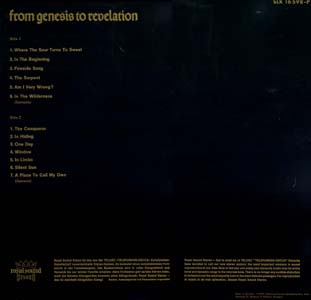
 It shows no or at best only the most minuscule traces of the style that would make them well-known later, and therefore frequently meets with a refusal and lack of affection. Justly so?







I'll get this out of the way quickly. "Supper's Ready," and many other beloved long classics like Suf’s "Impossible Soul," are obviously greater than the sum of its parts: there should've been a comedown after “Ikhnaton and Itsacon and Their Band of Merry Men,” but I wish “How Dare I Be So Beautiful” had anything like a tune or anything of textural interest (it’s these piano chords being treated to sound more like an organ).
But yeah, every section otherwise contributes to a feeling like you’re listening to prog rock’s magnum opus. “The Lover’s Leap” is already captivating in its triple-arpeggiated guitar (from Tony Banks, Steve Hackett and Mike Rutherford), and it was a wise decision to still have Phil Collins hitting something - in this case, mostly triangle - to bring us to the next line, to say nothing of Peter Gabriel describing a normal night turn sour: “Walking across the sitting-room, I turn the television off / Sitting beside you, I look into your eyes / As the sound of motor cars fades in the night” is how the song begins and soon, he introduces “Six saintly shrouded men move across the lawn slowly.” In between these two parts, he sings two lines that could be
prog rock’s great love couplet: “And it’s hello babe, with your guardian eyes so blue-ooh / Hey my bay-by, don’t you know our love is true,” and well, I can’t imagine any other artist during this time taking the chance Peter Gabriel does to sing “blue” or “baby” in that manner.
The song then slowly kicks into rock mode, segueing into “Ikhnaton and “Itsacon” with “The Guaranteed Eternal Sanctuary Man” that features one of my favourite moments on the album: that ghost child’s wail that comes in during, “You, can’t you see he’s fooled you all,” and more poignantly, “Look, look into my mouth he cries.” And oh man, “I know a fireman who looks after the farm” switching to “I know a fireman who looks after the fire” is clever, backed by Tony Banks’ organ runs.
“Ikhnaton and Itsacon” is pure battle music, with the military gallop of Phil Collins’ drums and how it culminates in Steve Hackett’s guitar solo, which sometimes sounds like John Coltrane by way of the Byrds: notes splitting and fraying in an assault. (It always brings me back to “Have You Seen Her Face?”) And the lyrics sell it as a weird battle, with Tony Banks’ keyboard notes swelling up and up and Peter Gabriel looking on ahead and realizing that “And even though I'm feeling good / Something tells me I'd better activate my prayer capsule!”
After “How Dare I Be So Beautiful?” we arrive at “Willow Farm,” and I’ll note here that Tony Banks’ has said that “Willow Farm” and “Lover’s Leap” were brought together from two different notebooks, so to speak, but it has never felt that way to me. Yes, it sounds tonally different with the rest of the song, but almost every part is tonally different, and it contains some of my favourite Gabriel singing ever when he sings, “There’s Winston Churchill, dressed in drag / He used to be a British flag, plastic bag, what a drag!” squeezing out “British flag” the way he does.
What’s also not mentioned enough is how funny Genesis were, in a genre constantly mocked for taking itself too seriously when Yes derived entire lyrics from Hindu texts. “Willow Farm” contains backing vocals that clearly go, “Fly away you sweet little thing, they’re on your tail! They’re going to change you into a human being!” To say nothing of describing “Apocalypse in 9/8” as “Co-Starring the Delicious Talents of Wild Geese” in programme for live performances and future Genesis songs: “I Know What I Like” and “Counting Out Time.” When Peter Gabriel left, he took a vital humour with him too.
The return to previous motifs after “Apocalypse in 9/8,” “Lover’s Leap” backed by Phil Collins on drums and Tony Banks on organ and “Guaranteed Eternal Sanctuary Man”’s melody backed by a different organ line actually feels like a release, and not merely a reprise.
“Supper’s Ready” is definitely the main attraction, but don’t be so quick to write off the other tracks. Even Hackett’s Baroque period-recalling instrumental “Horizons” is worthy, and deserves to be filed with the quick instrumentals by Led Zeppelin and Jefferson Airplane as stuff that we didn’t come for, but are glad to have. The only flaw is that “Can-Utility and the Coastliners” could’ve been tighter, especially the non-transition out of the first section (and the melody at the 1:45 mark will be put to better use on “Supper’s Ready”), and the loud section doesn't feel as vital as the loud parts of other songs here.
Opener “Watcher of the Skies” is more of the battle scene in “Ikhnaton and Itsacon,” but in a sci-fi setting instead of a fantasy one, inspired by Arthur C. Clarke’s Childhood’s End around the same time that Pink Floyd and Van der Graaf Generator were doing the same, even though the title comes from a Yeats poem. That intro, oh man. So silly, so serious, so excellent. Tony Banks had more problems than the rest of the band even though this was a pretty democratic band as they come in that every member gets the space they need to do their thing, but Tony Banks usually squandered that with dated, cheesy keyboard tones. Not here, just two chords on a Mellotron that perfectly set the scene for what the rest of the song, and his contributions on songs like “Watcher on the Skies” makes me think of Herbie Hancock of all people: two artists in the early 70s that just totally owned these sci-fi keyboard tones that haven’t aged well, but are still worthy from their technical chops. They tossed out Bob Potter, one of the original producers slated to work with them, because he wanted to cut this intro. Good move, not just for that but also because new producer Dave Hitchcock ultimately does more for them than their previous producers.
It’s also Banks that brings out “Time Table,” the shortest proper song on the album, both in his intro - it ain’t “Firth of Fifth” to be sure, but it’s still the perfect intro - and his toy piano solo later on.
The band’s humour, and Gabriel’s ability to sing fantastic stories that seem real, is on full display with “Get ‘em out by Friday,” presenting a one-man, three-character play by himself. Mike Rutherford has said that these are Gabriel’s best lyrics, another social commentary, this time about businessmen increasing the price of rent until the tenants can’t afford to live there anymore, and, by the year 2012, Genetic Control has the brilliant idea of imposing “a four foot restriction on humanoid height” that’s revealed so “they can fit twice as many in the same building site.” Quite love how earnestly (and melodically) Gabriel sings as Mrs. Barrow (a Tenant) and how he rolls his r’s as The Winkler to really show what an asshole that guy is.
For me, this album represents the culmination of prog rock into a tight set of songs that, crucially, still rock. Earnest takes on sci-fi and fantasy from one of the greatest bands at the absolute height of their abilities.