

 It shows no or at best only the most minuscule traces of the style that would make them well-known later, and therefore frequently meets with a refusal and lack of affection. Justly so?







Basic Box Variations
Color Box Variations
Basic Title Variations
Color Title Variations
Written by Thomas Schrage
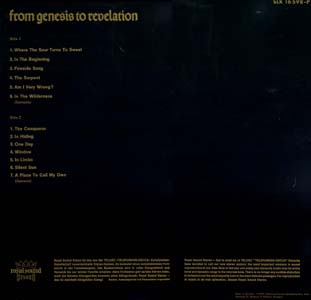
 Genesis‘ first album was not called Trespass but From Genesis To Revelation. Many fans tend to count it as their zeroeth album. It shows no or at best only the most minuscule traces of the style that would make them well-known later, and therefore frequently meets with a refusal and lack of affection. Justly so?
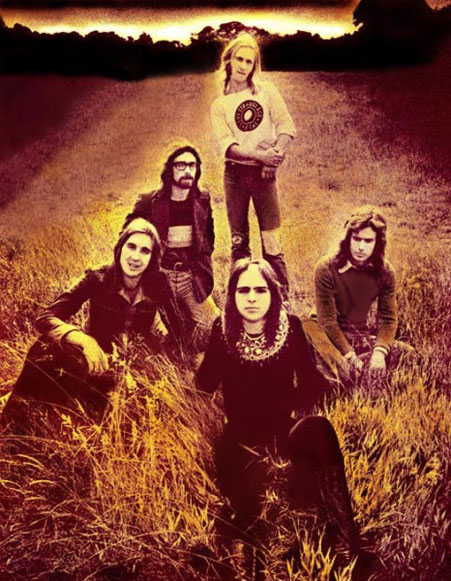
The band did not have the line-up they got known with yet. One could say they did not even exist. They came together to record demo-tapes in the first place. All of them knew each other from Charterhouse public school. The songwriter team Rutherford and Anthony Phillips asked Tony Banks to play the piano for them; Banks only agreed if he could bring his songwriting partner Peter Gabriel to record a song. Soon they were convinced that Gabriel’s voice sounded better than Phillips’ so he ended up singing on all the songs.
When he did not sing, Phillips played the guitar, a position he would retain up to Trespass. Initially, the drums were played by one Chris Stewart, though the drumming on the album would be done by John Silver. The drummer’s stool would not be filled permanently until Phil Collins joined Genesis. Only with him did the band find someone who was accepted as a full member and could incorporate himself.
Demos
These boys (most of them were around 17 at the time) managed to land a record contract with Jonjo Music in August 1967. That only meant that a single would be released. King was an alumnus of Charterhouse and had had quite a successful hit with Everyone’s Gone To The Moon. A shallow pop song though that may have been, he nevertheless seemed to be a person of success and influence, and they found it very promising that they could have him produce them.
They recorded two singles with King that came out in February and May 1968. Both did just well enough that Kind decided to record a full album with the band during the summer holidays. This was quite an unusual move. Rock music was quite a young business then that was run by young people and rather looked down upon by others in the world of music. Rock was new territory, with infinite space to explore, try out and invent things – in music as well as business. Radio stations were important means of distribution – for in those times you could not read as much about pop music in a whole year as you now can in one day (as Tony Banks put it).
The band were keen to into this business. In order to please Jonathan King, who liked it simple, they wrote a song in the style of the Bee Gees, Silent Sun. King liked it and made it the first of the two singles. The band were developing in another direction, though. Their music was more and more determined by long, meandering passages, a style they would develop and extend later on. Besides the usual guitars it was Tony Banks’ organ playing that left its mark; according to Anthony Phillips, Banks was the most accomplished of the instrumentalists). None of this can be heard on From Genesis To Revelation, though.
Recording
Jonathan King christened the band Genesis. He found it a fitting name for a new creation that would make the beginning of his career as a serious producer. He attempted to drive them in a same direction as the singles that had been gentle and acoustic. For one thing, he felt that there was a niche for them, and for another, such music did not require a large number of instruments the band could not afford. Another reason was the aim for mass-compatibility in easy listening. Not only did he try to steer the band away from all the “organ nonsense”, but he also had the idea to tell a story in the album, the story from Genesis to Revelation. (Which also means that The Lamb was not the band’s first concept album).
Did that idea come from the band name, or vice versa? Who knows. It turned out that there was an American band called Genesis, too. On short notice the band name was dropped from the cover so that it only had the album title in old-fashioned Gothic print. It is said that this caused record stores to place the album in the corner for religious music which in turn would have contributed to the meager sales. But that may be a pious legend…
As with the Silent Sun single, string arrangements were added to the recorded songs. It was a fait accompli for the band who only found out when the album was released. They had accepted the strings for the single, but this time Anthony Phillips found them terrible, disfiguring, overly sweet and not at all corresponding to the simple and straight approach of the band. The fourth CD on Archive I 1967-1975 contains several songs from the album without the strings (“FGTR naked”, as it were). From them one gets a good impression of what was originally intended.
The album
One of the problems in discussing the album is the fact that it has been (re-)released several times over on vinyl and CD with varying track lists.
Usually, the singles or other songs augmented the songs from the original version. This review shall concern itself with the original track list.
The songs are quite simple. The leading instruments are piano, guitar and vocals, plus the strings. The overall sound of the album is undemonstrative. There are no banging drums, not overpowering electric guitars, none of the aggression that surfaces in The Knife; everything is lovely and peaceful. – A hippie album?
The lyrics are quite simple. At times they are full of pseudo-sophisticated mock social criticism with imagery that tries to be poetic. The first half of the album actually does sort of follow the creation as described in the Bible. In The Beginning does not go far beyond a longer rephrasing of DIE ERDE WAR WÜST UND LEER. Fireside Song outlines something like “on the first morning the world was peaceful and beautiful”, and The Serpent describes man as innocent and free of sin right after the creation.
The second half of the album moves to more general topics. There is talk of aggressive rich conquerors, of limbo, but also of windows out of the confusion. Love is declared in One Day and of course also in Silent Sun. It all ends with the presentation that the devil is dead and one has finally found a place to call one’s own.
Musically, the songs stick to the conventional pattern of verse and chorus. There are several unconnected interludes between the rather short songs in which some of the tunes are reprised. What is remarkable is the fact that electric guitars are only used to characterize something as evil. Apart from the strings (that are not used for every song) there are also a brass group and a solo trumpet. They all give the album a gentle feel.
At the time the album was recorded the band were not tuned into each other, in fact they had hardly managed their instruments. Some of the flaws can be heard on the album, e.g. a bum note in the Window intro. Gabriel forces his voice up for In The Wilderness almost beyond his possibilities. The flute he plays on Am I Very Wrong is barely not off-key, but the whole song seems constantly on the brink of collapsing. The whole production is amateurish. The fade-out in A Place To Call My Own is extremely sudden – probably owing to the lack of space on the LP.
Some of the songs still capture the listener’s attention. Where The Sour Turns To Sweet right at the beginning has acceptable lyrics alongside a mysterious quiet tune penned by Banks and Gabriel that can muster some energy in the chorus. The harsh sounds of In The Beginning make one listen twice, too. The Serpent, the original of which was called She Is Beautiful tries to sound like the Rolling Stones. In The Wilderness is, at its core, an interesting composition that is absolutely drowned in violins. One Day sounds like the good old Beatles, and Silent Sun aims at an hymnic attitude that is actually really touching. There are good moments on the record, but if you use later Genesis qualities as a standard you will be disappointed. The songs run their course without causing much excitement, and there are hardly any artistic detours.
It should be mentioned that there also is a mono version of the album, which is an independent mix (so not just a 2 into 1 mix of the stereo version). What is most remarkable about the mono version is that it has almost no echo effect on the vocals and the string and brass groups do not come so far to the fore. Several songs are a few seconds longer or shorter. The overall artistic impression is not affected.
So then...
It was only after the release of the album that the band began to play shows and really become a tight formation. Genesis split from Jonathan King as a producer after their contract, which had been shortened to one year, had run out. Praise to the parents of the band members, because they insisted on reducing the runtime of the contract from five years to twelve months. Jonathan King certainly meant well, but he was the wrong person for what the band were going to do. Still: He did send Genesis on their way and gave the band a start that was not too easy, as some of them felt in retrospect. He prompted them to fight for their music and to look for the right partners. Soon after they met Tony Stratton-Smith who enabled them to properly start their career with another album, Trespass.
The live albums in one box - bonus material included
Genesis live – not just the band, but many critics and many fans felt that the strength of the band lay on the stage rather than in the studio. Though this may have changed a bit throughout the band’s long history Genesis have always been an excellent live band, whether they played clubs, theatres, arenas, stadium or such incredibly large places as Hockenheimring and the Circo Massimo. The live album set became a possibility when the first boxset 1976-1982 turned out to be a success. Now that the live box set has appeared it offers lots of material – for discussion: about the content, the technology, design, sound and bonus material.
Get ready for a long text about a story that perhaps was destined to be like this but still is a story of many missed opportunities.
Content
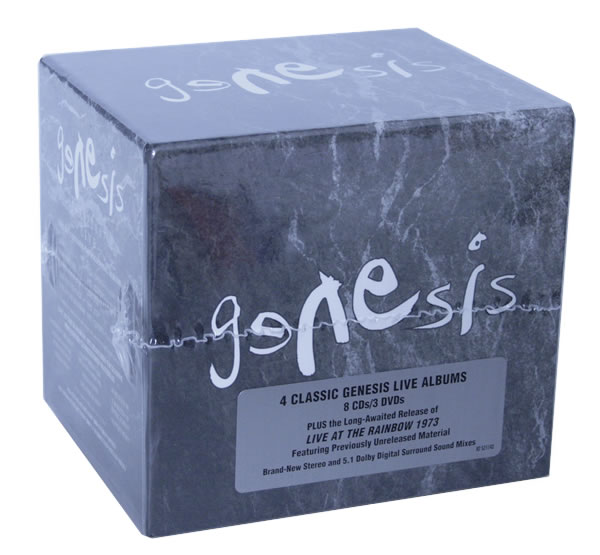
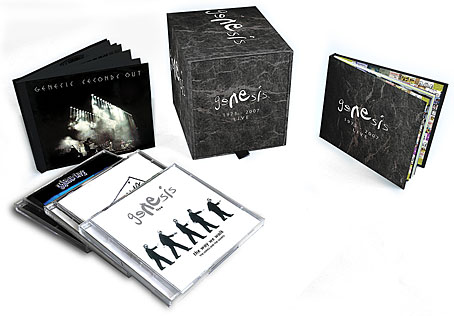
The 1973-2007 live box set contains:
| Genesis Live (Stereo/5.1 CD/DVD): Watcher Of The Skies Get 'Em Out By Friday The Return Of The Giant Hogweed The Musical Box The Knife Back in N.Y.C.* Fly on a Windshield* Broadway Melody of 1974* Anyway* The Chamber of 32 Doors* * bonus tracks from The Shrine Auditorium, Los Angeles - 24/01/75 |
Seconds Out (Stereo/5.1 2CD/DVD): Squonk Carpet Crawlers Robbery, Assault & Battery Afterglow Firth Of Fifth I Know What I Like (In Your Wardrobe) The Lamb Lies Down On Broadway The Musical Box (closing section) Supper's Ready The Cinema Show Dance On A Volcano Los Endos |
| Three Sides Live (Stereo only 2CD) Turn It On Again Dodo Abacab Behind The Lines Duchess Me And Sarah Jane Follow You Follow Me Misunderstanding In The Cage (Medley: Cinema Show / The Colony of Slippermen) Afterglow One For The Vine Fountain Of Salmacis It / Watcher Of The Skies |
The Way We Walk (Stereo only 2CD) Land Of Confusion No Son Of Mine Driving the Last Spike Old Medley (Dance on a Volcano/The Lamb Lies Down On Broadway/The Musical Box/Firth of Fifth/I Know What I Like) Throwing It All Away Fading Lights Jesus He Knows Me Home By The Sea / Second Home By The Sea Hold On My Heart Domino The Drum Thing I Can't Dance Tonight, Tonight, Tonight Invisible Touch Turn It On Again Mama That's All In Too Deep |
| Live At The Rainbow 1973 (Stereo/5.1 CD/DVD) Watcher Of The Skies* Dancing with the Moonlit Knight The Cinema Show I Know What I Like(In Your Wardrobe) Firth of Fifth The Musical Box* More Fool Me The Battle of Epping Forest Supper's Ready * on DVD only There is also a free slot for the Live Over Europe 2CD set. |
 |
 Technology:
Since 2004 the magic word for the ultimate sound experience in the Genesis camp is “Super-Audio CD”. Peter Gabriel started it all in 2003, Genesis soon wanted to follow, but it took until 2007 before the first set with SACD-hybrid/DVD double disc sets appeared. It was followed by two more boxsets in this format – lavishly equipped with SACD stereo, SACD surround, CD stereo, Dolby Digital 5.1 and dts 5.1 sound. You could not really as for anything more.
Whether surround sound makes sense for live albums is a question everybody has to answer for themselves. But before we come to the question of surround or stereo or both we need to note that there are no SACDs in this boxset anymore. The Super Audio CD has faded away in recent years and it is doubtful whether it still has a future.
So this tradition ends here. No high-resolution SACD sound, but at least there is dts on the bonus DVDs – which brings us to the next topic: There are no bonus DVDs for all albums. The Way We Walk and Three Sides Live are available in stereo only, and so is Live Over Europe because it is the 2CD set that you can buy on its own and place in the box set. Only Seconds Out, Genesis Live and the bonus CD Live At The Rainbow 1973 are treated to a bonus DVD and can be enjoyed in surround sound.
Design:
It is a well-known fact that you can complain about everything and be contented with nothing. The same goes for the design of the Live boxset. Since the previous Genesis box sets seem to have used up the whole set of colours available at EMI (green, blue and red), this box was “painted” in a selection of dark greys. So far, so good. But it was decided that this box had to differ even more from the others, and so the relevant album covers do not shine through the Genesis logos – the logos are simply white with a black border. The powers that be apparently decided that a special box does not have to fit to the rest of the series... So let us open the lid and find out whether the prints of the individual CDs have been reproduced with similar passion…
Genesis Live has the original artwork in a regular plastic jewel case. The booklet contains Peter’s weird story that was originally on the back of the sleeve and information on the tracks – that is not a lot, but the 1973 original did not have anything else either. It might have been an option to extend the booklet from four pages to eight and include photos from the period and a couple of words from a band member as a bonus, but … oh, well. The CD and DVD both carry the Charisma “pink scroll” label that looks really good.
Seconds Out comes as a little book with slots for the CD/DVDs and with a little faux-pas: The “G” of “Genesis” is situated exactly on the bend of the book because the whole cover motive was not centered but place too far to the left. This looks bad when you open the book and it could have been avoided, dear Mr Peyton from EMI! The 28 page booklet contains all photos that were in the original LP artwork and all the information about the tracks. It also has an essay in which the British comedian Al Murray talks about his love for Genesis in general and this album in particular. This is quite entertaining, but since the whole box set has no band interviews at all a couple of words by messieurs Banks & Co. might have been a better idea. CD and DVD follow the original release in that their labels show live photos. If you find fumbling the CDs in and out of the booklet annoying you may want to buy some empty 3CD boxes the size of a normal jewel case that facilitate the handling and avoids scratches.
Three Sides Live comes in another regular jewel box with a booklet that has the original artwork and photos. The information provided about the songs are a bit dodgy. It claims that Bill Bruford played the drums for Slippermen in the Cage medley. Steve Hackett on the other hand is not mentioned as the guitarist on It / Watcher Of The Skies though this recording is from 1976. Well, perhaps nobody ever realized before that Steve went home that gig before the encores. Did this booklet have to be as minimalistic? Was there no time for a comment? Are there no photos from the tour? The CD (no DVD, remember?) follows the design of the original UK LP release. Three Sides Live in block letters instead of handwriting looks peculiar, but it is authentic. And another thing – Three Sides Live was released only in the UK with four sides of live music (like the present version). Some export copies had a bright orange sticker that covered the word “Three” and read “Four” instead. If you want to be absolutely authentic you may want to create this sticker for yourself…
 Chris Peyton had some more room for his creativity on The Way We Walk because he had to create one new cover design from two individual similar, but essentially different cover designs. The black and white characters from The Shorts made it to the front of the new product while their colourful competitors from The Longs only qualified for the back. Since EMI loves to leave away colours the new logo is now neither golden nor purple but grey. The 8-page booklet (so they can do it!) does not contain all the photos from both booklets – they would have had to use 12 pages, and that would probably have blown the budget. Thus only minimal information without any extras. Even the info about the three bonus tracks only reveals that they were not recorded on the We Can’t Dance tour. Fans do not care whether the recordings are from 1983, 1986, 1987, right? Or were they taken from the Calling All Stations tour 1998 to make up for the fact that that tour is not presented at all in this nearly definitive Genesis live set? Well, it is a good thing that we are not presented everything on a silver platter, and a nice touch of the record company to motivate us to participate in life and use search engines and fan websites o track down the information. The design of the CD labels: Yes, you can do it like that, and the original was not much to write home about either.
The gap in the box is wide enough so that the double live album Live Over Europe (2007) fits in nicely. That is all we have to say about that. But the idea is a stroke of genius. Why did not they do it for Three Sides Live and The Way We Walk? The box could have been sold at a much lower price – and still offer the same collector’s value for the fans.
The bonus CD/DVD set Live At The Rainbow 1973 comes, as the bonus sets in the other box sets did, in a thick booklet designed like the box itself, that is, in this case, grey in grey. As soon as you open the booklet you realize why everything else had to be so grey: All the colours were saved for this. On the double pages that hold the CD and the DVD there are countless Genesis concert tickets, tour passes and posters. With a good magnifying glass you will be able to spot the odd rarity. The discs are hard to notice, though, because their label follows this design. Nothing to moan about here. Thank you, Chris!
Many photos in the booklet give us brief run-through of what Genesis have done on stages all over the world from the early 70s to 2007. That is okay for a booklet of this size. On 18 of the 60 pages Philip Dodd (Google knows who he is – I did not until five minutes ago) talks about his visit at The Farm when this box set was nearing completion. He also writes about the Genesis live albums and the tours on which they were recorded. In between he quotes Tony, Mike, Steve, Phil and Nick Davis, and these quotes provide additional, often very interesting insights on some live songs and shows. They also try to explain to the fans why some recordings many had fervently hoped for were left out and others added instead. The upshot of this is disappointing, though, because Tony and Nick feel that “everything worth releasing” has now been released and that fans will be happy. In thinking so they ignore the enormous gap between the amount of material available and the amount that actually left the vault at The Farm and made it to the stores as well as the equally large gap between what the members of the band consider good recordings and what fans would like to hear besides that. The information about the CD and DVD tracks complete the booklet with rudimentary data. If you want to know which day the concert at the Rainbow took place in 1973 EMI and Tony Smith Personal Management have given you a nice task so that you do not sit around in front of your speakers all day and get entertained by Genesis “live”.
The design of the box is okay, there is neither sloppy work nor big flaws. But while the artwork is well done and deserves the praise one would like to know why some of the things were designed so carelessly. This is supposed to be a box for fans who already have everything else and know everything the band has ever done, and one would expect more from it. There used to be a commercial with a fitting punchline: “Perhaps they should have asked someone who really knows their stuff.”
Six Of The Best: Rehearsals & Live
 There are many and various reasons why rock bands hold reunions. Most common is for nostalgia, the need to revisit past glories for contemporary fans and for the pocket book. Others are held for charitable reasons. Such was the case for the Six Of The Best show in 1982. Careful not to call it a Genesis reunion for legal and speculative reasons, it is to date the only time Peter Gabriel played with Genesis for a full-length concert since his departure in 1975 (Gabriel did join the band for “I Know What I Like” in New York in July 1978).
The cause was quite worthy. Gabriel, in his attempt to introduce and preserve the heritage of world music and to find such interesting acts a new audience, had invested quite a lot of time and money into the World Of Music And Dance (WOMAD) festival at Shepton Mallot on July 16th. Unfortunately, his ideals were higher than his business sense and didn’t count on acts such as La Place De La Concorde, OK Jive and The Drummers Of Burundi to NOT draw a sizable audience.
Genesis were still on the Encore tour, their biggest yet, and offered to donate proceeds from one of their shows for his cause. Instead of accepting charity from his old mates, Gabriel decided instead to schedule the one-off reunion to raise funds. Unfortunately the show wasn’t professionally recorded (as far as we know), but there were several enterprising audience members to capture the event for posterity.
In 2009 a soundboard recording of the rehearsal surfaced and was quickly pressed onto silver disc. Six Of The Best: Rehearsals & Live on Virtuoso is a four disc set presenting both tapes in one convenient package. This is the first time the reunion concert has been issued on silver disc in almost fifteen years and it receives a welcome overhaul in a definitive package. Hammersmith Odeon, London, England – September 29th, 1982
The only rehearsal for the event occurred on the afternoon of Genesis’ September 29th show at the Hammersmith Odeon, the penultimate show on the Encore tour which was recently released on Man On The Hammersmith (Virtuoso 137/138). The ninety minute soundboard recording was first pressed on All The Help I Can Get (GR 458/459). The sound quality of the Virtuoso doesn’t differ significantly from the Godfather release.
A very clear but unbalanced recording, it clearly illustrates the band resurrecting the older numbers for the reunion show. Several of the old songs like “The Lamb Lies Down On Broadway,” “I Know What I Like,” “In The Cage” and the epic “Supper’s Ready” are already well rehearsed because they were already part of Genesis’ live act.
But the other numbers require much more work. Gabriel has to practice the opening to “Dancing With The Moonlit Knight” several times before getting right. They choose to play the opening of the song as an introduction to “Carpet Crawlers,” the same arrangement Genesis employed on the Duke tour in 1980.
“Firth Of Fifth” was part of the set as recently as the Duke tour, but “The Musical Box” hadn’t been played in its entirety since 1974 (only the fast paced instrumental was played in medley). Collins and Gabriel try to sing the first verse of “The Musical Box” in union but quickly drop the idea. Gabriel’s flute out of tune in the beginning of “The Musical Box.”
“In The Cage” is cooking along until a key change is missed and they have to start again. Most work goes into Gabriel’s “Solsbury Hill.” It’s interesting hearing him teach the band how to play and to work on the Genesis arrangement of one of his most famous solo works. Cliff, in his review of the Godfather release two years ago, opined that there must have been much more to the rehearsal since “Turn It On Again” must have been rehearsed. Nothing new has surfaced since, so this is probably all we’ll get to hear from the rehearsal session.
Six Of The Best Reunion Show
Concert Bowl, Milton Keynes, England – October 2nd, 1982
Disc 1 (46:49): Back In NYC, Dancing With The Moonlit Knight (Take 1), Dancing With The Moonlit Knight (Take 2), The Carpet Crawlers, Firth Of Fifth, The Musical Box, The Lamb Lies Down On Broadway, Fly On A Windshield, Broadway Melody Of 1974
Disc 2 (47:39): In The Cage (Take 1), In The Cage (Take 2), Supper’s Ready, The Knife, Solsbury Hill (Take 1), Solsbury Hill (Take 2), Solsbury Hill (Take 3)
Disc 3 (72:49): Introduction by Jonathan King, Back In NYC, Dancing With The Moonlit Knight, The Carpet Crawlers, Peter Gabriel MC, Firth Of Fifth, The Musical Box, Solsbury Hill, Member Introduction, Turn It On Again, The Lamb Lies Down On Broadway, Fly On A Windshield, 1974 Broadway Melody, In The Cage
Disc 4 (47:25): Introduction Of Supper’s Ready, Supper’s Ready, I Know What I Like (with Steve Hackett), The Knife (with Steve Hackett), Closing Words
For such an important show in Genesis’ history, there have been very few pressed versions available. The first was The Lamb Woke Up Again (Stonehenge STCD 2008/2009) which contains the entire show plus the three song encore from Steve Hackett’s January 29th, 1983 show in Guildford where Peter Gabriel and Michael Rutherford joined him onstage for the encores. In the late nineties Highland released Six Of The Best (Highland HL 388/389) using a fair to good tape.
Since then several more audience tapes have been uncovered. Arguably, the best version was on the fan produced Live In Milton Keynes (TM Productions) and was commercially available on the CDR Emotional Reunion (Amity 106). It is a very clear and enjoyable audience tape of the entire concert. It also picks up nicely the sound of 60,000 punters singing along to the music and singing “Happy Birthday” to Michael Rutherford.
Genesis’ first manager Jonathan King gives some introductory words, speaking about how they formed sixteen years ago, before the band start with the thumping rhythms of “Back In NYC.” Six pallbearers carry a coffin onstage while the band extend the intro. After placing the coffin onstage, it opens and out comes Peter Gabriel dressed in Rael costume. The opening lines are muffled due to a faulty lead, but it clears up nicely and the show gets off to a wonderful start.
After a pause, Gabriel sings the opening to “Dancing With A Moonlit Knight” which segues directly into “Carpet Crawlers.” Collins joins in on the verses like in the old days, but it is Gabriel’s mesmerizing performance that carries the tune.
 “Some of you may be wondering what we’re doing here.” The audience replies “NOOOOOOOOO” in unison. Gabriel continues anyway to talk about WOMAD, its financial woes, and to tell the audience they will play a selection they think they would like to hear. “Firth Of Fifth” follows (with Darryl Steurmer playing the solo).
“The Musical Box” is a bit sloppy with Steurmer being the main culprit. He doesn’t know the guitar embellishments during the opening verses and makes up his own which sound strange. He’s much more confident during the heavy instrumental, however, since it has been part of the set.
The middle part of the show is a trade off. They play “Solsbury Hill” from Gabriel’s first album. And, after the band introductions, Gabriel and Collins switch places. Collins takes over vocal and Gabriel plays drums for “Turn It On Again” from Duke.
Gabriel then mentions they rehearsed in Hammersmith for the show and starts telling the train story from Genesis Live. He stops and jokes “the only thing we didn’t rehearse were the stories and that is the wrong story.” He then tells another story as an intro to “The Lamb Lies Down On Broadway.” They play all of the first side of the first LP except “Cuckoo Cocoon” after “Broadway Melody Of 1974? and “The Grand Parade Of Lifeless Packaging” after “In The Cage.”
Afterwards Gabriel tells the tube story again as an introduction to “Supper’s Ready.” It’s very tight since they’ve been playing it on tour. Gabriel dons his flower costume to the approval of the audience.
Steve Hackett comes onstage for the final two numbers. “I Know What I Like” features Collins playing his tambourine games, and “The Knife” is very short and powerful. Gabriel afterwards thanks everyone for coming and Collins wishes everyone a good night.
While this isn’t the greatest Genesis concert it is historically important. Thirty years on it is the final time Gabriel sang for Genesis in concert and, after the aborted plan for him to rejoin Genesis on their reunion in 2007, probably will remain so. There are many musical mistakes and miscues, but the emotion is right and is fun to listen to. Virtuoso did a good job bringing these two tapes together into one convenient package. Until a soundboard and / or video of the show surfaces, Six Of The Best: Rehearsals & Live will be the definitive silver title.
Genesis Concert 1973 in HD
Recorded at The De Montfort Hall, Leicester, England and The Free Trade Hall, Manchester, England in February 1973.
Much is said about the history of Genesis; What it is, what it was, what it could have been. As much as it is beating a dead horse, I can;t help but wonder if and/or wish that the rest of the band had had the vision to see the reality of how much Gabriel's theatrics added to the group as a whole, and how little it ultimately took away.
If anything, he was bringing the entertainment value to the same level as the musicianship.
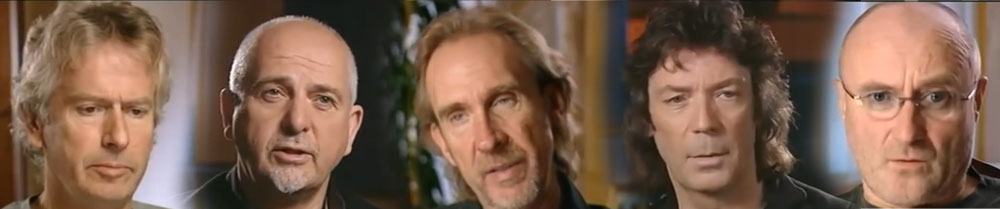
If you’re of a certain vintage—let’s just say old enough to bore millennials to death with nostalgic rants about how MTV used to play music videos, man—then you will remember Peter Gabriel’s visually stunning “Sledgehammer” video from his award-winning 1986 album So. You will have had your heartstrings tugged by his “In Your Eyes” and its pitch-perfect appropriation in Cameron Crowe's Say Anything. And you will know—though maybe not as well as Patrick Bateman—the sounds and images of Phil Collins’ “In the Air Tonight.” This music may not have aged as well as those of us who grew up hearing it (or vice versa), but it left an indelible impression on a generation and defined 80s pop culture as much as Michael Jackson or The Bangles.
But if you are of a slightly earlier vintage, you will remember these fine musicians for an entirely different reason. Before the catchy dance-pop silliness of “Sussudio” and "Big Time," there was the arty, high-seriousness of Genesis, as fronted in its heyday by Gabriel, with Collins pounding the drums. Though the band persisted well into the 80s and 90s after Gabriel’s 1975 departure, melding funk, soul, and pop in innovative ways as Collins took the lead, die-hard Genesis fans swear by its classic configuration, with its surreal concept albums and stage shows rivaling Wall-era Pink Floyd or Bowie’s Stardust phase. If you're none too keen on later Genesis, the slick synth-rock hit machine, and if the aforementioned flamboyant productions are your cup of English prog-rock tea, then we have a treat for you.
Just above is a fully restored concert film of a 1973 performance at England’s Shepperton Studios, "perhaps," writes Dangerous Minds, “the single best representation of Peter Gabriel-era Genesis on film.” Though the concert precedes the band’s Gabriel-era swan song---double concept album, The Lamb Lies Down on Broadway---it does showcase the strongest material from their two previous records, Foxtrot and the truly excellent Selling England by the Pound. Prominently on display are the eccentricities that sharply divided critics and enamored fans: the odd time-signatures and abrupt tempo changes, virtuosic musicianship, literate, esoteric lyrics, and Gabriel’s theatrical makeup and costuming. The effect of it all is sometimes a bit like Rush in a production of Godspell, and while This is Spinal Tap took a lot of the air out of this sort of thing three decades ago, the film remains an impressive document even if the performances are hard to take entirely seriously at times. See below for a full tracklist:
“Watcher of the Skies” (8:04)
“Dancing with the Moonlit Knight” (9:02)
“I Know What I Like” (5:46)
“The Musical Box” (11:39)
“Supper's Ready” (23:59)
The story of the film’s restoration is intriguing in its own right. The Shepperton footage was rescued by a small group who pooled resources to buy it in a New York estate sale. Since then, Youtube uploader King Lerch and his confreres have upgraded the original restoration to the HD version you see above.