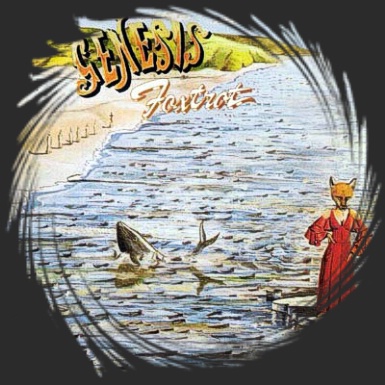
 Genesis' undisputed masterpiece, "Supper's Ready" first appeared on Foxtrot in 1972.
A 23-minute epic in seven parts, it told the cosmological tale of a fight between good and evil, beginning with a vision in an ordinary living room and ending with the triumph of the New Jerusalem. Sidelong suites were already becoming a standard progressive rock feature: 1972 saw the release of Yes' "Close to the Edge" and Van der Graaf Generator's "A Plague of Lighthouse Keepers" came out in 1971, not to mention Pink Floyd's 1970 "Atom Heart Mother" and Jethro Tull's 1972 "Thick as a Brick," the latter a 45-minute piece.
"Supper's Ready" was as good as any of them, but it also had Peter Gabriel's charisma and solid theatrical staging and the piece quickly became a stage highlight and a fan's favorite. The band would never be able to deliver another song of this caliber.
The piece starts with "Lover's Leap," an acoustic ballad that segues seamlessly into "The Guaranteed Eternal Sanctuary Man."
This one picks up the pace, with drums and keyboards entering and Gabriel's voice becoming more theatrical. The section cuts abruptly, leaving a group of children singing "We will rock you, rock you little snakes/We will keep you snug and warm" and making the transition to part three, "Ikhnaton and Itsacon and Their Band of Merry Men."
The battle begins and the beat becomes the horses' gallop, providing the first of two high-energy instrumental passages. "How Dare I Be So Beautiful?" takes us "in the chaos the battle has left," which consists of soft guitar chords played with a volume pedal.
This section is cut short by the transformation of Narcissus (and Gabriel) into a flower, which marks the beginning of "Willow Farm," a medium-tempo funny rock number full of plays on words.
Critics often pointed out the fact that this section feels out of place; it brings comic relief and became a live favorite (Gabriel with his flower mask executed a surreal dance), but its relevance is indeed puzzling.
After this interlude, the piece moves on to "Apocalypse in 9/8," a frightening section where the musical climax of the suite is built on a jagged rhythm, featuring one of Tony Banks' most memorable solos. Live, Gabriel reentered the stage after the solo with a strange triangular mask.
The final section, "As Sure as Eggs Is Eggs," provided a dramatic ending in a contrasting major key, accompanied live by a magnesium flash that revealed the previously black-clothed singer now all dressed in white and holding a neon light in front of him for the majestic finale.
The piece ended with a fadeout both on record and on stage, usually leaving the audience breathless. Live versions tended to be a more dramatic experience as a whole, but less interesting musically, as the band was forced to use tapes (children's choir, some atmospheres) and to scale down the instrumentation (the studio version had lots of overdubs).
A representative 1973 recording can be found on Genesis Archives, Vol. 1: 1967-1975, but the one found on the Live in Montreal bootleg is superior.
The piece was performed at every show from 1972 to 1978, except for the Lamb Lies Down on Broadway tour.
From 1976 onward, Phil Collins sang lead with less conviction, but the music tended to be more accurate (an example can be found on Seconds Out).
The "Apocalypse in 9/8" solo was performed as part of a medley in the 1990s and "Willow Farm" was intended to be the backing track for the"Watcher of the Skies" single (never released).
Otherwise, the piece was always performed in its entirety, usually introduced by an unrelated story (one version of which was printed on the back cover of Live).