I: "Lover's Leap" (0:00 - 3:47)
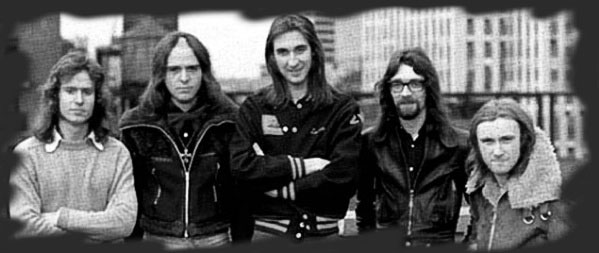
 This section features a gentle arpeggiated guitar backing (with Hackett, Banks and Rutherford all playing 12-string guitars), soft electric piano (Hohner pianet), bass pedals, cello and flute, and a section with folky three part vocal harmonies (which omit the third note of the chord). The only percussion used is triangle, cymbals, and bells.
Lyrically it tells of a man returning home after a long time to be greeted by his lover, and mentions supernatural imagery ("six saintly shrouded men"), which Gabriel claims relate to a genuine spiritual experience which occurred with himself, his wife Jill and producer John Anthony. According to Gabriel, during a late-night conversation, his wife began speaking with a completely different voice. Gabriel held up a makeshift cross out of a candlestick and another household item, and Jill reacted violently. Jill was eventually calmed down and taken to bed, but neither Peter nor John Anthony slept that night. On another occasion, also late at night, Gabriel looked out of the window of his wife's parents' house to see what he perceived to be an entirely different lawn, across which seven shrouded men were walking. Gabriel recounted that these experiences led him to contemplate notions of good, evil, and the supernatural, and eventually inspired the lyrics to "Supper's Ready."
In the programme given out at Genesis concerts at the time, "Lover's Leap" was explained as: "In which two lovers are lost in each other's eyes, and found again transformed in the bodies of another male and female."[4]
This segment was performed as part of an acoustic medley on the group's 1998 Calling All Stations tour with Ray Wilson on vocals.
II: "The Guaranteed Eternal Sanctuary Man" (3:48 - 5:43)
Banks composed the chord progression whilst still at University. When performing the song live, Gabriel would don a "crown of thorns" headpiece at this point. The piece segués into the next with a Lover's Leap reprise.
The programme describes this section as follows: "The lovers come across a town dominated by two characters; one a benevolent farmer and the other the head of a highly disciplined scientific religion. The latter likes to be known as "The Guaranteed Eternal Sanctuary Man" and claims to contain a secret new ingredient capable of fighting fire. This is a falsehood, an untruth, a whopper and a taradiddle, or to put it in clearer terms; a lie."
III: "Ikhnaton and Itsacon and Their Band of Merry Men" (5:44 - 9:42)
This section is much more dynamic than the previous two, with lively drums, an elegiac electric guitar solo, and a lot of interplay between the guitar and organ (including a section with fast organ and guitar arpeggios, Hackett employing the "tapping" style of playing). The lyrics refer to a battle of some sort, presumably involving Ikhnaton.
The programme spells "Itsacon" as "Its-a-con". It describes this section as follows: "Who the lovers see clad in greys and purples, awaiting to be summoned out of the ground. At the G.E.S.M's command they put forth from the bowels of the earth, to attack all those without an up-to-date "Eternal Life Licence", which were obtainable at the head office of the G.E.S.M.'s religion."
IV: "How Dare I Be So Beautiful?" (9:43 - 11:04)
This is a slow and gentle section, the only instrumentation being treated acoustic piano chords, each chord being faded-in on the recording, thus losing the piano's characteristic attack and sounding more like an organ (it was done on Hammond organ live). The title is a catchphrase used by the band's early music-business contact, Jonathan King. The lyrics deal with the aftermath of the preceding battle, and referring to the Greek myth of Narcissus, who turned into a flower.
The programme describes this section as follows: "In which our intrepid heroes investigate the aftermath of the battle and discover a solitary figure, obsessed by his own image. They witness an unusual transmutation, and are pulled into their own reflections in the water."
V: "Willow Farm" (11:05 - 15:37)
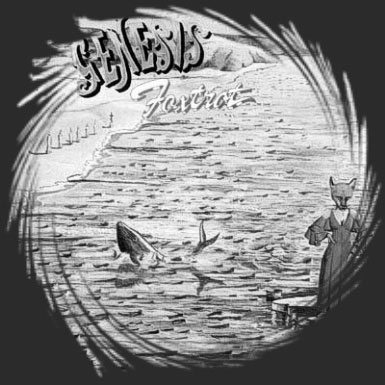
Live in concert, Gabriel would appear in his "flower mask" (by Gabriel's own admission, partly inspired by the BBC children's programme The Flower Pot Men). This section features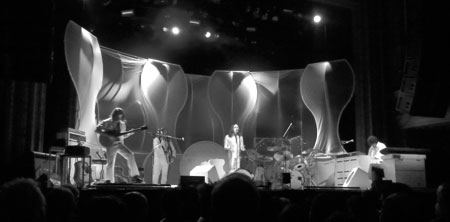 vaudeville-style sections, the Mellotron Mark II's "combined brass" tape set, sped-up vocals, and musique concrète noises of trains and explosions. Lyrically, it has a Python-esque quality, dealing with elements of the absurd in the English psyche, "there's Winston Churchill, dressed in drag, he used to be a British flag, plastic bag, what a drag!" and numerous elements of word play, boarding schools, agricultural depravity and social conformity. The lyrics also reference Foxtrot's cover artwork ("the fox on the rocks") and a song from Nursery Cryme, Genesis' previous album ("The Musical Box").
The programme describes "Willow Farm" as follows: "Climbing out of the pool, they are once again in a different existence. They're right in the middle of a myriad of bright colours, filled with all manner of objects, plants, animals and humans. Life flows freely and everything is mindlessly busy. At random, a whistle blows and every single thing is instantly changed into another."
"Willow Farm" was originally a stand-alone song, with music and lyrics by Gabriel. At one point, while "Supper's Ready" was being written and assembled, Banks or Gabriel had the idea of including "Willow Farm" in the middle of it. Banks commented that this jarring, fast-paced piece prevented "Supper's Ready" from seeming too much like a repeat of their earlier epic "Stagnation".[5]
After the vocal section of "Willow Farm" ends, there is a reflective interlude, not definitely belonging to either "Willow Farm" or the following "Apocalypse In 9/8". It starts with bass pedal, electric guitar, organ and mellotron drones, then proceeds with soft guitar and flute.
VI: "Apocalypse in 9/8 (Co-Starring the Delicious Talents of Gabble Ratchet)" (15:38 - 20:50)
At this point, the drums enter, with the rhythm section striking out a pattern using the unusual metre of 9 beats to the bar (expressed as 3+2+4).[6] The lyrics employ stereotypical apocalyptic imagery, alternating with an organ solo from Banks (played in 4/4 and 7/8 time signatures against the 9/8 rhythm section), then switching to a climactic vocal from Gabriel, and the Mellotron "three violins" tape set. Banks has said that his approach to writing the solo was to parody the style that Keith Emerson had developed with Emerson, Lake & Palmer.[citation needed] In live performances, during the organ solo, Gabriel would don a bizarre "Magog" outfit with geometrical headdress which can be seen on the cover of the band's Genesis Live album. This headdress seems to be associated with the mention of Pythagoras-he of the Pythagorean theorem fame (Euclidean geometry). "Gabble Ratchet" is a reference to the Hounds of Hell;[7] they are usually portrayed as geese, which explains the sound effect heard during this section (18:48–18:53 on Foxtrot). They are also known as "Gabriel's Hounds". The programme for the 1972/3 tour refers to this section as "co-starring the delicious talents of wild geese".[8]
The programme describes this section as follows: "At one whistle the lovers become seeds in the soil, where they recognise other seeds to be people from the world in which they had originated. While they wait for Spring, they are returned to their old world to see Apocalypse of St John in full progress. The seven trumpeteers cause a sensation, the fox keeps throwing sixes, and Pythagoras (a Greek extra) is deliriously happy as he manages to put exactly the right amount of milk and honey on his corn flakes."[4]
This segment was performed as a standalone once in 1978 and on the first leg of the 1986 Invisible Touch Tour as part of the "In the Cage"/"...In That Quiet Earth"/"Supper's Ready" medley.
VII: "As Sure As Eggs Is Eggs (Aching Men's Feet)" (20:51 - 22:54)
 "As Sure As Eggs Is Eggs" is a folklore variation of the logical tautology that "X = X"[9] and in this context is a reference to certainty and faith—being absolutely convinced of the ultimate victory of good over evil and that God and Heaven do indeed exist. "Aching Men's Feet" is a play on "making ends meet".[citation needed] "Apocalypse" segues into this part via a slower section that reprises the lyrics from "Lover's Leap" in combination with the chord progression from "The Guaranteed Eternal Sanctuary Man", backed by a pressed snare drum roll and tubular bells. During live shows, a flash charge would be fired and Gabriel would discard his Magog costume to reveal himself in shining white apparel that glowed when exposed to black light. During one gig, he attempted flying on a kirby wire, and was nearly strangled.[citation needed] From this point to the end, drums, deep bass pedals and Mellotron brass are present, as are Blakean lyrics which reference The New Jerusalem (The Crystal City of God that is established after the death of the Anti-Christ) and the Second Coming of Christ with reference to the biblical Revelation 19:17: "I saw an angel standing in the sun. He cried with a loud voice, saying to all the birds that fly in the sky, Come! Be gathered together to the great supper of God."
After completing the lyrics in this section, Gabriel would pick up and raise an active blacklight tube, holding it near himself, upraised with both hands, as though it were a sword. Gabriel would be the only one lit onstage at this point and would actually appear to be glowing from the combination of blacklight, his reflective white costume and fluorescent makeup. Gabriel considered this effect to be a theatrical way of symbolizing the victory of good/light over evil/darkness.
The piece fades out on overdubbing cascading electric guitar parts. On the original recording this section is in the key of A, but because of Gabriel's inability to properly recreate the vocal performance onstage from either hoarseness or tiredness, the band regularly had to change the key to G.
The program describes this section as follows: "Above all else an egg is an egg. 'And did those feet ............' making ends meet. Jerusalem = place of peace."[4]
This segment was performed as a standalone twice in 1978 and on the first leg of the 1986 Invisible Touch Tour as part of the "In the Cage"/"...In That Quiet Earth"/"Supper's Ready" medley.
The final song on A Trick of the Tail, entitled "Los Endos", quotes from this segment near the very end. As the band fades out, Collins can be heard singing "there's an angel standing in the sun" twice in succession, followed by "free to get back home" as the last notes disappear. These are the only lyrics heard in the song, which is otherwise instrumental; this quote has generally been omitted from live versions (except for Steve Hackett's Genesis Revisited: Live At Hammersmith in 2012).