

Written by Thomas Schrage


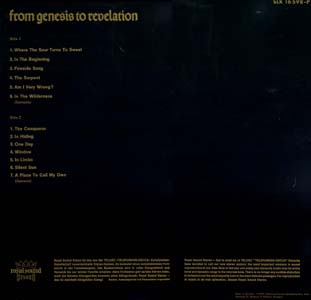
Genesis‘ first album was not called Trespass but From Genesis To Revelation. Many fans tend to count it as their zeroeth album. It shows no or at best only the most minuscule traces of the style that would make them well-known later, and therefore frequently meets with a refusal and lack of affection. Justly so?


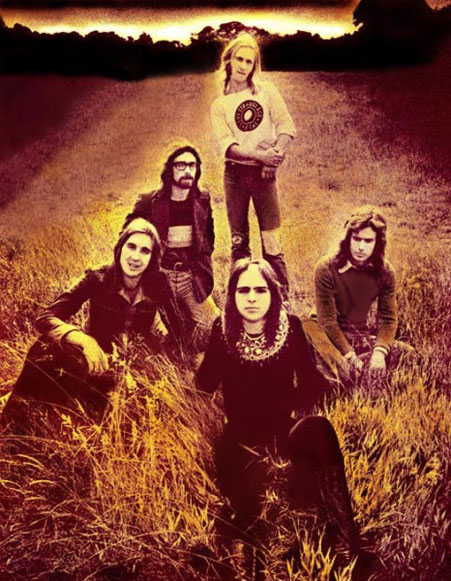
The band did not have the line-up they got known with yet. One could say they did not even exist. They came together to record demo-tapes in the first place. All of them knew each other from Charterhouse public school. The songwriter team Rutherford and Anthony Phillips asked Tony Banks to play the piano for them; Banks only agreed if he could bring his songwriting partner Peter Gabriel to record a song. Soon they were convinced that Gabriel’s voice sounded better than Phillips’ so he ended up singing on all the songs.

When he did not sing, Phillips played the guitar, a position he would retain up to Trespass. Initially, the drums were played by one Chris Stewart, though the drumming on the album would be done by John Silver. The drummer’s stool would not be filled permanently until Phil Collins joined Genesis. Only with him did the band find someone who was accepted as a full member and could incorporate himself.

These boys (most of them were around 17 at the time) managed to land a record contract with Jonjo Music in August 1967. That only meant that a single would be released. King was an alumnus of Charterhouse and had had quite a successful hit with Everyone’s Gone To The Moon. A shallow pop song though that may have been, he nevertheless seemed to be a person of success and influence, and they found it very promising that they could have him produce them.

Read More


The year was 1969. Among the many discoveries made that year was something called "the import record" - albums from England that were either different from those released here, or just plain never released in Athens.

I remember pulling together a stack of domestic promotional albums and heading to a downtown rendezvous, near Acropolis to a place called Plaka, where in a small records shop they were traded for a decidedly smaller stack of imports. One of them was a little item that had a black cover with gold lettering proclaiming FROM GENESIS TO REVELATION. It was the first effort of a British group that couldn't decide on their name, although the music was much more decisive - I immediately vowed to become a fan once they figured out what to call themselves....


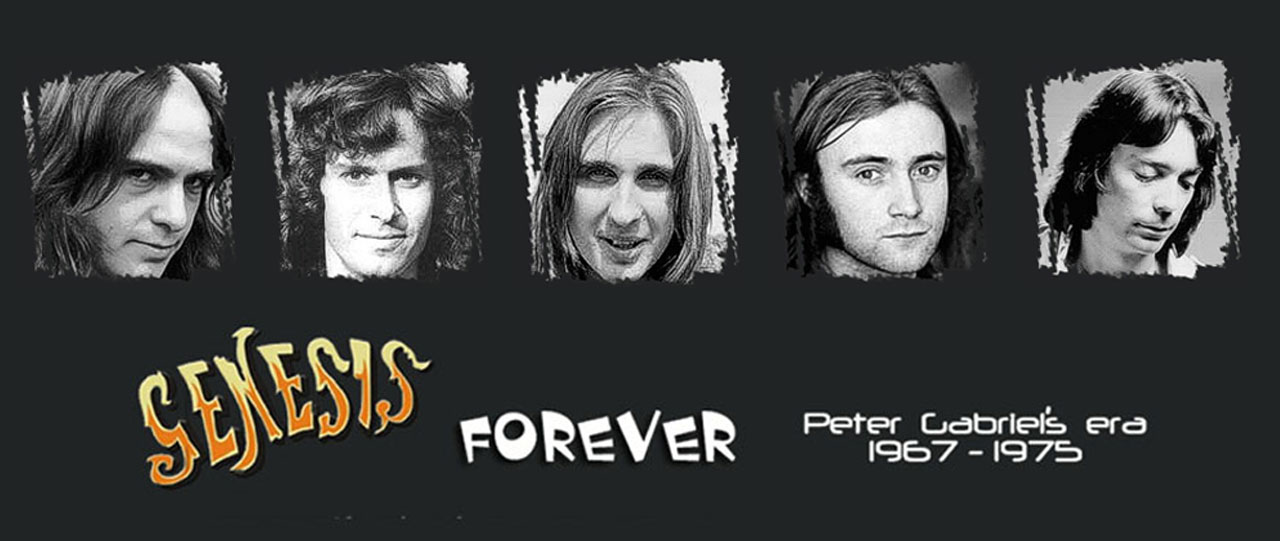
Genesis Group Members
Peter Brian Gabriel Gemesis 1970 - 1975
BORN: February 13, 1950, London, England
As the leader of Genesis in the early '70s, Peter Gabriel helped move progressive rock to new levels of theatricality. In his solo career, Gabriel was no less ambitious, but he was more subtle in his methods.
Anthony George Banks Gemesis 1970 - 1975
BORN: March 27th, 1950, East Sussex, England
Tony Banks started his career with Genesis in 1967 as the pianist/keyboardist, after the emergence of the Charterhouse School Bands The Garden Wall, which Tony was a member,..
Michael John Rutherford Gemesis 1970 - 1975
BORN: October 2nd, 1950, Guildford, Surrey, England
A founding member of the long-running art-rock band Genesis, Mike Rutherford also made the occasional excursion into solo projects, most notably the pop combo Mike + the Mechanics.
Phillip David Charles Collins Gemesis 1970 - 1975
BORN: January 31, 1951, Chiswick, London, England
Phil Collins' ascent to the status of one of the most successful pop and adult-contemporary singers of the '80s and beyond was probably as much of a surprise to him as it was to many others.
Steven Richard Hackett Gemesis 1970 - 1975
BORN: February 12th, 1951, England
Formerly a member of various minor bands, including Canterbury Glass, Heel Pier, Sarabande and Quiet World, the latter releasing a solitary album on Dawn Records in 1970, Hackett joined Genesis as guitarist in early 1971.


March 16th, 2015 By Jim Laugelli

I could have very easily chosen a number of other Genesis albums but I decided on this one simply because it features what is perhaps the most significant song in all of progressive rock: “Supper’s Ready.” My introduction to Genesis occurred 41 years ago and had one of the most profound impacts on my personal musical journey. On that night, in May of 1974, a friend asked if I wanted to see a concert. He had a few extra tickets for a Genesis show and no one to join him. I never heard of the band and for some reason thought they were probably some sort of acoustic act. As far as I recall, my friend knew little about the band as well. I believe someone just gave him the tickets. With nothing better to do I decided to check it out. When we arrived at the venue and had taken our seats I remember my curiosity ratcheting up when the pre-concert music over the P.A. was Mike Oldfield’s Tubular Bells. This signaled to me that I was probably going to hear something unexpected. Sure enough, when the lights went down and the crowd quieted, the opening chords to “Watcher Of The Skies” begins. I immediately leaned forward in my seat totally consumed by the sound of the mellotron.

As that instrument eases, the staccato rhythm of the bass begins and in the darkness a pair eyes appear, they seem to be searching, radiating, only to reveal a figure in a cape with bat wings wrapped around his head. The vocals then begin and until the end of the show I remain completely and utterly captivated. My mind was officially blown. It was a revelation. I left that show a changed person. This was music that went beyond my imagination. It was presented like theater, it told stories. In fact, before many songs, Gabriel told surreal little tales as a way of introducing the tunes. The next day I bought Foxtrot, and then Selling England By The Pound, Nursery Cryme and Trespass all in short order. I immersed myself in their music.

Foxtrot begins the band’s high point of three consecutive outstanding albums. It was released in 1972, a banner year for progressive rock that also saw the release of Close To The Edge by Yes, Thick As A Brick from Jethro Tull, Trilogy by ELP, Three Friends from Gentle Giant and a slew of other incredible records. For Genesis, Foxtrot saw them tackle ideas they started with their two previous releases, Trespass and Nursery Cryme. The level of complexity in song structure, the emphasis on theatricality and drama, storytelling and extended song form all reached a new level of sophistication on Foxtrot.

Read More

1967 - 1975
Discography Comments Compiled by Ikon Designing
Aside from a portion of the box set, this is the only commercially available live document of vintage Gabriel-era Genesis.
Official Album Releases Compiled by Ikon Designing
That's it. Genesis' most ambitious work to date that ultimately led to the shock departure of their much loved singer Peter Gabriel.
Genesis Album Artwork Compiled by Ikon Designing
The painterly texture of the album art is a very nuanced addition to the artwork., but with a plain light yellow-tan border, the artwork itself can feel a bit drab.
Jonathan King and the Name Compiled by Ikon Designing
In 1963 Peter Gabriel and Tony Banks met at Charterhouse, a boarding-school, that layed in the English county Surrey in the middle 1960s.
Before Phil Compiled by Ikon Designing
Once upon a time, in a land far, far away. . . England, I think it was called. . . There lived four young men. . Their names were Ant Phillips, Michael Rutherford, Tony Banks and Peter Gabriel.
The Glory Years Compiled by Ikon Designing
While recovering from this, he began writing Genesis' most ambitious project to date, "Supper's Ready," a 23-minute masterpiece
Touch of the Jaggers Compiled by Ikon Designing
On every level the band transcend any kind of expected performance standard. Musically they are so proficient they make that part of the job look like a secondary exercise.
Man behind the Mask Compiled by Ikon Designing
Genesis obviously differ from the dressed-up 12-bar that most bands unravel. And because of these very differences, the band have been slated over over their motives.
Hall of Mutant King Compiled by Ikon Designing
Lifeless was the performance of leader Peter Gabriel; the protagonist's name is Rael so it's surely no accident that Gabriel is a Roger Daltry sound alike.

From Genesis to Revelation

Released in March 1969 this album is a record which was obviously made by inexperienced schoolboys.
Their theme was the creation of the world, as told in the Bible, and the subsequent evolution of Mankind.
It was a bit like a local film club remaking Ben Hur for their first movie project.
The album remained an unmentionable topic for many years. Few fans were even aware of its existence. Despite its faults, the album did have considerable artistic merit. It gave an early indication of Peter Gabriel's unique vocal qualities and the musical capabilities of Tony Banks.
It began in 1967 when the band sent a demo tape to Jonathan King, a former Charterhouse pupil, the school they went to.
The first singles both were a flop.

They have just recruited a new drummer (John Silver) replacing Chris Stewart. The material was rehearsed at Silver's home in the country. In London they recorded the whole thing as a concept album at Regent Sound. King added strings by Arthur Greenslade. Those took up one whole stereo channel while Genesis were on the other one.
Released in black cover with golden letters the album was not recognised as it was placed in the religious record racks. Without radio plays it sank without trace.
The only positive thing they got from King was the band's name - GENESIS.


Trespass

Released in October 1970 this seems to be the first real Genesis-record. Their new manager was Tony Stratton-Smith, who signed them to his Charisma label after seeing them play a gig in March. They also have a new drummer, J.Mayhew, recruited through an advertisement in the Melody Maker. After completing this album in July 1970 guitarist Phillips and drummer Mayhew both quit. TRESPASS was produced by John Anthony. It was recorded at Trident Studios, London during June & July. More confident and dynamic than the first album it included an astonishing 7minute opus 'The knife'

This shows that the band was doing something nobody else has done at that time: extended pieces !!  TRESPASS had a distinctive and attractive cover with artwork by Paul Whitehead that depicted two figures peering through a castle window. A jewelled, serrated knife stabbing through the design, added to the air of mystery and intrigue. Despite the superiour package it failed to get into the charts. It sold about 6000 copies worldwide.


Nursery Cryme

Released in November 1971 NURSERY CRIME was a crucial album which saw the band take another step with the arrival of Phil Collins to strengthen the rhythm section as a new drummer, and Steve Hackett to flesh out the guitar sounds. Collins was a good humoured brilliant drummer who cheered the group up when they almost have given up. Hackett's playing combined both melodic charm and outbursts of unexpected violence. Even with the two new members the album sounded surprisingly similar to TRESPASS.
And on "For absent friends" Phil Collins makes his vocal debut.

Production was by John Anthony again, assisted by engineer David Hentschel who would produce later Genesis albums. The album boasted a superb cover designed by Paul Whitehead. Inspired by the opening track 'Musical box' he painted a yellowhued, strangely disturbing scene. A Victorian maiden, resembling Alice in Wonderland armed with a croquet mallet, stands bestride a massive lawn that stretches to infinity and is littered with severed heads.


Foxtrot


With this masterpiece released in October 1972 the great trio of classic early albums was completed. It delighted fans finally attracted the full attention of the music press. Packed with innovative ideas, FOXTROT included two of their most celebrated works, 'Supper's ready' and 'Watcher of the skies'. These coincided with Peter Gabriel's increasingly theatrical stage presence, in which he used masks and costumes to act out various roles. FOXTROT was produced by David Hitchcock and recorded at Island Studios, London during August 1972.
With UV light and Peter's make up, 'Watcher of the skies' became a very strong opening for Genesis' live shows.


Selling England by the Pound

Certainly Genesis could not be expected to continue producing elaborate Gothic works like 'Supper's ready', nor 'Watcher of the skies', ad infinitum. Instead they began to devise shorter, more self-contained radio friendly songs, while retaining their musical standarts. The result is another masterpiece recorded at Island Studios during August 1973, produced by John Burns and Genesis. Undoubtedly this was the best produced album so far, with a markedly improved sound quality that elevated Gabriel's vocals out of the mush of overdubs. Also there was a change in artwork with a cover painting by Betty Swanwick, while Rutherford introduced an electric sitar to his armoury of instruments.


The Lamb lies down on Broadway

That's it. Genesis' most ambitious work to date that ultimately led to the shock departure of their much loved singer Peter Gabriel. This record was meant to be the blockbuster that elevated the band to mega star status. However, it was based on such a complicated, demanding story line developed independently by Peter Gabriel, that in the short term it proved hard for audiences to understand and accept and caused friction within the group. Gabriel's comic fantasy stories that had endeared him to fans lost their appeal when taken too seriously and spread over four sides of an album. But nevertheless the work became the basis of an impressive stage show. Peter produced some of the most bizarre costumes for 'The lamb' show, including the lumpen and misshapen 'Slipperman', and weird looking 'Lamia'.The band illustrated the story with Peter as the main character 'Rael' and three projection screens.

THE LAMB was recorded at Glosspant, Wales, with the Island Mobile Studio and was mixed in Island Studios, London, during late summer 1974. It was produced by John Burns with Genesis and engineered by David Hutchins, while the sleeve was provided by Hipgnosis, the design team famed for their work with Pink Floyd. Over 23 songs Gabriel told the story of Rael, the spray gun toting Puerto Rican punk from NYC. Dealing with problems of alienation and split personality, even Gabriel found it difficult to explain the complex story. Even the explanation on the LP sleeve it did not really help.



Go Back