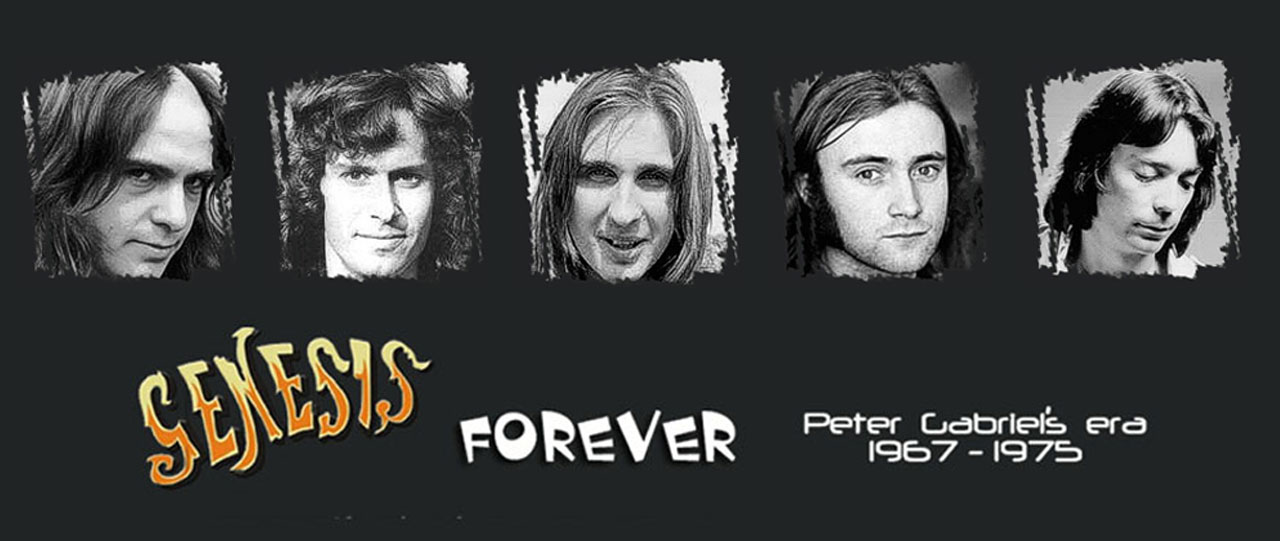



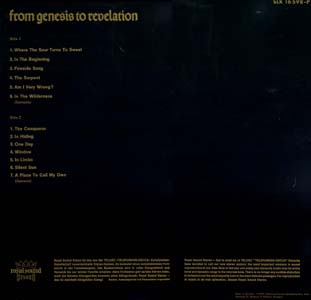
 It shows no or at best only the most minuscule traces of the style that would make them well-known later, and therefore frequently meets with a refusal and lack of affection. Justly so?







Page 2 of 2
A double LP. It is progressive rock incarnate: overblown, mostly incoherent, and the type that takes many, many listens to unravel. It has transcendent, 'How did they do that?' moments and stretches of 'Why are they still doing this?' Tony Banks plays seven different types of keyboard on it (including the almighty Mellotron), Gabriel is credited with "experiments with foreign sounds", and Brian Eno gets a small credit for "enossification"; you never go for very long without the band trying something bizarre.
The recording process was filled with drama; though Gabriel conceived of the album's story and structure, he spent much of the time dealing with family issues and pursuing a career as a screenwriter. This left Tony Banks, Phil Collins and Mike Rutherford to write all the music. (I guess they left Steve Hackett behind at a mall in Hampshire or something.) As you may expect from a band that was touring extensively and releasing albums at a yearly pace, there isn't quite two LP's worth of material in them. A lot of bands in this situation would fill time with solos or long instrumental jams, but Genesis really aren't that type of band, so they dig deep.
One tune devolves into an avant-garde noise collage ('The Waiting Room'), two are adapted from unused songs dating back to the band's early days ('Lilywhite Lilith', 'Anyway'), and the band comes up with just enough ambient bits and linking interludes to fill 94 minutes' worth of space with music.
Of course, when reduced to its best material, The Lamb is superb. The album opens with Banks playing a frantic, almost romantic piano figure that's too fast to be pretty; instead it almost feels oppressive. The resulting song is a pure shot of heavy-hitting prog theatre; Gabriel cycles through several different voices ("Don't look at me, I'm not your kind; I'm Rael!", the first of many spine-tingling moments), Rutherford overdrives the bass while Collins blows through the scenery.
A year or two earlier, the band might've extended the quiet part in the middle, but now these guys had work to do; 'The Lamb...' is one of the few prog epics that got radio play. You couldn't say  that for anything else from this album except perhaps 'The Carpet Crawlers', though that one is almost unbearably creepy. Maybe 'Counting Out Time'? It's certainly catchy enough, but it also features lyrics about trying (and failing) to find a girl's hot zones, so that one's out. The first disc is practically flawless; although there are several repeated phrases (this is a concept album, after all), every song presents something different. There's the gorgeous, lullaby-like 'Cuckoo Cocoon', the abrasive, hard-edged synth rock of 'Back In N.Y.C.', the sweeping, Mellotron-laden 'Fly On A Windshield', and the sinister march of 'The Grand Parade Of Lifeless Packaging'. They even toss out a bona fide prog epic with 'In The Cage', and it's absolutely classic, with bouncy keyboard lines, a pounding rhythm and the amazing "back in the cage…" section which is my pick for the best moment on the entire album.
that for anything else from this album except perhaps 'The Carpet Crawlers', though that one is almost unbearably creepy. Maybe 'Counting Out Time'? It's certainly catchy enough, but it also features lyrics about trying (and failing) to find a girl's hot zones, so that one's out. The first disc is practically flawless; although there are several repeated phrases (this is a concept album, after all), every song presents something different. There's the gorgeous, lullaby-like 'Cuckoo Cocoon', the abrasive, hard-edged synth rock of 'Back In N.Y.C.', the sweeping, Mellotron-laden 'Fly On A Windshield', and the sinister march of 'The Grand Parade Of Lifeless Packaging'. They even toss out a bona fide prog epic with 'In The Cage', and it's absolutely classic, with bouncy keyboard lines, a pounding rhythm and the amazing "back in the cage…" section which is my pick for the best moment on the entire album.
Alas, my mind starts wandering somewhere around track 11, 'The Chamber of 32 Doors'. The second disc is where things start getting strange; maybe not sonically strange the way 'Grand Parade' was, though you do get to hear some things you wouldn't normally hear on a Genesis record. Much of 'The Waiting Room' is a noise collage à la 'Moonchild', and there are several ambient passages such as 'Silent Sorrow In Empty Boats' or 'Ravine'. In other words, much of the second disc is about atmosphere, though there are a few nice shorter tunes like 'Anyway' or the terrific album closer 'it'. Even 'The Colony Of Slippermen', the disc's analogue to 'In The Cage', seems to tone down the rock factor considerably to focus on the storyline.
After all, The Lamb is all about the story, and quite frankly it's tough to do it justice here.
If you found Tommy or The Wall hard to follow, The Lamb may just do your head in. Gabriel plays Rael, a young punk who finds himself in Times Square, becomes encrusted in dust, and wakes up in a cage underground. There he finds his brother John, who at first appears as a lifeless husk, then as part of a parade of empty human bodies. Rael reminisces about his life, mostly about what a scoundrel he's been ('Back in N.Y.C.'), but also about his first sexual experience ('Counting Out Time', the album's only moment of comic relief). From there Rael is subjected to what sounds like a lengthy series of Peter Gabriel's bad dreams; we meet carpet crawlers, supernatural anaesthetists, female snake-like creatures called Lamia, and a colony of Slippermen, who (according to the stage show) are lumpy creatures with inflatable genitalia. The idea being that the Lamia seduce Rael and attempt to eat his blood, only to find that it's poison to them, as his blood is somehow corrupted (perhaps, as 'Counting Out Time' suggests, because Rael has lost his innocence).
The Slippermen (of which Rael has become one) are hideous creatures, dedicated only to the pursuit of physical pleasure, leading Rael to understand that the only way to truly free himself and his brother (though John increasingly sounds like a metaphor for Rael's other life) is to "dock the dick". True enlightenment through castration. What's it all mean?
Well, that's the thing. Lyrically, it's nearly impenetrable, and the several-page-long booklet in the gatefold doesn't help a whole lot. There is a lot of Judeo-Christian imagery - from the symbol of the lamb itself (and a reference to Jonah and the whale), to one of the final lines - "It is real/ It is Rael" ("is real" = Israel?), to the themes of redemption and rebirth. There are references both to Greek mythology (Lamia was a once-beautiful woman who became a hideous creature once her children were taken away) and modern figures ("Lenny Bruce/ declares a truce/ and plays his other hand"). Some of the lines probably only make sense to Peter Gabriel, and others are so open that you could draw any conclusion you wanted to.
Among the narrative there are plenty of stray lines which seem meaningless but can later reveal something (consider the brief "raindrops keep falling on my head" section of 'In The Cage' against the later imagery of ravines and boats). In other words, this is plenty dense, and even after all this time, each spin reveals something new.
All this is essential to the experience; The Lamb is the rarest of concept albums, where the story really is inseparable from the music. For once, Gabriel plays a relatively normal character the whole way through, reacting to the increasingly crazy things happening around him in a way similar to how you or I would. There is continuity from song to song - sure, songs like 'The Carpet Crawlers' or 'it' may sound great on their own (the former has a claim as the greatest pop song the band ever did), but it's a story that's meant to be followed. This causes the music to become somewhat obscured; you may not notice how many killer basslines Rutherford gets until you actually start listening for them, nor the pure technical skill of Phil Collins, whose playing was starting to hit its peak.
Apparently, the band started to feel this too. The Lamb came slated with an enormous stage show with the scope of an actual Broadway play, and with it came the perception that Genesis was Peter Gabriel's show. This was not exactly a new perception, but The Lamb took everything to new heights, particularly in terms of the press, who could now spend an entire review talking about everything but the actual music. The tour itself became unsustainable; all the money it made was funnelled back in, and the band now laments that only a handful of shows went off without a hitch. Sadly, there is little documented from this era; a more-or-less complete show was released on Genesis Archive, but due to bad recording both Gabriel and Hackett had to re-record some of their parts.
Well, this is just where progressive rock was at back then. We lionise this era today; there are dozens of new bands determined to pretend it's still 1972, and there exists a Genesis tribute act called The Musical Box that has spent the last 20 years trying to emulate exactly what Genesis was doing in the first half of the 70s (for the record, most tend to agree that they pretty much nail it, particularly Phil Collins who claims "they played it better than we did").
Great prog albums continue to be released right up until today, but those that came after The Lamb Lies Down On Broadway have the benefit of hindsight and often come from outfits who tour less and have more time. Looking back, the class of 1974 were really flying by the seat of their pants, innovating and trying to get bigger at every turn, till it all blew up in their faces. King Crimson, Yes and ELP all (temporarily) split in 1974; the latter two would come back in 1977 to a musical landscape that was very different than the one they'd thrived in.
As for Genesis, everything had a funny way of working out. Gabriel began his solo career and Collins took over on vocals, and their next two albums went mostly along the same path; hell, much of Wind & Wuthering sounds like an improved version of what happens on disc two of The Lamb, probably because Gabriel was out of the way. But once Steve Hackett left, the band quickly turned pop, and Genesis had the remarkable distinction of having spawned two megastar acts in Peter Gabriel and Phil Collins while remaining a commercially successful act in its own right. It's hard to think of any other band that pulled off anything quite like that, especially considering that the trio of Tony Banks, Mike Rutherford and Phil Collins were the same guys who wrote nearly all the music on The Lamb.
Today, The Lamb stands as a moment in time. It wound up being a UK number 10 and went gold in three countries, and the insane stage show managed to at least break even. After 1974, this sort of success would be unthinkable; while Yes's Going For The One hit number 1 in 1977, it was the last of its kind to do so. After that, you had the Sex Pistols, ABBA, Gary Numan and The Police. Genesis re-tooled their sound and wound up scoring a number 1 album with Duke - it's not entirely divorced from prog (not to the extent of say, the totally un-Yes-like 'Owner Of A Lonely Heart'), but it's so much less obtuse, allowing the listener to enjoy it without having to contemplate the symbolism of hairless hearts and dicks in test tubes being carried off by ravens.
The Lamb still remains an enigma four decades later, long after we've transcribed every last note of Close To The Edge and Tarkus (nowadays, those albums and plenty others come with bonus tracks; something that seems unthinkable with The Lamb). It's not exactly prog's very finest release - Close To The Edge has a better case for that throne, and Genesis themselves hardly have any consensus as to their high point. Hell, if you're more a fan of the band's three-piece incarnation, The Lamb probably isn't even in consideration. But if we're talking about the genre's pinnacle, the one album that tried to outdo everyone else, the one you'd put in a time capsule so the generation of 2074 could understand how strange and amazing and up our own asses we really were, then The Lamb Lies Down On Broadway is it.