

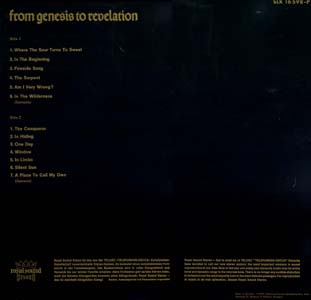
 It shows no or at best only the most minuscule traces of the style that would make them well-known later, and therefore frequently meets with a refusal and lack of affection. Justly so?







Written by Derk van Mourik
 You could write a book about the story behind the album and some people probably have. Lots of great interpretations can be found on the Internet and my aim in this review will therefore not be to give an in depth explanation of the story and the lyrics but to concentrate on the musical side of the album, using the lyrics as a guide.
The album starts of with the titletrack The Lamb Lies Down On Broadway, introducing Rael, the main character of the story. The song starts with Tony Banks' frenzied piano playing, which slowly increases in volume before the rest of the band joins in. Mike's heavy bass and Tony's energetic piano make this a quite aggressive song, especially compared to Genesis' earlier work. Tony Banks began to increasingly dominate Genesis' music at this time, at the cost of Steve Hackett, whose guitar can hardly be heard in this song. This track was also released as a single, but it did not rock the charts.
Rael is caught by a cloud of dust and loses consciousness in Fly On A Windshield. This is a short song, just gentle mellotron and acoustic guitar with Gabriel relating Rael's experiences in a very laid back manner.
This calm is deceptive because as soon as his voice ebbs away Broadway Melody Of 1974 kicks in and we are treated with one of the most bombastic pieces of music Genesis has ever written. Steve's atmospheric guitar playing has moved to the foreground, supported by Tony's mellotron. Peter delivers the lyrics in a combination of narration and singing.
The bridge between Broadway Melody Of 1974 and Cuckoo Cocoon sets the tone for all musical interludes that are to follow. Very gentle, often only Tony's keyboards accompanied by Steve or Mike on acoustic guitar.
The first part of Cuckoo Cocoon is largely based around a riff by Steve, and has the feel of a ballad, a feeling only augmented by Peter's lamenting voice. Rael regains consciousness but finds himself in a place he does not recognize. The second part of the song features Peter on flute, supported by some delightful piano.
The bass line that opens In The Cage is one that Genesis fans can recognize in their sleep: simple yet so characteristic. Soon the mellotron joins in and Peter tells us of Rael's bleak situation in a very subdued voice. Tony steals the show again, first with the Hammond organ, which carries the song through its first three minutes, and then with a blistering solo on the ARP, which can be considered legendary. What follows is a very aggressive part, really heavy bass, and an angry Peter relating Rael's rage about being locked up inside a cage. A reprise of Tony's solo leads us into the final part, once again supported by the Hammond, and some great bass playing by Mike. The last minute of the song is really a bridge to the last track on side one.
The Grand Parade Of Lifeless Packaging is a fun song in the vein of such early gems as Happy The Man and Harold The Barrel, although the lyrics describe an altogether different situation. They tell us about Rael visiting a factory where the commodities that flash by on conveyor belts are actually human beings.
Peter's voice is heavily distorted, an effect he would use on more than one occasion on the album. The song, which starts of very gently, slowly increases in intensity with Peter screaming together with the mellotron and some great drumming by Phil Collins. I haven't said much about Phil's drumming yet but his true gems on this album have yet to come.

Side two opens with Back In N.Y.C. The song starts with the same bass line used for In The Cage but before long Mike switches to bass pedals. Back In N.Y.C. is a prime example of the more aggressive direction Genesis took with The Lamb. Gabriel shouts his way through the lyrics and the music is as hard and cold as steel in places. The song regains some of its warmth when the piano enters the foray. The lyrics tell us about Rael's violent youth in a New York gang.
Hairless Heart is a delightful instrumental, starting with acoustic guitar and gentle organ. Steve reappears for some of his trademark playing, as explored in previous songs like Firth Of Fifth. The 'chorus' is all Tony, mellotron and synth form a beautiful rich tapestry of sound. The song flows into Counting Out Time, recounting Rael's first romantic encounter and the problems that arise from the way he addresses the situation. Musically it is a lot less serious than the better part of the other tracks on the album, and probably one of the most suitable Genesis songs for dancing! It was completely written, both the music and the lyrics, by Peter.
Carpet Crawlers is a beautiful ballad. Peter's very gentle voice is supported by a nice interplay between piano and guitar. The main part of the song is carried by Mike's very warm bass playing. Steve's guitar adds its sad voice in the background. Rael has realized he must get out of this situation he's in but he don't know how.
Another song largely by Peter's hand is The Chamber Of 32 Doors, which closes the second side of the album. This song has a very desperate feeling to it, both musically and lyrically. Rael is looking for someone to help him find the way out, finds no one and is left alone, totally lost and helpless.
Side three opens strong with Lilywhite Lilith. This song had already been written a long time ago and was once part of an epic affair called The Light, which reportedly lasted over forty minutes and was a mining ground for many later Genesis songs (The Cinema Show among others contained parts of The Light). The guitar is used in a supportive role again with keyboards being omnipresent, giving the song depth.
In this part of the story, a mysterious woman named Lilywhite Lilith leads Rael out of the chamber of 32 doors into a big cave, the waiting room.
The instrumental of the same name starts of with some weird random noises. Its seems like Genesis are testing the limits of their instruments and discovering hitherto unknown applications! The second half of the song has more structure. It sounds like a jam session and indeed the live version of The Waiting Room was also called The Evil Jam.
Anyway opens beautifully with some vintage Tony Banks piano playing. Peter's voice sounds aloof and distant as if Rael is watching himself from somewhere above. Having been left alone in the waiting room, Rael thinks he is about to die. Tony's piano melody carries the song into the bombastic middle section, featuring a guitar solo by Steve Hackett, his first real solo on the album. The final part of the song is a reprise of the first part, with an extra melody line on the ARP added in.
Death comes for Rael in Here Comes The Supernatural Anaesthetist. This song has a large role for Steve's guitar: this time it's Tony who is hardly present in the song, except to the end of the song where his mellotron beautifully complements the guitar.
Rael does not die, but instead is allowed to escape from the cave. Outside he comes to a pool where he has a sexual encounter with The Lamia.
The main melody line of this song is another great piano piece by Tony. In addition, mellotron, organ and RMI can all be heard laying rich tapestries at various stages in the song. Peter's voice beautifully conveys Rael sense of wonder at his dealings with the lamia, and the song is ended in style with a long guitar solo.
Silent Sorrow In Empty Boats is an instrumental, the title actually being a part of the lyrics to The Lamia. Just like The Waiting Room this sounds a lot like a jam. A guitar riff is repeated throughout the song, with the mellotron fading in and out.
Peter Gabriel as Rael The same weird collection of effects that can be heard in The Waiting Room form the intro to the first track of side four of the album, The Colony Of Slippermen. It has three named parts, the first being Arrival where Rael meets the slippermen who just like him have had an encounter with The Lamia. Musically the song harks back to the Foxtrot days, with a large role for the hammond. A Visit To The Doktor brings Rael face to face with Doktor Dyper. The Doktor castrates Rael in order to prevent him from becoming just like the slippermen. Rael's member is placed in a tube which is subsequently stolen by a Raven, an event adorned by another blistering ARP solo. The raven drops the tube in the water that flows at the bottom of a ravine.
The rushing of the water and the howling of the wind through the ravine is portrayed in the instrumental Ravine. A very atmospheric, filmic piece of music.
The Light Dies Down On Broadway is based on the same melody as the first track of the album, The Lamb Lies Down On Broadway. It features some very emotional guitar work by Steve.
Rael gets a glimpse of his home but just as he is about to escape he hears his brother John, who seems to be drowning in the river below.
The lyrics for this song were written by Tony and Mike, because Peter was running out of time. Not coincidentally this is also the only lyric that has been written in the third person. All the other lyrics are written in the first person, from Rael's perspective.
Rael decides to go down in the water and try to save his brother. This song, Riding The Scree, features some of what I consider to be Tony's most virtuoso playing. The ARP has really been stretched to its limits for the solo in this song! Also be sure to notice Phil's drumming: it's among the best he has ever done for Genesis, although on the live version he's even better!
In The Rapids is made from the true Genesis mould: great mix of acoustic 12-string and electrical guitar. Rael catches up with his brother but when he looks at his face he discovers it's not his brothers face but his own!
The very uplifting and energetic it closes the album. The jazzy feel of this track would later also appear in songs like In That Quiet Earth and Duke's Travels. Lyrically it is very difficult to interpret. One interpretation could be that Rael has come to terms with his life up to his journey and that this whole ordeal was meant just to get him to that point.
It Is Rael, It Is Real!
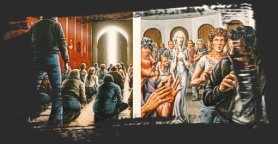 After the album had been completed, Genesis went on tour and performed The Lamb live in its entirety for one hundred and two times during the last quarter of 1974 and the first half of 1975. Peter had costumes made to portray several persons and creatures in the story on stage. Some of those costumes, like the one for the hideously bloated slippermen, were so cumbersome that they caused Peter great difficulties with moving and even singing! Some of the vocals were so unintelligible that when a live version of The Lamb was released in 1998 most of the vocals had to be redone.
In fact, since everybody's attention was drawn completely to Peter's stage presence, his star was rising rapidly while the rest of Genesis seemed to become no more than his backing band.
Silent Sorrow
It was for this and other reasons that Peter decided to leave the band after the tour was completed. He felt more and more constricted within the band format and he feared that it would become harder and harder to get his ideas accepted by the group. The other four members were shattered by the news and especially Tony Banks practically begged Peter to reconsider. As we know now, he did not succeed.
In a way, The Lamb was also the beginning of the end for Steve Hackett. He experienced the same problem as Peter, in that he couldn't get his ideas accepted by the rest of the band. And it didn't help that he was never very good friends with Tony, who was the most influential member of the band, especially after Peter had left. Steve would stay for another two years but the cracks that had appeared would prove to be irreparable.
Both Peter and Steve became very successful solo musicians and Genesis proved they could survive very well without their erstwhile members by first dispelling Peter's ghost with the phenomenal A Trick Of The Tail and then becoming one of the most famous rock bands of the world in the eighties.
The Light Will Never Die Down
The Lamb Lies Down On Broadway is a true milestone in the history of Progressive Rock. Both lyrically and musically it has inspired countless of other bands, albums and songs, and not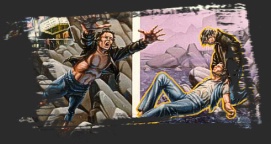 even always inside the Progressive Scene. For recent examples, think of Aragon's Mouse and IQ's Subterranea.
Looking at the whole of The Lamb, one can say that the first disc is more consistent and accessible whereas the second disc contains some experimental pieces which some listeners might feel breaks up the flow of things. Maybe Genesis did overreach themselves a tiny bit by aiming for a double album, indeed, Peter Gabriel himself admitted that he took more on his plate than he could digest when he demanded that he be the sole lyric writer, but nowhere do I get the feeling that there's unnecessary music on the album.
Genesis was a truly unique entity when Peter Gabriel was in the band, producing albums, which without exception have become classics. Albums that were progressive in the strictest sense of the word, taking the previous album and improving upon it. In that sense, The Lamb Lies Down On Broadway is Genesis at their peak, the crown on that remarkable period of time.