

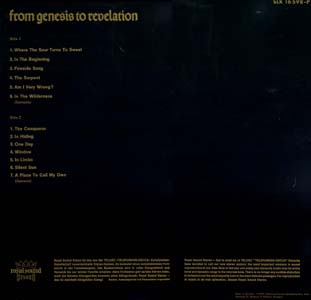
 It shows no or at best only the most minuscule traces of the style that would make them well-known later, and therefore frequently meets with a refusal and lack of affection. Justly so?








 At this point Rael blacks out. He awakens to find himself in a cocoon. It's dark and dank. This is purgatory. He feels secure, but he is in denial. "Don't tell me this is dying, 'cos I ain't changed that much." The traumatic experience of death leaves him in disbelief of what has happened. This begins his soul's journey. He is in purgatory because of his acts on earth and yet he's not in hell because of the circumstances that surrounded what he did. During this journey, Rael will visit hell, go back home, and go through a series of tests to determine if he ends up in heaven or hell.
He awakes in the cave after drifting into sleep in his cocoon. Then a cage begins to form around him. The reason he is in a cage is that he is trapped by his past decisions in his physical life. This is keeping him back and not allowing his soul to move freely. His brother John comes and looks at him in the cage. Rael yells for help, but John looks at him with a vacant look and says nothing. As he leaves, Rael feels pains shooting throughout his body and as John leaves his sight, the cage dissolves and Rael is left spinning.
After he is done spinning, he finds himself in the lobby of the doll factory. Thus begins his trip to hell. The Grand Parade of Lifeless packaging is hell. Rael wanders around the factory and comes to a line of dolls. He notices some of his old gang is a part of the line. Once he realizes he is in danger, Rael scurries from the factory. On his way out, he sees his brother John with a number 9 stamped on his forehead. When you go to hell, you become a plastic, lifeless doll. Your soul no longer lives as it is transformed into a plastic, lifeless doll. It's interesting that no one takes up the chase after Rael. He does not belong in hell. The reason John could not help Rael in the cage was that he could not help him on the right path.
He then enters a reconstruction of his life above ground. An interesting line here is that Rael "was better off dead than slow in the head" in his old life, above ground." Notice how he has moved to above ground. This means the doll factory is below ground. Keep in mind that as the story progresses, the higher Rael goes. This fits into the old world thinking that heaven was above and hell was below ground.
Here we learn the reason for Rael's deviancy. His mother and father apparently were always on his back. They gave him a hard time. He left home and joined a gang. To gain the respect the gang, he had to end up in the Pontiac reformatory. This was his only way of acceptance. His gang are the only people who ever accepted him. Now Rael is walking home from a raid in this reconstruction and begins to cuddle his sleeping porcupine. We get a sense of his life in the song Back in NYC. He has a destructive personality. His hairy heart is being shaved clean, after this song, as he recalls his first romantic encounter. I think you may be able to figure out on your own what he's cuddling.
His memories of his first romantic encounter reveal a lot about Rael. His self-confidence is obviously very weak as he turns to a book for guidance on love making. Again the final line of the song returns to his 'cuddling', "Without you, mankind handkinds thru the blues." He doesn't trust he'll get it right on his own so he buys a book, Erogenous Zones and the Difficult Problem of How To Find Them, from a discount bookstore. He's a very self-conscious person. This is why he joins the gang and adopts his destructive attitude. He just wants acceptance. This is why he is in purgatory. He needs to be tested to find out what his true self is without outside pressures.
He leaves his "mixed up memories" and now finds himself in a passage way and finds a long carpeted corridor. This begins the testing of Rael to determine where he does belong. He finds people crawling toward the heavy wooden door. After heading through the heavy wooden door and climbs up the staircase to the chamber of 32 doors. This is where Rael is tested to see if he can trust another person. "I need someone to believe in, someone to trust." He meets Lilywhite Lilith who leads him through the correct door. This is the first step in the direction of heaven. Although she is blind, Rael trusts in her to lead him down the right path. She brings him to a cave and tells him that "they will come for you soon. Don't be afraid." This is another test of trust. His fear gets to him. When the light enters the tunnel, he begins to shake with fear. He panics and fires a stone at the light. The sound of glass echoes as the stone impacts. Two golden globes enter the room and when they disappear, the room begins to collapse around him. He is trapped again. The reason why he is trapped is that his trust left him and his fear took over. He has failed this character test.
At this point in time, Rael is panicking and is going through a series of rambling thoughts. This is where Rael meets Death. Death helps him out of quandary by releasing gas leading through the rubble. Although Rael meets Death, his soul does not die and he gets a second chance. This may be because Rael did learn trust to a certain point and thus did not merit Death yet. Death was willing to give him a second chance to make it.
From the rubble, Rael reaches the pink-water pool inhabited by the Lamia. This is a very interesting scene. The Lamia begin to eat him and when they nibble his flesh, they die. Again in the song The Lamia, the line "Putting fear beside him, he trusts in beauty blind." He not only learns trust, but he learns love in a way. He is distraught as they die and eats their bodies in order to "bring what is left of them into his being." This is what we look for in a relationship. To bring a part of another person into our own being.
 After leaving the pool, Rael finds himself in a freak's ghetto. This is where Rael meets the Slippermen. He has become a Slipperman because he let his passion overrun him. He did learn to love in a way, but let his physical needs overtake his sensibility as it did in his Physical life. The Slipperman test is designed to see if he can live without the tool for absolute physical pleasure. It's a test of his priorities. He meets his Brother John who has succumbed to the same pleasures. They visit the Doktor who castrates them and gives them their yellow tubes holding the source of their problems. Here Rael has taken another step toward salvation.
Rael's yellow tube is taken from him from the raven. John leaves him and tells him he will not help him. This is one of the reasons why John has ended up in hell. John appears not for his own benefit in Rael's journey. He is there to help in testing Rael. Rael goes off and chases the raven to an enormous ravine. The raven drops his tube in the rapids at the bottom of the ravine. He runs along a path along the top of the ravine watching his tube racing down the rapids. As he walks around the corner he sees a sky light above him built into the bank. He can see home through the bank. He starts to run for it. As he does, he hears his brother John struggling in the rapids below. This is his final test to see if he has learned true love.
If he goes through the gate, then he will probably go back to the reconstruction and begin again. If that doesn't happen, then he probably ends up in hell. Nevertheless, he decides to jump into the rapids below. He catches John's arm and pulls his body onto the bank. When he looks into John's face, he sees his own. Rael has saved himself. By choosing to save John, he has saved himself. He has learned what life is all about. It's not about yourself, but about others. He has learned the importance of family. By saving John, he has saved him self. There is a question as to whether he has saved John for both of their physical bodies melt into a purple haze. Rael's soul has now left his body and has gone on to heaven. It is heaven. Just think of all the things mentioned in the song. They are all exhilarating experiences and that's what heaven is.Rael will now live on forever. He doesn't have to worry about making a name for himself. That doesn't really matter. Salvation is what matters. To get there, you have to learn to trust and love others. That is the whole point of the Lamb in my wonderful opinion.