

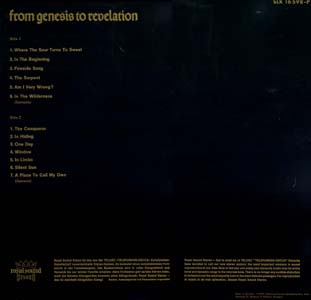
 It shows no or at best only the most minuscule traces of the style that would make them well-known later, and therefore frequently meets with a refusal and lack of affection. Justly so?







"Meanwhile from out of the steam a lamb lies down. This lamb has nothing whatsoever to do with Rael, or any other lamb-it just lies down on Broadway"
This is just the faintest hinting of Rael journey through the netherworld between sanity and insanity. Basically it sets the tone for what is the commonly accepted reality. Cruel movie attendants, suspicious cops, druggies coming down from their trip entering withdrawal or hangover "Nightime's flyers feel their pain", businesses opening for the day, etc.
Two characters emerge here in the beginning who add to the element of absurdity. "Patrolman Frank Leonowich (48, married, two kids)" only mentioned in the accompanying story, and Suzanne the working woman returning home thinking very pragmatic things "money-honey [her boyfriend/ husband- be on [perhaps sexual desire?]- neon [the city, her life?]". Both of these characters are described in detail which is completely unnecessary, and thus absurd. Their entire existence is meaningless, but there nonetheless, why? That is the question existentialism asked and responded with the answer that there is no logical reason why, there is no sanity.
We are told he spraypaints his name in the subway. There is few other things which generally describe life in a big city than a subway, you see it all there. It is an mixed bag of reality condensed in a relatively small space. By putting his name in big letter, Rael hopes to start defining himself, a "process going towards 'making a name for yourself'" as the story narrator puts it. This is a sane move by Rael in terms of self definition, he is still working within the context, the mythology of present day society.
"Cabman's velvet glove sounds the horn." "Autoghosts keep the pace for the cabman's early mobile race." These sentences lead us to believe that cab drivers are being spoken about here, not men who hail taxis in front of hotels. The cabbie honks his horn at Rael, who must have been jaywalking, as he drives Suzanne home from work. To Rael, this is but another blow to his ego, his structure of existence in this life, this reality. "The sawdust king spits out his scorn", Rael responds here with anger, lashing out at the world which has treated him so cruelly through the vehicle of this cabbie and the woman who rides within. Here we actually get some speech from Rael, or perhaps his thoughts (more likely actually), "Wonder Women draw your blind, don't look at me I'm not your kind. I'm Rael!" He tells this woman that he doesn't want her attention anyway, he'd prefer it if no one recognized his existence. He proclaims his independence from the mainstream of rational thought. With that proclamation, he begins his journey into his own reality. "Something inside me has just begun, Lord knows what I have done."
Finally the song ends with references and lines taken from the song "On Broadway" which deals with opportunity, and those who would naysay the protagonists ability to make it on Broadway. It plants the seed that this journey could go either way for Rael, he has a number of choices. Perhaps he will define himself in the context of society's reality, while still existing in it. Maybe he will give in entirely and go on as a nobody in terms of this reality, never defining himself at all in any terms. Finally he can design, tailor make, his own reality, where he is not only perfectly defined, but completely at ease and at home. It's perfectly absurd.
...life on the streets of New York. He is successful in running away from this death for a time, symbolic of his success at avoiding death on the street.
 Looking back, he sees the cloud take shape into what appears to be a movie screen, "showing what had existed before in three dimensions". Now is the time to hold on to your hats, for not is only the wind blowing harder now, but the movie screen image is key here, answering a bunch of past and future questions, but also creating a mess of questions at the same time. This movie screen he alone sees is much like the one in the movie-palace he slept in the night before. The one in the theater shows a false reality created by someone in Hollywood who hopes the moviegoers believe it, that is, buy into the reality of something which is obviously false. And people obviously do... ask children who they want to be when they grow up, what kind of answers do you get? Movie stars, but more than that, they want to grow up to be like characters in the movie. That is the romance of the movie, that it takes something unreal and presents it in a form which people can believe, that they really want to believe. The screen that is moving in the street (behaving much like "The Langoliers" in the short story of the same name by Stephen King) is taking what Rael "knew" to be reality and turning it into a movie. Are we to believe what is on this screen? If what I once thought was real is now a movie, is what was a movie now real?
Rael struggles against these thoughts, much like he struggles against the wind blowing against him, "blowing dust into my eyes", obscuring his vision of what he once thought was real. He fights himself into a standstill, completely encrusted in the dust. Like us, he is a "sitting duck" a "fly waiting for the windshield on the freeway". His difference is that he sees it coming, and although he is not prepared, he is spared immediate death, at least how he sees it. From his viewpoint, everyone else who gets swallowed by the wall/screen dies, but this is just a symbolic death of the reality he once knew.
I haven't discussed the symbolism in the music yet, even though the manic keyboards in the beginning hint of psychosis they don't technically match the plot. The contact of the wall/screen with Rael is directly tied in during "Fly on a Windshield". After the word "...waiting for the windshield on the freeway are spoken" there is a sort of silence for an instant. Then suddenly the crash comes.
"The moment of impact bursts through the silence and in a roar of sound, the final second is prolonged in a world of echoes as if the concrete and clay of Broadway itself was reliving its memories".
Rael is overwhelmed by the confusion and disorder of the sensory input he is perceiving. He has now been sucked into the movie! Images begin to take shape out of the soup in a stream of consciousness style.
Take time and throw it out the window. It was an integral part of the "real world", the world Rael has taken his leave of. The next second in the reality of New York may consume the entire journey Rael is about to take. Human dreams have been found to take only a few seconds each, though we remember them as happening in real-time. Many times they seem just as real as when we are awake. Is Rael awake, or asleep in the movie theater still from the night before? Is he dead, or is everyone else dead...both, neither?
Anyway, somebody mentioned a "Lamb" movie. Well, there was to be one- with Peter rejoining the band to do the soundtrack- back in the early 80's But this got shot down. From inferences from interviews, I think that Tony really didn't want to do it. I remember a 1986 Rockline interview where someone asked him( and Phil) about it and he said he thought it would mean too much new material and that working with music you did years ago did not appeal to him. In Peters book, it mentioned that some people in the band did want it to happen.