

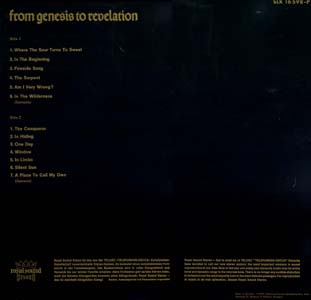
 It shows no or at best only the most minuscule traces of the style that would make them well-known later, and therefore frequently meets with a refusal and lack of affection. Justly so?







Top Ten Rated Genesis Songs

Genesis 1969 - 1974
- Dancing With The Moonlit Knight
- Firth Of Fifth
- Firth Of Fifth16
- Supper's Ready
- The Carpet Crawlers
- The Cinema Show
- The Fountain of Salmacis
- The Knife
- The Lamb Lies Down On Broadway
- The Musical Box
- Watcher Of The Skies

 Certainly Genesis could not be expected to continue producing elaborate Gothic works like 'Supper's ready', nor 'Watcher of the skies', ad infinitum. Instead they began to devise shorter, more self-contained radio friendly songs, while retaining their musical standards. The result is another masterpiece recorded at Island Studios during August 1973, produced by John Burns and Genesis. Undoubtedly this was the best produced album so far, with a markedly improved sound quality that elevated Gabriel's vocals out of the mush of overdubs. Also there was a change in artwork with a cover painting by Betty Swanwick, while Rutherford introduced an electric sitar to his armoury of instruments.
Dreams of Merrie Olde England turn into consumerist nightmares on Genesis's third album — and its last as a cohesive creative unit. "Can you tell me where my country lies?" sings Peter Gabriel in "Dancing With the Moonlit Knight," the first of several songs that pillory and parody the island nation's hey-nonny stereotype. For guitarist Steve Hackett, who trips the light fantastic throughout, Selling reflects "the sense of old England being taken over; the cornershop giving way to the multinational [corporation]." Selling also contains "Firth of Fifth," the longish composition that many consider the band's finest moment, as well as "More Fool Me," their first Phil Collins vocal vehicle and a taste of poppier things to come. Gabriel carried the record's sometimes Monty Python-esque Arthurian caricature to the ensuing tour, appearing onstage costumed as the knight Britannia. R.G.
Selling England by the Pound Tour


"Can you tell me where my country lies", said the Unifaun to his true love’s eyes is the very first thing you hear on Genesis' 4th album. No music, just Peter Gabriel's husky voice. The music doesn't start until the third sentence, and by then you already know that this album is something very special.
A year after the critically acclaimed hit album Foxtrot Genesis is back, with the difficult task to surpass the album that had brought them their first real success and allowed them to step out of the shade of small university and club gigs, into the first bright rays of international success. Selling England by the Pound succeeded and brought the band international recognition with comparisons made by the press to Yes, ELP, The Rolling Stones and The Doors.
Where Foxtrot had still sounded as if the band was yet searching for a certain direction (despite the fact that this album contained their all-time masterpiece Supper's Ready) on Selling... they presented themselves as one solid band. You could hear that the band had grown and matured during their five years of existence and how the music had evolved from the gained experience.
The opening track Dancing with the Moonlit Knight is an 8-minute composition with the usual incomprehensible lyrics of Peter Gabriel. It starts with vocals only, while the rest of the band slowly joins in. After this mellow start all hell breaks lose after the third minute where The Mellotron, so blatantly introduced on the predecessor is now degraded to a more supporting role. And although the instrument is present on almost every composition on the album Tony Banks refrains from indulgent actions like the Watcher of the skies intro off the previous album.
I know what I like (in your wardrobe) is the band's first shot at the charts. Tony Banks' catchy melody line and Gabriel's funny lyrics make the song perfect for a single. The song reached a modest 19th position in the English charts and would probably have been a real hit, had the promotional video not been refused by Top of the Pops. The single did however boost the sales of Selling England.
The third track turned out to become another classic in Genesis' history. Firth of Fifth (a word-spin on the delta of the Scottish Forth River) is entirely written by Tony Banks and probably the best he's ever done to date. The classical piano intro is of true high-class standard. Tony's lyrics are so full of metaphors that even the best linguist won't get further than concluding that the song's about a river. And Steve Hacket's partly improvised guitarsolo has been often imitated yet never surpassed.
More Fool me, the next track, is written by Phil Collins and Mike Rutherford, with the result that Peter Gabriel let Phil do the vocals on the track, although Phil is clearly trying to copy Peter's vocal style. The song does however shows that Phil is more than just the drummer of the band, although probably nobody would have guessed at the time that Peter would leave the band two years later, leaving Phil at the singing spot.
The first song on side two The Battle of Epping Forest is the only "misser" on the album. As Tony later explained in an interview: "The music is great and Pete's vocal melody is great, however the two just don't seem to work together". Despite the serious subject of the lyrics, a gang fight, the song just doesn't sound serious at all.
After the ordeal is the instrumental on the album. It is a very calm, serene piece based around a beautiful guitarsolo by Steve Hackett,
The next track is the third song on the album that has become an all-time favourite: Cinema Show. The song has a slow build with a couple of lyrics sung by Gabriel, before Tony takes over for a 6-minute keyboardsolo, which is still considered one of his finest. (Although his solo of 1974's In the cage is considered his best ever). The song finishes with the theme of Dancing with the moonlit knight which completes the circle.
The last song on the album Aisle of plenty is also based on that same theme, which makes it a short reprise of the first song. The lyrics are a spin on the British supermarket industry. (Ease you now, there's the safe way home. Thankful for her fine fair discounts, Tes co-operates) and thus makes the circle, which started with Moonlit knight (which also deals with the British consumption industry) complete.
Selling England by the Pound is one of the few so-called head-and-tail records. There is a clear start, a middle piece and a worthy ending which sort of reprises the start.
The album did indeed bring them the international success they deserved after Foxtrot and a world tour followed the album. The tour brought them to America, and Peter's stage extravaganza received even more raving reviews by the American press than it ever had got by the British press. It was something they had never seen this side of hardrock.
To me, this album stands as a solid rock in Prog history. Despite the fact that their previous album Foxtrot was maybe a more emotional album, with more feeling, and despite the fact that their follow-up album The Lamb lies down on Broadway is maybe a far more ambitious album, I still prefer to listen to Selling... as this album is a lot easier to listen to - it is a real listening album, rather than an album which needs your full attention when you play it.

Man behind the Mask
'THE MAN BEHIND THE MASK' - from NME, October 13, 1973 - PETER GABRIEL OF GENESIS TALKS TO BARBARA CHARONE.
"People think we ripped off Yes and Alice Cooper - and of course that is what happened."
 THE MUSIC world rarely awakens before noon, but I met Peter Gabriel at the unlikely hour of 9.30 a.m. Genesis, having finished their 'Selling England By The Pound' album, were rehearsing the new show. The man was looking veary-eyed as he ate buttered toast and sipped a coffee - the living proof that rock is all late-night rave-ups.
Off-stage, Gabriel is unassuming, rather slow at opening up in conversation, and a far cry from the figure who runs rampant in bizarre gear
But anyway, what exactly have the conquerers of Epping Forest been up to in preparation for the new act?
He thinks for a moment and gives with a schnide smile "I've been having conversations with my mask maker. I gave him a copy of the lyrics to the new album ... I've found it helps to go over the words with him, trying to get pictures from the words, conceptions of characters.
"We've also have a guy working for us on stage designs. We explain what effects we'd like, with lighting and all.
On this tour we'll be using a screen for backdrop projections. All these things," he stresses, "help to create the fantasy we work under."
Character is a word that crops up often in a conversation with Gabriel. The theatrical comparison is obvious, and always apparent on stage.
"My part has been to conceive all the characters and masks I can from a piece. The visuals are really just an adaptation of something that's already been written, and recently I've been trying things out with new characters.
"The visuals did begin out of necessity," he agrees. "With gaps in the playing the door was left open to me. At first I used to improvise completely - which I don't do now.
"When the visuals work, they set up pictures in the mind. That way someone can enter the music more receptivily.
But visuals can only succeed if the music is just as satisfying. It's actually a means to an end.
"The only reason we're up on a stage is to communicate to people, to entertain, and you're better able to do that with movement. So whatever we can get our hands on, we'll use."
That, my friends, includes pyramids, flowers, fox masks and other image-oriented objects.
Since the band is a five piece with five very separate opinions, I wondered how Gabriel convinced the others of his stage ideas. Or did he simply show up one day in his flower regalia?
"Actually," says Gabriel with a smile, "that's exactly what happened."
Gabriel believes that one day film, music and theatre will merge. Already they're moving closer together in a working partnership, and he offers the Red Budha Theatre as proof. Genesis, who incorporate a bit of several mediums in their stage show, hope to one day operate from their own inflatable theatre.
Says Gabriel: "In this portable theatre there'd be various textures. At the theatre's entrance you'd go through a selection of things happening - which would set your mind thinking in a fantasy situation. The whole experience wouldn't relate to anything you've known before.
"The fantasy would stay with the audience from the moment they entered the theatre until they went home. During the entire two or three hours of the show a complete fantasy would be going on all around. Then people could relate all the time, being all insular and vulnerable."
Genesis obviously differ from the dressed-up 12-bar that most bands unravel. And because of these very differences, the band have been slated over over their motives.
Gabriel says: "I think some people have a rip-off concept of us, which goes something like this: they see us as a band who were sitting around doing nothing, and who looked at who was pulling in the money in the music market, so they think we ripped off Yes's music, Alice Cooper's visuals, and we came up with Genesis.
"And of course," Gabriel both laughs and sighs, "that's how it happened.
"And just because I was dressing up, people assumed I was imitating Bowie. But the thing is, the characters I play are things talked about in the lyrics, and they do occur. Bowie's a great writer, but I don't always think his costumes are relevant to his music.
"Visuals should provide some images that sink into the music, so if you're listening at home you've still got traces of the characters floating around."
Onstage, there's something almost hypnotic in the way Peter Gabriel addresses an audience. Does he believe Genesis make people feel uncomfortable?
"Great if we do ... I like to disturb the audience a bit and then bring them into our world."
Typed up by Thomas Holter, from a copy of another article in the archives of Jeff Kaa.

I think it is a mistake to think the Lamb is "about" something, especially about one particular thing, and to think there is some correct answer to the question that starts "the Lamb is about ..." and goes on with a single "true" answer. (I would also advise you to be wary of people who claim to have a one true answer to the question, because they are probably missing a lot.) The Lamb Lies Down On Broadway is something that every listener must decide a personal meaning that satisfies as an explanation.
 18 November 1974 by Charisma Records
 18 November 1974 by Charisma Records
 18 November 1974 by Charisma Records
 18 November 1974 by Charisma Records
 18 November 1974 by Charisma Records
 18 November 1974 by Charisma Records
18 November 1974 by Charisma Records
18 November 1974 by Charisma Records
18 November 1974 by Charisma Records
18 November 1974 by Charisma Records
18 November 1974 by Charisma Records
18 November 1974 by Charisma Records
18 November 1974 by Charisma Records
18 November 1974 by Charisma Records
18 November 1974 by Charisma Records
18 November 1974 by Charisma Records
18 November 1974 by Charisma Records
18 November 1974 by Charisma Records
Hall of Mutant King
'Village Voice', December 16, 1974
Editor's Note: This article is from a series of lost and rare Genesis articles, features, and interviews which were preserved by Paperlate member Chloe Lev. Without her preservation of these articles, they would most likely have been lost to Genesis fans forever. Transcription of these was done by Lev and Linda Darling. Village Voice,
December 16, 1974
 IN THE HALL OF THE MUTANT KING
Peter Gabriel in Genesis: Whatever gets you through the song, can't be wrong
Genesis: Meatloaf on Parade
"The Lamb Lies Down on Broadway" is a musical production by the English group, Genesis, that represents New York as a labyrinthine meg-structure with nightma rish images fluttering about like bats within the passageways.
It's an insanely ambitious attempt to fuse a pop epic from the bleakness of Bequeaths "The Lost Ones" and the phantasmagoria of Borge's "The Circular Ruins"; what you get is corrupted Bequeaths, sullied Burgess and ponderous pop. Serious (e.g. humorless) rock theatre has never worked and probably never will - high solemn intentions imprison the spontaneity of rock within an Alcatraz of cultural pretension.
Certainly every brick was solidly in place for last weekend's production of "Lamb" at the Academy of Music. Not a single moment of excitement was allowed to intrude.
Rock theatre is necessarily based upon the personalities of the performers, which is why the Who's theatrical power is strongest not in "Quadrophenia" but in "I Can See For Miles", where the dramatic tension is rooted in dynamics of Peter Townshend's rollercoaster moods. For Genesis, however, overproduction fills the voids of personality.
Despite all the hard work - the imaginative slide show, complex stage lighting, and numerous entrances and exits -one of the "Lamb" song titles describes the production with painful accuracy: "The Grand Parade of Lifeless Packaging."
Lifeless was the performance of leader Peter Gabriel; the protagonist's name is Rael so it's surely no accident that Gabriel is a Roger Daltry sound alike. On stage he looks like a stoned somnambulist from the cabinet of Dr. Caligari, but that cadaverous sleepwalker at least had a haunting aura, where Gabriel has all the stage presence of an ambulatory meatloaf. Gabriel is said to have a large following, but he sings without power and moves as awkwardly as Bowie. (Bowie may have studied mime but with his twitches, tics and emaciated angularity he looks as if he has animal on his back, and I don't mean a chipmunk).
Gabriel and company are trying however to go beyond Bowie, beyond Tom O'Horgan. I suspect Grand Guignol gulch is where they're heading. With their magpie eclecticism, they may get there. Following the incomprehensible liner notes to the two record set of "The Lamb Lies Down on Broadway" is acknowledgement given to Keats and, indeed, one of the tracks is entitled "The Lamia" ("Lamia" being one of Keats's later poetical dramas). Actually, the opening lines to "The Fall of Hyperion" are more appro priate to the numbed, dead-eyed crowd watching Gabriel at the Academy: "Fanatics have their dreams, wherewith they weave/ A paradise for a sect."
-James Wolcott