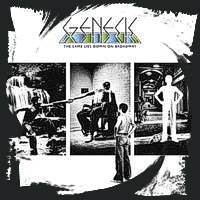
Various interpretations follow below. You may want to base your interpretation on one of these, or perhaps do some investigation of these concepts and draw your own conclusions.
The secret to understanding in The Lamb Lies Down on Broadway lies in an understanding of the concept of existentialism. A philosophic and literary movement which, in its current form, began in the nineteenth century, I believe. Its basic tenets are this: First, life is totally absurd. The "reality" which people accept is false, merely an invention of convenience so that we are all communicating on the same wavelength, so to speak. This also ties in the idea that life itself is utterly meaningless. Second is the idea that we, as individuals, are capable of constructing our own reality, which is just as valid and "real" as the reality of everyone else. Shakespeare touched on this when he wrote in Hamlet something to the effect of "There is no good or bad, merely thinking makes it so" and "I could live a nutshell and count myself King of infinite space".
Well, well, well Bernard, there's nothing like jumping right into the deep end! No comments yet on your observations other than you've obviously spent some time thinking about this. I must however, comment on your description of existentialism. Having received my M.A. in Philosophy and concentrated in existential thought, I hate to see the term thrown around quite so loosely. A couple of points:
1. Existentialism is a very broad term which encompasses many different ideas, even contradictory ones at times. I'm not denying that *some* existentialist thinkers espouse the doctrine of nihilism which you assert above; but to say this is a basic tenet of all existential thought is not true. The idea of the absurdity and meaninglessness of life was championed by the French existentialists, and is popularly known through the writings of Sartre. But even some of this group saw this as a denial of some basic laws of rationalism and had trouble with it. Certainly a Christian existentialist like Kierkegaard would not accept your definition.
2. The idea that we can construct our own reality by asserting that whatever we choose to believe is "true" is another idea asserted by some (particularly the German philosopher Schleiermacher) and refuted absolutely by others. The idea of the total subjectivity of truth is an idea that creates some real philosophic problems and has been moved away from by most existentialists.
3. If there is one common thread which unites all existential thinkers it would probably be that freedom of choice (free will) is fundamental to life.
When TLLDOB begins with the song of the same name, we are immediately immersed in the absurdity of the reality which everyone exists in, at least those who are considered sane.
 The lamb itself has two meaning, and then can be left alone for awhile. First, it is representative of the sacrificial lamb, which society creates, then offers up as an offering for slaughter. Rael is that lamb, the situation as a child of the streets has been thrust upon him by his birth, and he has never been given an opportunity to make something of himself. Second is the absurdity of the existence of a real lamb lying down somewhere on Broadway.