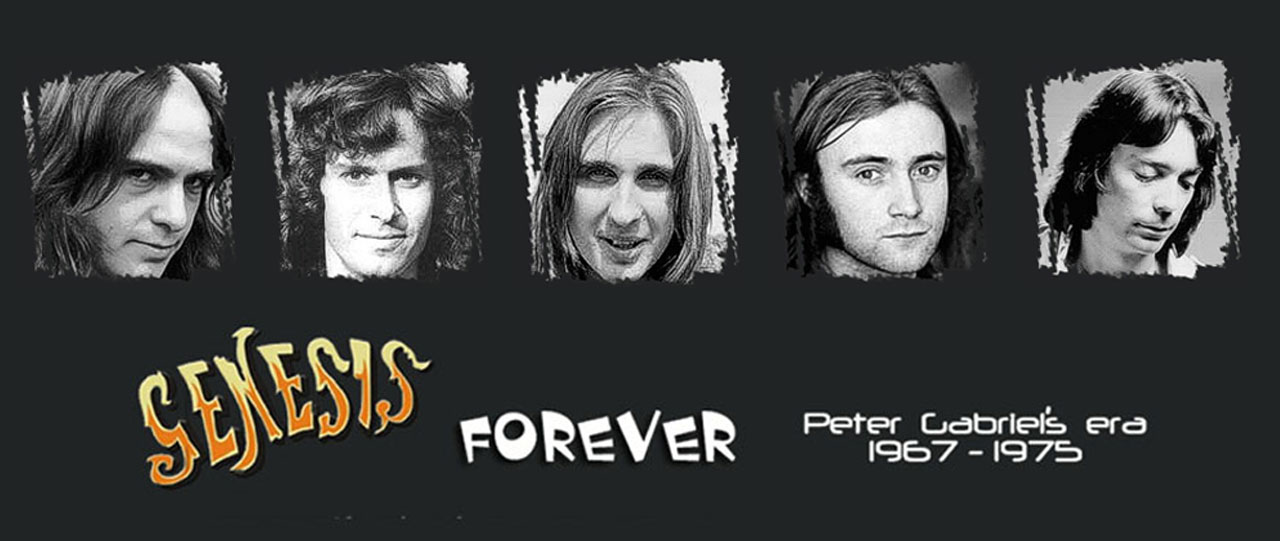



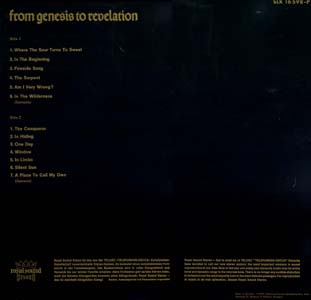
 It shows no or at best only the most minuscule traces of the style that would make them well-known later, and therefore frequently meets with a refusal and lack of affection. Justly so?











The album art of Genesis: an evaluation by criticalhit 2009

From Genesis To Revalation, 1969
Genesis’ first album is mostly a footnote in the band’s career. The black with dark…something text only pushes the album from memorability. D-
Trespass, 1970
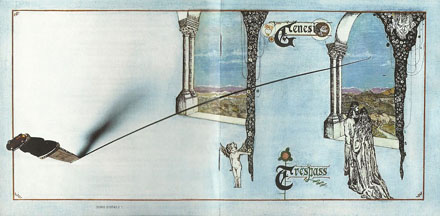
Much improved. The ornamentation adds to the presentation without overpowering it, and the rendering of the knife cutting through the artwork itself adds a meta-textual layer to the work, connecting to the breakout song of the album, “The Knife.” Sophisticated lettering adds a lot as well, considering Genesis has a troubled history with its logo. B+
Nursery Cryme, 1971
Kind of doofy, but I like the texture of the artwork. The stripes leading to a singular horizon point adds some visual interest, and the central figure is incredibly intriguing. B-
Foxtrot, 1972
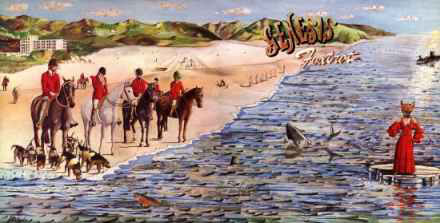
So there’s a whale, and the Watcher of the Skies, and some people on the shore. A curious scene, to be sure. Unfortunately, Genesis used the same name logo from Nursery Cryme. It’s ok, but I find the logo on Trespass more interesting, even though it would not translate well to many of the other albums. I find the overall blue ocean feel nicer than the bland yellow/tan of Nursery Cryme, with some nice illustration of the waves. B+
Selling England By The Pound, 1973
The painterly texture of the album art is a very nuanced addition to the artwork., but with a plain light yellow-tan border, the artwork itself can feel a bit drab. A few of the figures have some interesting flavor to them in their fashion, but the scene is enigmatic, making it difficult to evaluate. Unfortunately, the name logo is just plain text, which is also another disappointing entry in the “Genesis never really has a good logo for their name” history. B
The Lamb Lies Down On Broadway, 1974
One of the best entries. The tension between the men in the palpable. The figures are dynamic, and each photo background reflects the textures and terrors of modernity. The conceit of the artwork itself is interesting and insightful to the album, a nice plus. The logo is probably the weakest link in the ensemble, but it’s still a vast improvement to plain text. A-
Paul Whitehead is an accomplished artist who has had his paintings displayed all over the world. To Genesis fans; however, he is best known for the creation of classic Genesis album covers like Trespass, Nursery Cryme and Foxtrot.
World of Genesis sat down for a quick chat with Mr. Whitehead on July 25, 2001 to talk about his recent Italian exhibition, his work on the Genesis album covers, his current projects and more.
World of Genesis: I understand that you recently re-created the album artwork for the three Genesis album covers you designed. What made you decide to take on that task, and what happened to the originals?
"...The originals were stolen from Charisma (Records). When Charisma was sold to Virgin (Records), and the staff of Charisma got wind of the sale coming down, they just looted the place. So, no one knows where the originals are. They just disappeared."
Paul Whitehead: Well, the originals were stolen from Charisma (Records). When Charisma was sold to Virgin (Records), and the staff of Charisma got wind of the sale coming down, they just looted the place. So, no one knows where the originals are. They just disappeared.
Actually, someone challenged me to do it (recreate the original paintings), I never thought of doing it myself.
I had this show in Milan (Italy), and they said, "Do you think you could recreate them?" and I said, "I never ever thought of doing such a thing, but I'll give it a shot!" I did Foxtrot first, because I figured Foxtrot was the most difficult... and I kind of enjoyed it! It was kind of funny! ...Like Deja Vu.
 WOG: Did you rely heavily upon your memories of the original, or did you work straight off of a copy of the LP cover?
PW: We knew each other in London. We had worked together on the Genesis covers. He'd taken a lot of pictures of them. Then, we re-met over here.
WOG: Did you have a favorite of the three album covers you did for Genesis?
PW: My favorite? It's probably Nursery Cryme. It just works very well with the music. It fits perfect. It's the right color, the right vibe...
WOG: Since the advent of your website, your work certainly seems to have gotten much more attention in the Genesis fan community. Have you noticed an increased interest in your work since creating the site?
PW: Yeah. I'm sure you know, there's a network out there for practically everything. So, it's kind of grown from one thing to another. I mean, I've been doing lots of music festivals and things, particularly Progressive music festivals, all over the world.
PW: I used the album cover. I just copied it, basically.
WOG: Can you tell me about your recent exhibit in Italy and if you're planning any more exhibits in the near future?
PW: It was kind of an interesting show. It was at a museum in Milan. The guy who put it together was originally a dealer in comic book art, and he'd done very well.
He thought the next step from dealing and trading in comic book art was guys like me who had done either book illustrations or record covers. He was a Genesis fan, so he asked me, and I agreed to do it. It was a very nice show.
WOG: How Did you originally get chosen to do the covers of those Genesis albums? I'll go to one, and then I'll meet someone at that one, and they say, "Oh, we're having a festival in France" or "We're having a festival in Mexico" or whatever... and they ask me, "Would you like to come to that?"
 So, it's all been kind of fed by the Internet. We're amazed! We sell our stuff out of Nevada here in America, but it's amazing where the orders come from! It's just unreal!
WOG: So, would you say that fans of your work and the band have responded well to the Genesis related merchandising on your site?
PW: Yes. Well, there wasn't any at all to begin with, and suddenly there's this sort of esoteric merchandise available. People like what we do. We do quality stuff as well.
WOG: Are there plans to create more Genesis related items to buy on your site in the future?
PW: I was Art Director of a magazine called Time Out in London. I had an art show in the West End of London, and John Anthony, who was the producer of Genesis, saw my work and thought it was a match for them. He felt we had the same kind of vibe. So, he said, "Come and meet the guys and see if you get on. I think what you do would be great for the cover of one of their albums."
PW: We're looking at different products. I've always tried to do stuff that other people don't do, but everybody seems to want t-shirts.
WOG: Are you planning any new exhibitions in the near future?
PW: Yeah. It looks like I might be doing another art show in Venice (Italy) in September. We're just kind of finalizing that now.
WOG: Were you surprised when the band came back to you do the album cover of a second album and, eventually, a third?
PW: No, not really, because it worked so well. It was a great collaboration! I went and stayed with them while they wrote some of the tunes and rehearsed and so on. So, it was a good relationship.
WOG: So, how did it work? Were your paintings based upon the lyrics that you heard Genesis writing or did they look at samples of your work and say, "I feel strongly about this one..."?
You see, by me doing that show in Milan, I shipped 50 paintings over there. So, having got the paintings over in Italy, it's easier to put shows together there. I went to Venice last time I was there, and I made a great connection with a gallery so, it looks like that's going to happen.
 WOG: Any plans for a U.S. exhibit?
PW: I don't know. To tell you the truth, there doesn't seem to be a lot of interest in my work in America. It's not as much as in Europe or other parts of the world. It's strange. I think America has a very strange attitude about Progressive music. It's considered a very obscure, fringe kind of music.
WOG: Did you have any new projects in the works?
PW: No, really what happened was, I was there while they were writing and rehearsing. So, I'd hear the lyrics and over breakfast or dinner we would throw ideas around. It was a collaboration... It was a great collaboration!
WOG: When the time came that the band did the Selling England By The Pound album in 1973, were you disappointed that Genesis didn't continue that collaborative effort?
PW: Actually, I'm working on a kid's book, which I would like to let people know about. That's something I've never done before. I showed a few of the pictures in Milan, and it was very well received. It's quite a challenge.
WOG: Any idea when that will be released?
PW: We were hoping by the end of the year, but it's taking me a lot longer, because obviously I had distractions. If I could just sit down and work on that, it would probably take about a month, but I just have to do it when I have the time. It's called The Grippity Gru, and it's about a bad tempered little boy. I'm also working on some album covers. I'm working on one now for a band called Éclat, a French Progressive band (the album is called Cry For The Earth). I just finished the new cover for Leorme, an Italian Progressive band (the album is called Elemente).
WOG: Will the book be available on your website?
PW: Yes. It's going to be a book with a CD. At the moment, we're trying to get Peter Hammill to read the book. He's tentatively agreed, but he's hard to nail down, time-wise.