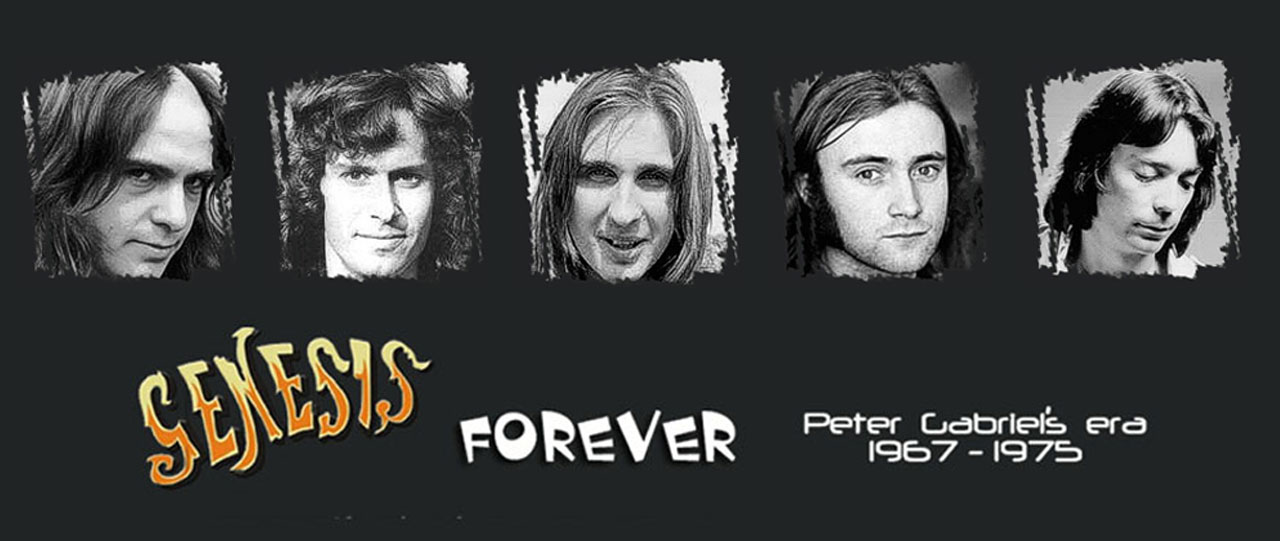



Written by Thomas Schrage


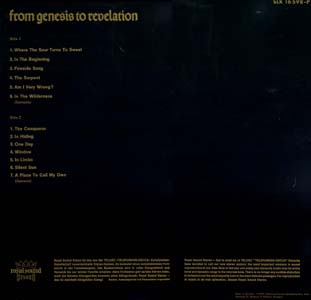
Genesis‘ first album was not called Trespass but From Genesis To Revelation. Many fans tend to count it as their zeroeth album. It shows no or at best only the most minuscule traces of the style that would make them well-known later, and therefore frequently meets with a refusal and lack of affection. Justly so?


The band did not have the line-up they got known with yet. One could say they did not even exist. They came together to record demo-tapes in the first place. All of them knew each other from Charterhouse public school. The songwriter team Rutherford and Anthony Phillips asked Tony Banks to play the piano for them; Banks only agreed if he could bring his songwriting partner Peter Gabriel to record a song. Soon they were convinced that Gabriel’s voice sounded better than Phillips’ so he ended up singing on all the songs.

When he did not sing, Phillips played the guitar, a position he would retain up to Trespass. Initially, the drums were played by one Chris Stewart, though the drumming on the album would be done by John Silver. The drummer’s stool would not be filled permanently until Phil Collins joined Genesis. Only with him did the band find someone who was accepted as a full member and could incorporate himself.

These boys (most of them were around 17 at the time) managed to land a record contract with Jonjo Music in August 1967. That only meant that a single would be released. King was an alumnus of Charterhouse and had had quite a successful hit with Everyone’s Gone To The Moon. A shallow pop song though that may have been, he nevertheless seemed to be a person of success and influence, and they found it very promising that they could have him produce them.

Read More


The year was 1969. Among the many discoveries made that year was something called "the import record" - albums from England that were either different from those released here, or just plain never released in Athens.

I remember pulling together a stack of domestic promotional albums and heading to a downtown rendezvous, near Acropolis to a place called Plaka, where in a small records shop they were traded for a decidedly smaller stack of imports. One of them was a little item that had a black cover with gold lettering proclaiming FROM GENESIS TO REVELATION. It was the first effort of a British group that couldn't decide on their name, although the music was much more decisive - I immediately vowed to become a fan once they figured out what to call themselves....


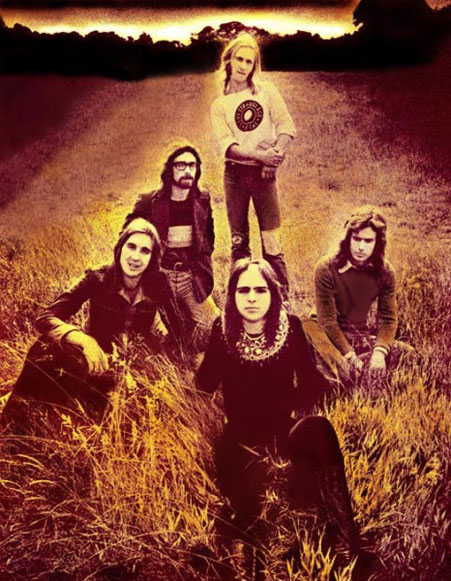
Genesis Group Members
Peter Brian Gabriel Gemesis 1970 - 1975
BORN: February 13, 1950, London, England
As the leader of Genesis in the early '70s, Peter Gabriel helped move progressive rock to new levels of theatricality. In his solo career, Gabriel was no less ambitious, but he was more subtle in his methods.
Anthony George Banks Gemesis 1970 - 1975
BORN: March 27th, 1950, East Sussex, England
Tony Banks started his career with Genesis in 1967 as the pianist/keyboardist, after the emergence of the Charterhouse School Bands The Garden Wall, which Tony was a member,..
Michael John Rutherford Gemesis 1970 - 1975
BORN: October 2nd, 1950, Guildford, Surrey, England
A founding member of the long-running art-rock band Genesis, Mike Rutherford also made the occasional excursion into solo projects, most notably the pop combo Mike + the Mechanics.
Phillip David Charles Collins Gemesis 1970 - 1975
BORN: January 31, 1951, Chiswick, London, England
Phil Collins' ascent to the status of one of the most successful pop and adult-contemporary singers of the '80s and beyond was probably as much of a surprise to him as it was to many others.
Steven Richard Hackett Gemesis 1970 - 1975
BORN: February 12th, 1951, England
Formerly a member of various minor bands, including Canterbury Glass, Heel Pier, Sarabande and Quiet World, the latter releasing a solitary album on Dawn Records in 1970, Hackett joined Genesis as guitarist in early 1971.


March 16th, 2015 By Jim Laugelli

I could have very easily chosen a number of other Genesis albums but I decided on this one simply because it features what is perhaps the most significant song in all of progressive rock: “Supper’s Ready.” My introduction to Genesis occurred 41 years ago and had one of the most profound impacts on my personal musical journey. On that night, in May of 1974, a friend asked if I wanted to see a concert. He had a few extra tickets for a Genesis show and no one to join him. I never heard of the band and for some reason thought they were probably some sort of acoustic act. As far as I recall, my friend knew little about the band as well. I believe someone just gave him the tickets. With nothing better to do I decided to check it out. When we arrived at the venue and had taken our seats I remember my curiosity ratcheting up when the pre-concert music over the P.A. was Mike Oldfield’s Tubular Bells. This signaled to me that I was probably going to hear something unexpected. Sure enough, when the lights went down and the crowd quieted, the opening chords to “Watcher Of The Skies” begins. I immediately leaned forward in my seat totally consumed by the sound of the mellotron.

As that instrument eases, the staccato rhythm of the bass begins and in the darkness a pair eyes appear, they seem to be searching, radiating, only to reveal a figure in a cape with bat wings wrapped around his head. The vocals then begin and until the end of the show I remain completely and utterly captivated. My mind was officially blown. It was a revelation. I left that show a changed person. This was music that went beyond my imagination. It was presented like theater, it told stories. In fact, before many songs, Gabriel told surreal little tales as a way of introducing the tunes. The next day I bought Foxtrot, and then Selling England By The Pound, Nursery Cryme and Trespass all in short order. I immersed myself in their music.

Foxtrot begins the band’s high point of three consecutive outstanding albums. It was released in 1972, a banner year for progressive rock that also saw the release of Close To The Edge by Yes, Thick As A Brick from Jethro Tull, Trilogy by ELP, Three Friends from Gentle Giant and a slew of other incredible records. For Genesis, Foxtrot saw them tackle ideas they started with their two previous releases, Trespass and Nursery Cryme. The level of complexity in song structure, the emphasis on theatricality and drama, storytelling and extended song form all reached a new level of sophistication on Foxtrot.

Read More

1967 - 1975
Discography Comments Compiled by Ikon Designing
Aside from a portion of the box set, this is the only commercially available live document of vintage Gabriel-era Genesis.
Official Album Releases Compiled by Ikon Designing
That's it. Genesis' most ambitious work to date that ultimately led to the shock departure of their much loved singer Peter Gabriel.
Genesis Album Artwork Compiled by Ikon Designing
The painterly texture of the album art is a very nuanced addition to the artwork., but with a plain light yellow-tan border, the artwork itself can feel a bit drab.
Jonathan King and the Name Compiled by Ikon Designing
In 1963 Peter Gabriel and Tony Banks met at Charterhouse, a boarding-school, that layed in the English county Surrey in the middle 1960s.
Before Phil Compiled by Ikon Designing
Once upon a time, in a land far, far away. . . England, I think it was called. . . There lived four young men. . Their names were Ant Phillips, Michael Rutherford, Tony Banks and Peter Gabriel.
The Glory Years Compiled by Ikon Designing
While recovering from this, he began writing Genesis' most ambitious project to date, "Supper's Ready," a 23-minute masterpiece
Touch of the Jaggers Compiled by Ikon Designing
On every level the band transcend any kind of expected performance standard. Musically they are so proficient they make that part of the job look like a secondary exercise.
Man behind the Mask Compiled by Ikon Designing
Genesis obviously differ from the dressed-up 12-bar that most bands unravel. And because of these very differences, the band have been slated over over their motives.
Hall of Mutant King Compiled by Ikon Designing
Lifeless was the performance of leader Peter Gabriel; the protagonist's name is Rael so it's surely no accident that Gabriel is a Roger Daltry sound alike.

Article Index


The group even enters some free territory on "The Waiting Room," though there's still an underlying structure. But individual aspects of the music aren't what The Lamb is about. Despite friction during its writing, and Gabriel's decision to leave the band early into the 102-date tour that began in the fall of 1974 (though Gabriel kept his decision to leave out of the press until after the tour was completed), The Lamb may be the Genesis album that's weathered the best over time. It may not have been a classic in the day, but it's achieved that status in the intervening years. The biggest shame is that while there's a live audio recording of The Lamb, available in its entirety on Genesis Archive 1967-75, it was never filmed, and those who saw the show know it was the culmination of Genesis' early, theatrically focused years. For those who didn't get to see the show, Genesis tribute band The Musical Box managed to acquire all the props and projection slides from Genesis a number of years ago, along with the permission to use them in launching full-scale performances.

The bonus CD/DVD that comes with 1970-1975, while crossing over some of the material on Genesis Archive 1967-75, also has a number of tracks that reveal just how advanced the group was from its earliest days. "Happy the Man" and Twilight Alehouse" are worth having as early attempts by the group at a more radio-friendly sound, and a handful of tracks from a BBC Nightride radio show are further examples of the group's early pastoral days, with the Fairport Convention influence even more pervasive.

But it's the four tracks from an aborted project called Genesis Plays Jackson, an abandoned documentary about painter Mick Jackson, that are the real gold of this bonus disc, as they reveal a number of themes that would reappear in more well-known Genesis tunes. "Provocation" opens with themes that would become part of Nursery Cryme's "The Fountain of Salacmis," as well as an instrumental section that would be reused on Trespass' opener, "Looking for Someone." "Frustration" directly foreshadows "Anyway," from The Lamb, right down to the instrumental break that would lead into Hackett's solo in the later version.

"Manipulation" possesses many of the passages that would ultimately be expanded on Nursery Cryme's "The Musical Box," including an intro that's almost identical. Only the instrumental "Resignation" has no reference to later songs, though it fits comfortably within the musical context that Genesis was already beginning to shape.

The accompanying DVD includes a final interview, as well as a 45-minute VH1 television documentary originally aired at the time Genesis Archive 1967- 75 was released, and two 1973 performances from the American The Midnight Special show—the clearest video of "Watcher of the Skies" in 1970-1975 as well as "The Musical Box."

While the video performances on the six DVDs accompanying the seven CDs of 1970-1975 are clearly a case of working with what was available— often taken from videotapes that may not have been first generation—they provide an opportunity for Gabriel-era Genesis fans who missed the opportunity to see the band at the time a chance to see what they missed. And taken together, the three hours of brand new interview footage shed considerable light on a group that has never truly been heard properly...until now. The remix/remaster work is absolutely top-notch, bringing clarity and depth, detail and transparency to music that still holds up nearly 40 years later.

With the entire Genesis studio discography now reissued and sounding as good as it likely ever will, the only question is: will there be an accompanying box set that includes remixed and remastered versions of Live (Charisma, 1973), Seconds Out (Atlantic, 1977) and Three Sides Live (Atlantic, 1982), Live: The Way We Walk Vol. 1 (The Shorts) (Atlantic, 1992) and Live: The Way We Walk Vol. 2 (The Longs) (Atlantic, 1993)? Given the live material released on Genesis Archive 1967-75 and its accompanying follow-up, Genesis Archive 2: 1976-1992 (Atlantic, 2000), it's almost certain that there's plenty more live material in the archives, so perhaps there will be more to come. In the meantime, 1970-1975 fulfills a significant need, and is the best of the three Genesis studio box sets. Taken together with 1976-1982 and 1983-1998, however, these three boxes not only document, in the best possible way, the entire studio career of one of rock's most important and influential bands, but represent, without question, the best reissue series ever undertaken.

Go Back