But for many progressive fans, it's the move towards a more symphonic approach (Banks' mellotron figured far more prominently here), and the emergence of a consistent line-up that now possessed five distinct and strong musical personalities, that made Nursery Cryme a watershed for the group.
From the opening mellotron intro to "Watcher of the Skies," Genesis announced yet another leap forward with Foxtrot. Still considered by many to be a pinnacle of the early group, retrospectively it's both hard to argue—and hard to agree.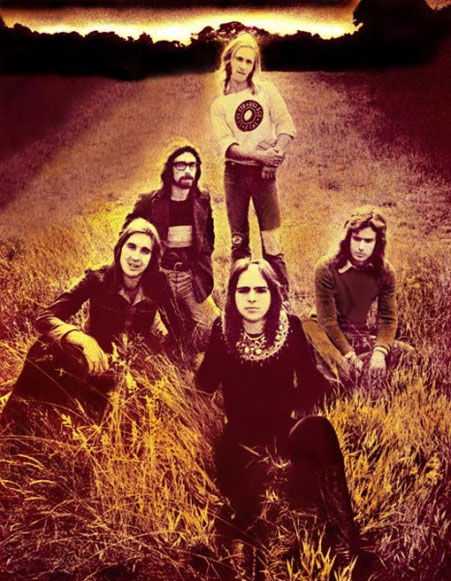
With the more straightforward "Time Table" the album's only possible weak spot (and it's still a strong tune), the album introduced two of the group's most enduring and classic tunes—"Watchers" and the sweepingly ambitious, side-long "Supper's Ready." But with each album possessing its own strengths, it's more a case of yet another career high point amongst many.
With greater compositional confidence, Genesis was beginning to gain commercial ground as well, with Foxtrot the group's first album to enter the UK pop charts (peaking at #12). It's hard not to see why. "Watcher of the Skies," once the group enters, becomes a potent rocker with plenty of dramatic twists and turns (and an equally dramatic costume for Gabriel that, while looking a little low-tech and even hokey now in concert footage from the 1973 Shepperton Studio, Italian TV performance, was still captivating and thrilling in the day). "Get 'Em Out By Friday" was another episodic classic, this time addressing social concerns with a hint of science fiction thrown into the mix, another early concert favorite.
The benefit of the remix can be heard to great effect, with the vocals clearer, and transitions like the entry of the group on "Watchers" more smooth and seamless. Like "Musical Box," it featured Gabriel playing a number of characters, moving the group further into theatrical territory. Unlike most progressive bands of the day, and in clear view on the DVD video performances, Genesis did everything to de-emphasize attention on the individual players, and more on the visuals—lights, later slides, and always Gabriel and his "in character" approach to relaying the group's stories in song.
Despite the greater virtuosity of Hackett and Collins, and the increasing strength of Rutherford and Banks, Genesis remained a band that avoided lengthy solo posturing. It wasn't necessarily intended as such, but Hackett's solo spot, the Bach-like "Horizons," which shone a spotlight while avoiding all suggestions of excess, set the tone perfectly for the 23-minute "Supper's Ready." The suite would quickly became the high point of Genesis' live sets with Gabriel's numerous costume changes, and a gradual build to one of the most orgiastic releases in the history of progressive rock, paralleled only, perhaps, by Van Der Graaf Generator's "A Plague of Lighthouse Keepers," from its career-defining Pawn Hearts (Charisma, 1971). The first fifteen minutes of the suite are filled with vivid lyrics, strong melodies and challenging arrangements, but it's the suite's final minutes, with the instrumental, riff-driven "Apocalypse in 9/8," segueing into the climactic "As Sure as Eggs is Eggs (Aching Men's Feet)," where Genesis make the leap from being a strong group to an important one that would, had it dissolved immediately after this record, still gone down in the history books as one of progressive rock's seminal acts.