

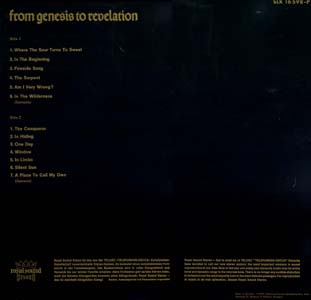
 It shows no or at best only the most minuscule traces of the style that would make them well-known later, and therefore frequently meets with a refusal and lack of affection. Justly so?







March 16th, 2015 By Jim Laugell
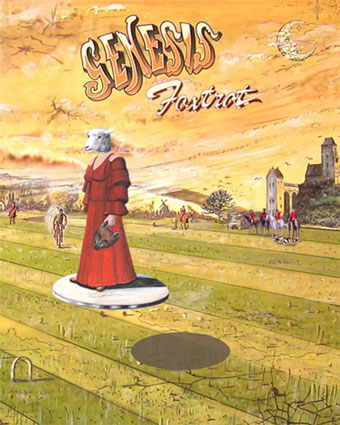 I could have very easily chosen a number of other Genesis albums but I decided on this one simply because it features what is perhaps the most significant song in all of progressive rock: “Supper’s Ready.”
My introduction to Genesis occurred 41 years ago and had one of the most profound impacts on my personal musical journey. On that night, in May of 1974, a friend asked if I wanted to see a concert. He had a few extra tickets for a Genesis show and no one to join him. I never heard of the band and for some reason thought they were probably some sort of acoustic act.
As far as I recall, my friend knew little about the band as well. I believe someone just gave him the tickets. With nothing better to do I decided to check it out. When we arrived at the venue and had taken our seats I remember my curiosity ratcheting up when the pre-concert music over the P.A. was Mike Oldfield’s Tubular Bells. This signaled to me that I was probably going to hear something unexpected.
Sure enough, when the lights went down and the crowd quieted, the opening chords to “Watcher Of The Skies” begins. I immediately leaned forward in my seat totally consumed by the sound of the mellotron.
Few Words from the Author
 All started back to 70's, the time I was student in Montreal, Canada. On Sunday, April 21st, 1974 I was attending a Genesis concert, at the Auditorium Center of Montreal University. I will never forget the intro "Wacher of the skies" and the "illuminated Eyes" on the backdrop stage to open.
As a true admirer of Peter Gabriel and Genesis' creativity, I have always been wanted in getting as many information as possible about their music.
The records were all there to listen and enjoy, but was that enough? Never!!!
When I decided to add my small contribution on the 50th Anniversary of Genesis' Album "Foxtrot" to the web, I obviously wanted to talk about Genesis masterpiece "Supper's Ready". What I'm offering here is a collection of critically evaluated information about their Foxtrot discography and live performing activity, until the day Peter Gabriel resign from the group, in 1975.
I know this might sound like something for hardcore fans only, but that does not necessarily mean it is useless. My best hope is that this website effort may become a serious reference for the true fan and a nice approach for anyone to the wonderful world of Genesis, beyond the albums. I would like to thank all the fans out there, friends and material contributors for their wonderful work collecting the rarest items from that period.
An unforgettable era. The Peter Gabriel's Era !
 Peter Gabriel: Speaks softly but carries a big sledgehammer
Peter Gabriel: Video Will Bring Us Justice in the Long Run
One Republic Taps Peter Gabriel for 'A.I.'
Peter Gabriel’s Solo Debut: A Look Back, 40 Years Later
Peter Gabriel Sings Genesis Song In Concert For First Time In 34 Years
Peter Gabriel – 10 of the best
Peter Gabriel, From Genesis to Growing Up
Top 10 Peter Gabriel Era Genesis Songs
 Genesis - Firth of the Fifth - Montreal 1974
Growing Up Live: Selected Concert Videos
Trevor McLaren reviews Genesis1967-1975
The Lamb Paintings - Patrick Zoller 2014
Genesis interview: 'We were hated'
Peter Gabriel: Video Will Bring Us Justice in the Long Run
Experiencing Peter Gabriel – Book Summary and Writing Sample
Steve Hackett: 'Genesis are a bunch of repressed English guys'
In Defense of Both the Phil Collins and Peter Gabriel Eras of Genesis
Insanely Great Genesis Songs Only Hardcore Fans Know
Writing Sample (from Chapter One)
It was 1991. A plumber planning to record the Los Angeles marathon with his newly acquired Sony Handycam was trying it out when he heard a commotion outside and saw flashing sirens below his apartment window. He pressed the record button and began filming the brutal beating of Rodney King by the Los Angeles Police Department. Within 12 hours, it had been seen around the world. The video sparked outrage and brought a new focus onto police conduct and brutality, racial injustice and human rights.
A couple of years earlier, I had a life-changing experience as part of Amnesty International’s Human Rights Now! tour. I was profoundly shocked by my conversations with many victims of human-rights abuses, both by the extent of their suffering but also by how often their horrific experiences were denied and buried.
I believed then what I still believe today — that people armed with cameras can create change. With cameras in our hands, we all can protect and defend human rights.
And so in 1992, I helped found WITNESS. The organization is based on the idea that technology can transcend all borders and that information is power. Change flows when the right tools are in the right hands with the right skills.
In the last 25 years, technology has evolved many times over. Heavy, expensive video cameras have been shrunk into chips, and a tiny lens is found in every cell phone. There are now very few people who do not have access to a cell phone. More video is generated in a day today than was generated in an entire year when WITNESS was formed. And that cell phone in your pocket has the power to capture what's going on and use it to ignite change.
In 2014, a Staten Island grand jury declined to charge a New York City police officer in the death of Eric Garner. His death and last words “I can’t breathe” became a rallying cry for a new generation of activists fighting to end police misconduct. Mr. Garner’s death was captured on cell-phone video and circulated widely on social media and news outlets around the world. The prevailing opinion was that the officers in charge would face justice and be held accountable for their misdeeds. That was not the result.
In April, the world was yet again shocked and horrified by images coming out of Syria. The use of sarin in a chemical weapons attack in the rebel-held city of Khan Sheikhoun in Idlib province and the subsequent airstrike on the hospital tending the survivors of the attack were captured on video. In the aftermath of the attack, President Bashar Assad claimed that the videos of the attack were faked. The authenticated video evidence of the attacks, verified on multiple fronts, proves otherwise. This evidence is irrefutable.
Examples like these may leave us at a loss. Crimes were documented — and the footage captured circled the globe many times over. Sometimes, documenting a human rights crime doesn’t directly lead to justice. But it can galvanize a movement. It can be proof regardless of what a jury decides. Most importantly, it can transform public opinion as well as national and international policies. We may not see the outcome we want when we want it, but there is power in arming truth with evidence.
The reality is that human-rights crimes happen all around us, and most of us have the tools to document them. We need to not only show the truth, but to verify and prove it. We need to know how to save, protect and curate our video footage, because in most cases the road to justice is long and difficult.
At times, it seems like we live in the post-truth age. Propagandists sit alongside those in power who see our world as theater, in which shocking news stories are rapidly countered by fabricated accounts suggesting that the opposite happened. We end up stunned and subdued, unsure of what we can and cannot believe. When you factor in that we only end up seeing the news that is increasingly chosen for us through algorithms and our own filter bubbles, the truth appears elusive.
One way to counter this is to empower, protect and champion the storyteller and the human rights activist. History shows us time and time again the power of truth. The most effective way to counter Holocaust deniers was by diligently assembling the stories and first-hand accounts of survivors. As Archbishop Desmond Tutu explained about the Truth and Reconciliation Committee in the wake of South Africa’s apartheid, letting people have their stories seen and heard is an act that itself is empowering and is the foundation for justice.
I still believe that seeing is believing. The value of video footage lies not just in its existence, but in the inability to deny what is captured for posterity.Timely, accurate and impartial information is the most powerful force we have to protect the fundamental rights of all people. Now more than ever, there are more bystanders willing to step forward and speak truth to power. And, as ever, they need your help to do it.
This story was submitted via our Talk to Us platform. If you would like to send a story for consideration online, follow the "submit a story" links on the home page of thespec.com
by Peter Fleming
Peter Fleming is a writer and a retired Special Ed teacher. He was born in Northern Ireland and educated in Southern Ontario.
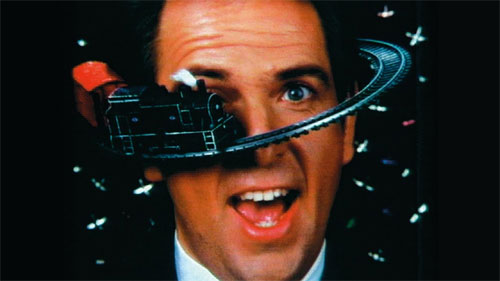
Great Britain’s most influential oddball-- Richard Branson notwithstanding-- is probably Peter Gabriel, and he just released his fourteenth solo CD-- And I’ll Scratch Yours, a companion-piece to the 2010 cover album Scratch My Back. Flipped and taken together, the two recordings comprise an entire, coherent sentence-- instructive for the dyslexic amongst us; but more than that, they represent an instance of the iconic “Wicked Neat Idea.” Scratch My Back is Peter singing covers of 12 artists; And I’ll Scratch Yours features those same artists, doing covers of Gabriel songs. Neat! Peter covers Paul Simon’s The Boy in the Bubble, while Paul returns the favour by doing the heart-breaking Biko. Randy Newman (of all people!) covers Big Time, as payback for Peter’s beautiful version of I Think It’s Going to Rain Today. Etcetera. It’s a wicked neat idea! But then again, Peter Gabriel is the Crown Prince of such ideas. His very existence is a terrific idea. Outside the box isn’t where the guy thinks, it’s where he lives and breaths; outside the sphere is probably more like it-- a twelve-dimensional photosphere constructed of mirrors and laser-beams. For all I know that’s where he was born (ironically, his recording facility, Real World Studios, is in a little village in western England called Box) though his childhood seems to have been normal enough, up to a certain point…
It’s tempting to say Peter Gabriel is brilliant, but that’s inside the box-- it’s not that simple. Certain people get called brilliant as though brilliance were an inherent, albeit rare, characteristic of human psychology-- Bertrand Russell, Kurt Goedel, Albert Einstein, Steve Jobs, the writers of the Simpsons-- when in fact they’re just hard-working and goal-oriented smart guys, hell-bent to do one thing really, really well, like one-trick ponies. The flip-side is a common assumption that certain people are inherently stupid-- especially sports figures and rock stars-- when just the opposite is true. There’s the myth of the “dumb jock,” and after that… Iggy Pop, for example? Ozzy Osbourne? Meatloaf? Dumb as stumps, right? Dull as butter-knives?
Nope.
You’d be surprised how many professional jocks have advanced degrees, how many NFL football players went on to become doctors and lawyers, canny and successful businessmen; to say nothing of famous figures in the rock world, the low-brow art-form par excellance of the Common Man. Iggy Pop went to college, and so did Tommy Lee of Motley Crue (and Pamela Anderson) fame-- to be exact, he went to Harvard. Brian May-- the lead-guitarist from Queen-- recently completed his PhD in astrophysics. Astrophysics! He even wrote a book on the subject. The novelist and polymath intellectual Anthony Burgess once said of Mick Jagger (who attended the London School of Economics, by the way, before the Stone’s got big) “I admired this young man’s intelligence, if not his art…”
After the dirt-poor Elvis Presley and (especially) the pretty-poor Beatles got rich, it became evident this interesting new musical form, low-brow though it surely began, wasn’t just an avenue out of poverty for stupid and/ or working-class kids. It was bigger than that. It had potential. Middle and even upper-middle class kids suddenly became interested, in the ‘70s, in what previously had been little more than an escape hatch for working-class boys, and started chiming in with their own ideas about where rock might go next. The classically trained Keith Emerson saw which way the wind was blowing, looked in the mirror, and figured, “What the hell-- I could pass as a rock star, and I actually know a little about music. Like how to play an instrument…”
Welcome to the jungle, Emerson, Lake and Palmer.
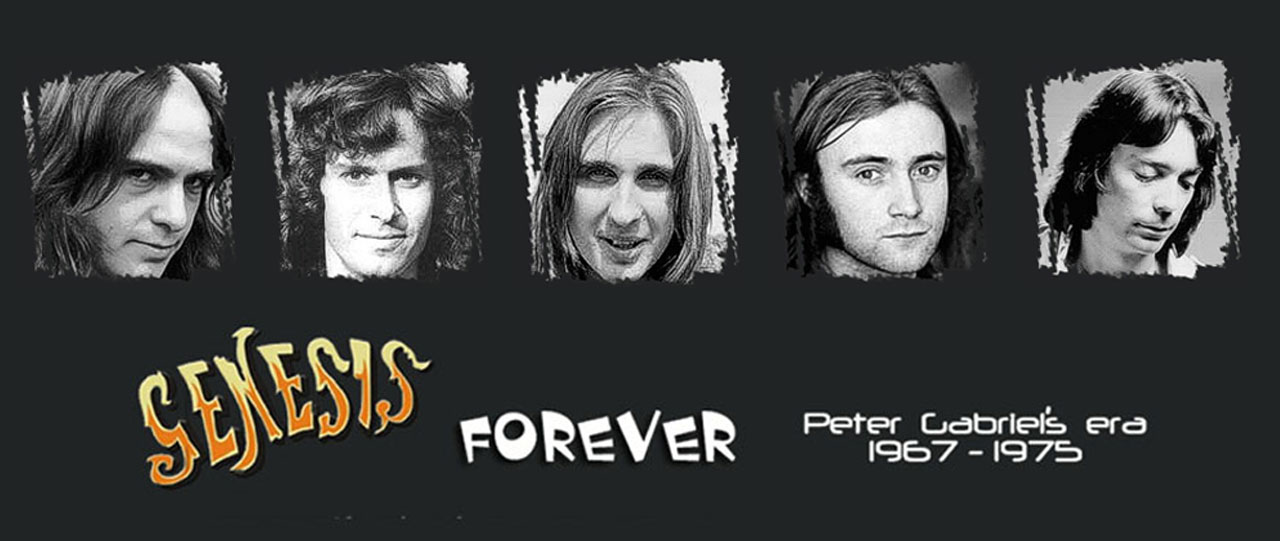
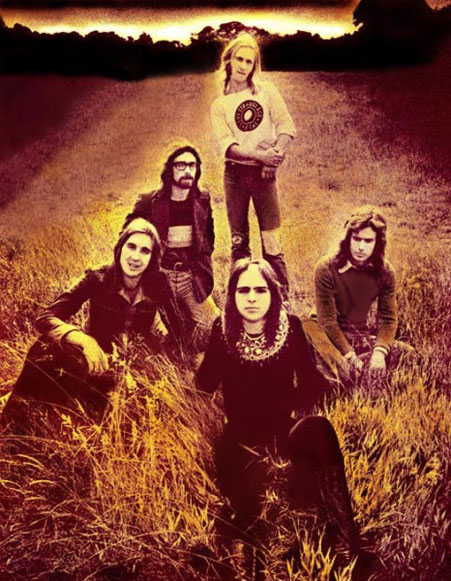
The kids in Geneses-- Tony Banks, Peter Gabriel, Chris Stewart, Anthony Phillips and Mike Rutherford-- all clever boys from privileged backgrounds, met in Charterhouse school, one of Britain’s more posh, “public” schools, where their parents had sent them expecting them to become lawyers, doctors or officers in the British military. Politicians in the long run-- the dream-destination of well-heeled Brits of the upper middle-class, like Winston Churchill. Rock ’n’ roll still retained the residual stink of ‘60s working-class slovenliness, in nasty industrial harbour-towns like Liverpool (or Hamilton for that matter), so this was an unlikely breeding-ground for the genre. Charterhouse nurtured poets and politicians, academics and television pundits-- not head-bangers. Not that you could equate Genesis with old-school rock’n’roll. These guys were hell-bent on… experimentation. They were cocky (and naïve) enough to believe, while still teenagers, that they could push cultural limits. Their first record was produced by fellow Charterhouse alumni Jonathan King, who rechristened “Anon”, as they were then (absurdly) called, Genesis-- literally a new beginning-- and called the resulting album From Genesis to Revelation, which got it relegated to the “religious recordings” bin, and from there the garbage bin. From Genesis to Revelation sold only six-hundred copies, despite not-bad reviews. Clearly fortune and glory were just around the corner. The year was 1969. Big changes were in the air.
“Peter Gabriel” sounds like one of those too-cute-by-half stage names, like “Elton John” (Reginald Kenneth Dwight), or “Freddie Mercury” (Farrokh Bulsara.) But no-- neither pretentious nor self-conscious enough to assume a flashy name, Peter Gabriel was born to trumpeting angels as Peter Brian Gabriel, on 13 February, 1950, in Chobham, Surrey, UK, to Ralph and Edith Gabriel, his father an electrical engineer believed to have been instrumental in the evolution of radar technology during WWII (and thus to the outcome of the war), and a musical mom who taught Peter to play piano at an early age. He grew up in a rural British village (and lives to this day in another one-- guess he likes the sound of baaing sheep and the smell of cow-flop) and at Charterhouse he was so withdrawn he was virtually invisible, except that every now and then he would hop up on a table in the cafeteria, and dance a little soft-shoe. Strange boy with a strange name. After their first record tanked, Genesis broke their contract with Jonathan King and started slogging the highways and byways of England, playing their weirdo music for bored, disinterested and minuscule audiences, in pubs that clearly didn’t care for cutting-edge genius in a 3/4 musical landscape created by pimply kids who barely knew how to tune a guitar. In one such dive Genesis were heard by an A and R man from Asylum records-- itself so new as to be unknown at the time-- where they were signed and released their other albums, Trespass (1970). Nursery Cryme (1971), Foxtrot (1972), Genesis Live (1973), Selling England By The Pound (1973), and the ambitious and strange The Lamb Lies Down on Broadway (1974). Meanwhile, British kids-- and finally the kids of the rest of the world-- fell in love with “progressive rock”-- from Yes to Emerson, Lake and Palmer, to King Crimson, to Jethro Tull, Gentle Giant, The Strawbs, Rush, Roxy Music, but especially Genesis-- a band so weird, so convoluted (or muddled, depending how much you like progressive rock) and so… Victorian, in a way… but also so increasingly Monty Pythonesque and ambitious and expansive in their manner-- Foxtrot includes a twenty-five minute micro-opera called “Supper’s Ready”-- that their sheer complexity became a growing problem within the band.
Peter Gabriel quit Genesis in 1975, and offered the world a startling explanation-- he told Melody Maker he felt he was being “forced into the role of a rock-star”, a pretty out-of-the-box thing for a rock-star to say. How had such a band become so big with a front-man who didn’t want to get big? One explanation had to do not just with the evolution of their style, but how Gabriel presented himself, as the voice and image of the band. On a whim he bought a stuffed fox-head in a small Scottish town Genesis was scheduled to play, and wore the head (garnished with a bright red dress) in a smoky little hall filled with Scottish skin-heads and train-spotters, who didn’t consider a night-out successful unless a pitched-battle broke out, and skulls got broken. Instead of the usual two column-inches the band’s shows usually got, they got twenty column-inches plus a colour picture of Gabriel dressed in this unbelievable outfit. Well, alright then-- after that, everything just rolled out-- with Peter dressing more and more strangely, and the music getting more complex and nuanced, until finally the sheer breadth and depth of the band’s evolution got in the way not just of the way their music got made, but the psychology of each member; everything just got too big for the shy and withdrawn Peter Gabriel, who quit at a critical moment when Genesis was on the cusp between locally big and world-wide gigantic, and retired for a year, to the country, where he could reconsider his options, listen to the baaing of the sheep, breath the reinvigorating stink of cow-dung, and grow tomatoes.
He took a year off from being Britain’s biggest weirdo (Richard Branson notwithstanding) and contented himself with puttering in his garden and raising his first child, Ann, who had been a hard birth-- he also shaved his head (as did his wife-- what was wrong with the Brits back in the day?) and in the meanwhile the surviving members of Genesis had a big problem. Their famous front-man had not only dropped off the radar, but the press in England was predicting that Genesis would never survive the loss of this man, this mysterious stranger, the Supernatural Anaesthetist from The Lamb Lies Down on Broadway…
Here comes the Supernatural Anaesthetist
If he wants you to snuff it
All he has to do is… puff it…
He’s such a fine dancer!
The problem was not simple, but eventually it was solved. Phil Collins (the drummer who took over from Chris Stewart after 1970’s Trespass) assumed lead vocals, and almost immediately they put out a new record, A Trick of the Tail, which came as a big relief to a million Genesis fans, and sold more copies than all the earlier albums combined. The four remaining members of the band felt they had an axe to grind with the British press-- because Gabriel was so flamboyant he was assumed to be the band’s creative mother-load, when in fact they had always been an egalitarian democracy of five equal parts-- and thus a point to prove… which they proved splendidly, but with a poison-pill incorporated in the text; as time passed, Genesis became more and more mainstream-- slowly betraying their early originality even as their sales figures piled sky-high. Taking the road less travelled, Peter Gabriel contented himself with pruning the tomatoes in his garden, throwing his weight behind noble causes, starting with Greenpeace and ending with the Elders and Witness projects, and putting out four solo records all called “Peter Gabriel.” While his former band-mates became millionaires, Gabriel remained what he had always wanted to stay-- a niche-artist. On his second self-titled album, he included a song that couldn’t get more autobiographical, D.I.Y.:
When things get too big I don’t trust them at all--
You want to keep control? You’ve got to keep it small!
DIY stands for “do it yourself”, which you probably knew. It was Peter Gabriel’s cri de coeur. Starting in 1984 Gabriel started releasing the “two-letter” albums-- So, Us, and Up. He surprised himself by accidentally crossing over from niche-artist to mainstream artist with So, which made him wealthy and famous on a scale similar to his former band-mates. Evidently the transformation traumatized him-- his next project was Passion, a soundtrack for Martin Scorcese’s movie The Last Temptation of Christ, which was so blatantly not-commercial it sold maybe four copies (one of which I own.) Mea culpa. Peter Gabriel had become a reluctant superstar-- that strangest of entertainers, but he was good with it because to get there he didn’t compromise to the tastes of the world; he’d waited the world out, until the world bowed to his taste.
Such a fine dancer…
Concurrent with all this was an activism that cut across political, social, technological and musical worlds-- both Bono and Bob Geldof have said it was Peter Gabriel’s early activism in Greenpeace and WOMAD that inspired them to wield their own wealth and popularity to further the cause of human rights. Peter founded the annual WOMAD festivals-- the World of Music, Arts and Dance-- which launched the careers of Yungshen Lhambo, Nusrat Fatch Ali Khan, and Youssou N’dour-- all of whom are artists on Real World Records-- as is Peter himself. He also launched the Witness program, which provides third-world countries with digital video cameras, so people in those countries can record human rights violations. Here in 2013 it’s not uncommon to see pop stars with a social conscience spouting off-- Peter lit that fuse back in 1980, when he released the song Biko, an anthem of outrage against the fate of Steven Biko, who had been beaten to death in South Africa by the police for his rampant anti-apartheid activism-- a gross injustice the South African government simply assumed no one would hear or care about-- but they were wrong. This was no one trick pony-- Biko was taken up as a revolutionary anthem all over the world, and so embarrassed was the government of South Africa they complained to their British counterparts at the United Nations, who smiled and shrugged their shoulders. What could they do? Unlike some countries, Great Britain wasn’t in the habit of shutting up her artists. Or, for that matter, murdering her political activists.
Discography:
(With Genesis): From Genesis to Revelation (1969); Trespass (1970); Nursery Cryme (1971); Foxtrot (1972); Genesis Live (1973); Selling England by the Pound (1973); The Lamb Lies Down on Broadway (1974.)
(Solo): Peter Gabriel (1977); Peter Gabriel (1978); Peter Gabriel (1980); Peter Gabriel-- released in North America as “Security” (1980); Birdy (movie soundtrack) (1985); So (1986); Passion (movie soundtrack) (1989); Us (1992); OVO (Millennium Dome Project) (2000); Long Walk Home (movie soundtrack) (2002); Up (2002); Scratch my Back (2010); New Blood (acoustic live compilation) (2011); And I’ll Scratch Yours (2013.)
What was once a dream has now become reality for OneRepublic. The pop group released their new collaborative track with Peter Gabriel "A.I" -- which oddly enough was inspired by the 2001 movie of the same name. The single arrived Monday (Oct. 3), just days ahead of their fourth studio album Oh My My, slated to be released Friday.
One Republic Discusses Making Their Dream Collaboration with Peter Gabriel Come True at iHeartRadio Fest 2016
The 2001 movie A.I. centers on a young robotic boy who wants to attain human qualities such as the ability to feel love. "I just want your love automatic, if artificial love makes sense," OneRepublic's Ryan Tedder croons over the dark, synthy beat. The funky bassline meets Peter Gabriel's futuristic vocals leading into Gabriel's haunting outro.
https://www.youtube.com/watch?v=vxGmih-jZ7Q